 Ferndale Siding
 Custer's Exterior Climate: What Homes Are Actually Up Against
Custer is a small, rural community in northern Whatcom County, tucked between Ferndale and the Canadian border, close enough to the coastline that salt-laden marine air is a fact of life for anyone maintaining a house here. It's farmland and open country more than dense suburb, which means homes tend to sit exposed — fewer neighboring structures and mature windbreaks to blunt the wind, more direct exposure to whatever comes off the water and settles across the fields. That combination of coastal moisture, open exposure, and the long gray stretch of a Pacific Northwest winter is exactly the kind of environment that separates exterior materials that hold up from ones that don't.
We work throughout Whatcom County, and Custer's climate profile is consistent with what we see across the coastal parts of the county: damp for months at a stretch, salt in the air, and shaded, north-facing walls that rarely get a chance to fully dry out. None of that is dramatic on any single day. It's the accumulation — season after season — that determines whether a home's siding, roof, windows, and deck are still doing their job in fifteen years or are already showing problems in five.
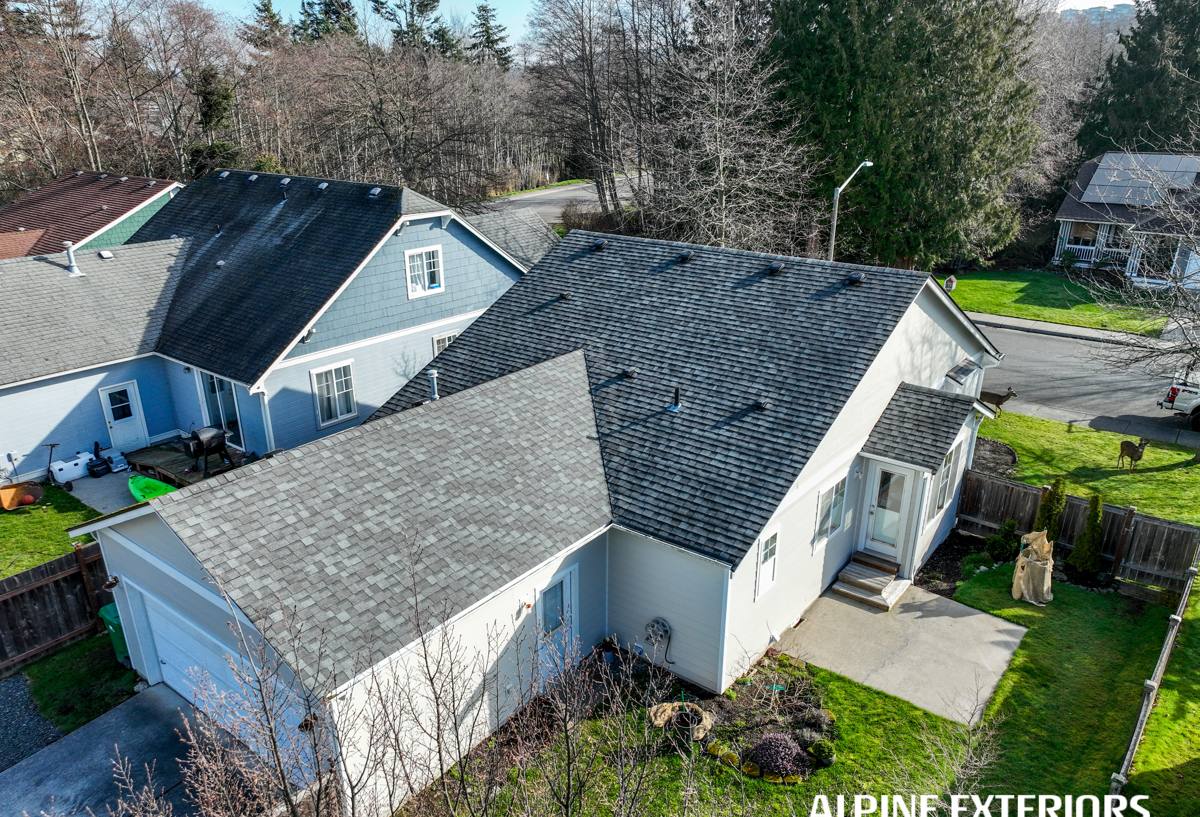
Salt Air, Driving Rain, and Moss: The Three Things That Wear Down a House Here
Salt Air
Homes near the Salish Sea coastline deal with airborne salt that settles on every exterior surface — siding, trim, metal flashing, fasteners, roof hardware. Salt is corrosive to unprotected metal and can accelerate the breakdown of coatings and caulking that aren't rated for it. Over time, that shows up as premature paint failure, rusting fasteners, and trim that deteriorates faster than it should. It's a slow process, which is part of why it catches homeowners off guard — nobody notices salt doing its work day to day, but the cumulative effect over a decade is real.
Driving Rain
Whatcom County gets a lot of rain, and a meaningful share of it doesn't fall straight down — wind off the water pushes it sideways into walls, especially on west- and south-facing exposures. Wind-driven rain finds every weak point in a building envelope: poorly lapped siding, gaps around window flashing, caulk joints that have shrunk and cracked. A siding system that performs fine in a calm rain can still let water in when it's being driven horizontally against the wall for hours at a time.
Moss and Prolonged Dampness
Custer's tree cover and cloudy winters mean a lot of exterior surfaces — roofs especially, but also shaded siding and deck boards — stay damp far longer than they would in a drier climate. That extended dampness is what moss and algae need to establish and spread. Moss on a roof holds moisture against shingles and can work its way under the roofing material over time. Moss and mildew staining on siding is mostly a maintenance and appearance issue on a well-installed fiber cement wall, but on wood-based products it can be a sign of moisture getting into the material itself, not just sitting on top of it.
Why We Install Only James Hardie Fiber Cement Siding
We made a deliberate decision as a company to install James Hardie fiber cement exclusively — not vinyl, not LP SmartSide, not primed wood products, not other fiber cement brands. That's not a marketing position; it's the product line we're willing to put our installation standards behind, especially in a climate like Whatcom County's.
It doesn't absorb water the way wood-based products can
Fiber cement is made from cement, sand, and cellulose fibers. It doesn't swell, rot, or delaminate the way engineered wood siding can when moisture works its way in at a cut edge or a failed caulk joint. In a region where walls stay wet for extended periods every winter, that's not a minor detail — it's the core reason the material holds up.
ColorPlus factory finish
Hardie's ColorPlus finish is baked on at the factory under controlled conditions, which gives it better fade and wear resistance than field-applied paint, and it comes with its own finish warranty. In a salt-air environment where painted surfaces take a beating, a factory-cured finish is a genuine advantage over site-painted trim and siding.
HZ5 — engineered for this climate
James Hardie makes region-specific product formulations, and the HZ5 line is engineered for climates with more moisture exposure, which fits the Pacific Northwest. It's a product designed around the reality of extended wet seasons rather than a general-purpose material adapted after the fact.
Non-combustible
Fiber cement doesn't burn. That's a straightforward, valuable property regardless of climate, and it's one more reason we don't see a compelling case for switching to combustible alternatives to save on material cost.
We're upfront that this means we're not the right contractor for a homeowner who's already decided on vinyl or LP SmartSide. We'd rather be honest about that than install a product we don't stand behind.
Beyond Siding: Roofing, Windows, and Decks
Siding doesn't work in isolation — it's one part of a building envelope that also includes the roof, windows, and any attached structures like decks, and all of them face the same climate stresses. We handle all four so the whole exterior gets addressed with a consistent standard, rather than having one contractor's siding work undermined by a roof or window detail nobody coordinated.
- Roofing: proper underlayment, flashing, and ventilation matter as much as the shingle or metal product itself in a climate with this much sustained moisture and moss pressure.
- Windows: correct flashing integration with the siding is where most water intrusion problems actually start — the window itself is rarely the failure point.
- Decks: ledger board flashing and proper drainage away from the house are the difference between a deck that lasts and one that quietly rots the wall behind it.
Installation Quality Matters More Than the Product Label
Even the best siding material fails if it's installed wrong. Fiber cement in particular is sensitive to installation details — clearance from grade and roof lines, proper flashing at every penetration, correct fastening pattern, and caulking only where Hardie's specifications call for it rather than caulking everything as a catch-all. A rushed or poorly detailed installation can undercut the material's performance advantages entirely, especially in a wet, wind-exposed climate like Custer's.
This is a big part of why we treat installation standards as seriously as product selection. A correctly installed lesser product will often outperform a premium product installed carelessly. We aim to get both right.
Signs a Custer Home's Exterior Needs Attention
- Paint or caulk failing faster than expected, especially on west- or south-facing walls
- Visible moss or algae buildup on the roof or on shaded siding sections
- Soft spots, staining, or bubbling on wood-based siding or trim
- Rust streaking from fasteners, flashing, or hardware
- Gaps or cracking in caulk joints around windows, doors, or trim
- Musty smell or visible staining on interior walls near exterior corners — often a sign water has already gotten past the exterior
- Deck boards that stay damp long after rain has stopped, or soft ledger board areas
Cost Factors to Understand Before You Budget a Project
Every home is different, and we don't quote sight-unseen, but these are the variables that generally move the price on a siding, roofing, window, or deck project in this area:
| Factor | Why It Matters |
|---|---|
| Home size and wall/roof complexity | More corners, dormers, and roof planes mean more flashing detail and labor time |
| Current condition and any hidden damage | Rot or water damage found once old siding or roofing comes off adds repair scope |
| Product line and profile chosen | Hardie offers multiple plank widths, textures, and trim options at different price points |
| Site access and exposure | Rural properties with long driveways, slopes, or limited staging area can affect labor logistics |
| Scope bundling | Combining siding with roofing, window, or deck work in one project often reduces overlapping setup and access costs |
Why a Local Crew Matters in a Community Like Custer
Custer isn't a dense subdivision with identical houses — it's a spread-out rural community where every property has its own exposure, tree cover, and drainage situation. A crew that works Whatcom County regularly knows what the coastal moisture and wind patterns actually do to a building over time, rather than applying a generic approach that might be fine in a drier or more sheltered part of the state. Being local also means we're accountable after the project is done — we're not driving in from out of the area for one job and disappearing. If a warranty question or a maintenance issue comes up years later, we're still here.
We also think it matters to be straightforward with homeowners about what a product can and can't do, what a fair scope of work looks like, and why we've made the choices we've made as a company — including refusing to install materials we don't think hold up to this climate over the long run.
If you're in Custer, Ferndale, or elsewhere in Whatcom County and want an honest look at your home's siding, roofing, windows, or decking, we're glad to come take a look. There's no pressure and no cost to get our read on where things stand — just fill out the form below to request a free estimate.