 Ferndale Siding
 One Product, One Standard
Most siding companies will install whatever a homeowner picks off a sample rack: vinyl, LP SmartSide, fiber cement from a handful of manufacturers, primed wood, cedar. We don't. We install James Hardie fiber cement siding, and that's it. No exceptions, no side jobs in vinyl to keep a crew busy in the off season.
That's not a marketing gimmick. It's a decision we made after years of tear-offs, warranty claims, and callbacks on other products in a climate that does not forgive shortcuts. Ferndale sits close enough to the water and the Nooksack lowlands that our siding deals with salt-laden air, driving rain off the Strait, and a moss season that can run eight months out of twelve. Products that perform fine in Spokane or Boise don't always hold up here, and we got tired of being the ones who had to explain that to a homeowner five years after installation.
This page is about why we narrowed down to one manufacturer's fiber cement line instead of offering a menu of options. It's not an attack on every other product on the market — it's an honest look at the trade-offs that made us pick a lane.
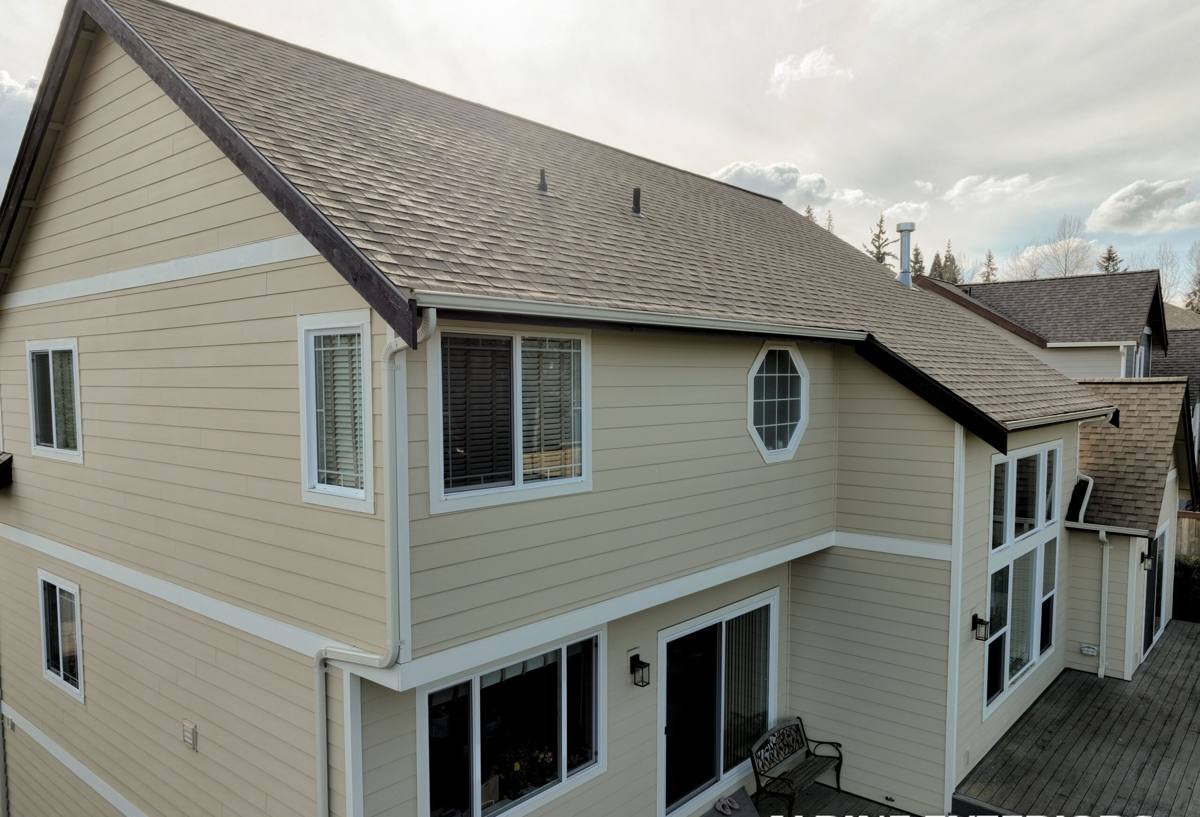
What Whatcom County Weather Actually Does to Siding
Every siding material claims to handle "the elements." What that means in Ferndale specifically is a combination of factors that stack on top of each other:
- Salt air: Proximity to Bellingham Bay and the Strait of Georgia means airborne salt is a real factor on the west-facing sides of homes, accelerating corrosion of fasteners and finishes not rated for it.
- Driving rain: Wind-driven rain off the water doesn't just wet the surface of siding — it tests the water-shedding design of the product and the quality of the flashing and house wrap behind it.
- Moss and algae growth: Constant dampness and shade from mature trees common on Whatcom County lots create ideal conditions for moss, mold, and mildew on any surface that holds moisture instead of shedding it.
- Freeze-thaw swings: Even our relatively mild winters bring enough freeze-thaw cycling to stress materials that absorb water, since trapped moisture expands when it freezes.
None of this is unique to Ferndale — it's the same story up and down the Whatcom County coastline and into the lowlands around Lynden and Custer. But it means the siding material matters more here than it would in a drier climate, and it's the reason we stopped treating siding brand as a matter of homeowner preference and started treating it as a matter of professional standard.
Why We Don't Install the Alternatives
Vinyl Siding
Vinyl is inexpensive and low-maintenance in the sense that it doesn't need painting. But it's a thin plastic product that expands and contracts significantly with temperature swings, can crack in impact or extreme cold, and fades over time with no way to refinish it short of replacement. In driving rain and wind events, vinyl's reliance on lap-and-lock seams rather than a rigid, fastened system is a real weak point. It's also not something we can warranty the way we warranty fiber cement.
LP SmartSide
LP SmartSide is an engineered wood product — essentially treated strand board. It performs reasonably well when installed and maintained exactly to spec, but it is still wood-based, which means it is more vulnerable to moisture intrusion at cut edges, seams, and fastener penetrations than fiber cement. In a climate with our rain totals and moss pressure, wood-based products demand more precise installation and more diligent long-term caulk and paint maintenance than most homeowners plan for.
Cemplank and Allura
Both are legitimate fiber cement manufacturers and technically similar to Hardie in composition. Our decision to standardize on one brand isn't a claim that these products are inferior — it's a practical one. Running one product line means our crews install it the same way every time, we stock one set of trim and accessory profiles, we know one warranty structure inside and out, and we can speak to product performance from direct, repeated experience rather than secondhand claims.
Primed Spruce and Cedar
Natural wood siding has real aesthetic appeal, and cedar in particular is a legitimate, time-tested product when maintained aggressively. But "maintained aggressively" is the catch — repainting or restaining on a tight cycle, chasing checking and splitting, and staying ahead of moisture and insect damage. In an area with our rainfall and humidity, that maintenance burden is significant, and most homeowners underestimate it until the siding is ten years old and showing it.
The James Hardie System, Explained
James Hardie fiber cement is made from cement, sand, and cellulose fiber, cured into a rigid board that does not burn, does not rot, and is not attractive to insects. It's manufactured in specific formulations engineered for different climate zones — Hardie calls this its HZ5 and HZ10 climate engineering, which accounts for regional moisture and temperature patterns rather than using one generic formula everywhere.
Product Lines
| Line | What It Is | Common Use |
|---|---|---|
| HardiePlank Lap Siding | Horizontal lap boards, several texture and width options | Most common choice, whole-house siding |
| HardiePanel Vertical Siding | Large-format vertical panels | Modern facades, accent walls, gables |
| HardieShingle | Individual or panelized shingle profiles | Craftsman and cottage-style homes |
| HardieTrim | Fascia, corner boards, and window/door trim | Finishing detail on every project |
| HardieSoffit | Vented and non-vented panels | Roof overhangs and eaves |
ColorPlus Factory Finish
Most of what we install uses Hardie's ColorPlus finish — a baked-on, factory-applied color coat rather than a coat of paint applied on site after installation. It's more UV- and fade-resistant than field-applied paint, comes with a longer color-specific warranty, and means the color is consistent board to board instead of varying with weather conditions on install day. It also means touch-up paint is available for the rare nick or scratch instead of having to repaint an entire elevation.
Cost Comparison, Honestly
Fiber cement is not the cheapest siding option up front, and we won't pretend otherwise. Here's roughly how the categories stack up in terms of upfront cost versus what you're likely to spend over 20-30 years of ownership:
| Material | Upfront Cost | Typical Maintenance | Repaint/Refinish Needed? |
|---|---|---|---|
| Vinyl | Lowest | Occasional wash | No — replace when faded or cracked |
| LP SmartSide | Low-Mid | Caulk and paint monitoring | Yes, on a repaint cycle |
| Cedar | Mid-High | Aggressive — stain/paint, sealing | Yes, frequently |
| James Hardie (ColorPlus) | Mid-High | Occasional wash | No — ColorPlus is factory-cured |
The way we explain it to homeowners: vinyl and engineered wood can look like savings on the estimate, but the long-term math shifts once you account for repainting cycles, moisture-related repairs, and earlier replacement. Fiber cement with a factory finish tends to be a "pay once, maintain lightly" product rather than a "pay less now, pay in labor and materials later" one.
Installation Is Where Products Succeed or Fail
Fiber cement's reputation problems, where they exist, almost always trace back to poor installation rather than the material itself — wrong fastener spacing, missing flashing, boards installed tight to concrete or soil, or caulking used where a gap should have been left for drainage. We hold our crews to Hardie's published installation specifications, not shortcuts, because a manufacturer's warranty is only as good as the installation behind it.
Things we check on every Hardie install:
- Minimum clearance from grade, roofing, and decks to prevent wicking moisture
- Correct fastener type, spacing, and penetration depth per Hardie's spec sheet
- Proper flashing and weather-resistive barrier behind every seam, window, and door
- Factory-cut and field-cut edges sealed or primed where required
- Expansion gaps maintained at butt joints and trim transitions
- Caulking used only where Hardie specifies it — not as a substitute for correct flashing
This is also why we don't subcontract our siding crews out to whoever's available. The people on the ladder need to know this system, not just "how to hang siding" in general.
Warranty: What You're Actually Covered For
James Hardie backs its fiber cement products with a non-prorated limited warranty on the substrate, and ColorPlus finishes carry their own separate finish warranty covering peeling, cracking, and fading of the factory color coat. Warranty terms and transferability are set by James Hardie, not by us, and the specifics vary by product line — we walk through the actual warranty documents with every homeowner before installation rather than summarizing them from memory, since the terms matter and we'd rather you read them directly.
What matters practically is that a warranty claim on a poorly installed product, regardless of brand, can be denied if the installation didn't follow spec. That's a second reason we care as much about how the product goes on the wall as which product it is.
Living With Hardie Siding in Whatcom County
Day to day, ColorPlus Hardie siding needs less from a homeowner than most alternatives. An occasional rinse with a garden hose or soft wash to knock off pollen, road film, or the beginnings of moss growth on shaded north walls is typically enough. Because the material itself doesn't rot or feed insects, you're not inspecting for the same failure points you'd watch for on wood siding. What we do recommend, especially on homes near mature trees or close to the water, is a periodic visual check of caulked joints and trim intersections — not because the siding fails there, but because caulking is the one component in the whole system that eventually needs renewing.
Is This the Right Approach for Every Home?
We'll be direct: standardizing on one product means we're not the right contractor for a homeowner who has their heart set on vinyl for budget reasons, or true cedar for a specific historic look. We'd rather tell you that upfront than take a job installing something we don't believe holds up in this climate, only to have you back on the phone with a problem in a few years. If Hardie fiber cement fits what you're looking for — durability, low maintenance, a factory finish, and a company that installs it the same careful way every time — we'd like to talk about your project.
If you're planning a siding replacement or new construction project in Ferndale or elsewhere in Whatcom County, we're glad to walk your home, explain what we'd recommend and why, and provide a free, no-pressure estimate.