 Ferndale Siding
 Siding That Has to Work in Lynden's Climate, Not Just Look Good on Install Day
Lynden sits inland from the salt water of Bellingham Bay and the Strait of Georgia, but the marine influence still reaches this far into Whatcom County. Add the Nooksack River valley's tendency to trap cool, damp air and the long gray stretch from October through May, and you get a climate that is genuinely hard on exterior building materials. Homes here don't fail because owners neglected them. They fail because the wrong siding product was asked to do a job it was never built for.
We install James Hardie fiber cement siding exclusively, and we service roofing, windows, and decks as well. That combination matters in Lynden specifically, because the envelope of a house — siding, roof, and window flashing working together — is what actually keeps moisture out. A great siding job undone by a bad roof-to-wall transition, or a window that wasn't flashed correctly, still leads to rot. We look at the whole exterior, not just one component.
What Whatcom County Weather Actually Does to a House
Driving Rain and Wind-Driven Moisture
Lynden gets a lot of rain, and a meaningful share of it doesn't fall straight down — it comes in sideways during winter storm systems moving off the Pacific. Wind-driven rain finds every gap in a building envelope: unsealed seams, poorly lapped joints, caulk that's dried out and cracked. Siding materials that swell, warp, or absorb water when saturated are working against the house instead of protecting it.
Salt Air and Airborne Moisture
Lynden is far enough inland that salt exposure is lighter than on the immediate coast, but Whatcom County's proximity to Puget Sound and the Strait means airborne moisture and mineral content are still part of the equation, especially on west- and south-facing walls that catch prevailing weather. Combined with near-constant humidity for much of the year, this is an environment where anything prone to trapping moisture against wood framing is a long-term liability.
Moss, Algae, and the Long Damp Season
From fall through spring, Whatcom County stays wet and shaded enough that moss and algae growth is a near-constant maintenance issue for local homeowners — on roofs, in gutters, and on north-facing siding that rarely dries out fully between rain events. Siding with a factory-applied, baked-on finish resists this kind of growth far better than field-painted or raw wood products, which give moss and mildew a rougher surface and organic material to take hold in.
Temperature Swings and UV in the Off-Season
Whatcom County winters aren't brutal, but freeze-thaw cycles do happen, and any siding material that has already absorbed moisture is more vulnerable to cracking or delaminating when temperatures dip below freezing overnight. Summers bring stretches of strong UV exposure that fade paint and stress lesser materials, even though the season is short.
Why We Standardized on James Hardie for Homes Like These
James Hardie fiber cement is engineered specifically for the kind of moisture cycling Whatcom County throws at a house. It's non-combustible, dimensionally stable when wet, and doesn't rot, warp, or provide a food source for pests the way wood-based products can. The ColorPlus factory finish is baked on under controlled conditions, which gives it far better resistance to fading, chipping, and moss staining than a coat of field-applied paint. Hardie also builds region-specific product lines — including an HZ10 formulation engineered for wetter, harsher climates — which is directly relevant to a place like Lynden.
We don't install LP SmartSide, vinyl siding, Cemplank, Allura, primed spruce, or cedar. Each of those products has legitimate strengths, and we're not going to pretend otherwise. But we made a decision as a company to install one system, install it correctly, and stand behind it — rather than offer five options and hope the cheapest one holds up.
Honest Comparison: Why the Alternatives Fall Short Here
| Material | Where It Struggles in This Climate |
|---|---|
| Vinyl siding | Can warp or crack in temperature swings; seams and butt joints give wind-driven rain an entry point over time |
| Cedar (untreated or standard) | Absorbs moisture, requires ongoing sealing/staining, vulnerable to rot and moss in shaded, damp exposures |
| Primed spruce/wood composites | Field-applied primer is only as good as the maintenance schedule behind it; edges and cut ends are exposure points |
| LP SmartSide | Engineered wood strand product — performs well when maintained, but wood-based composition means moisture management and caulking upkeep are non-negotiable |
| Cemplank/Allura fiber cement | Similar base material to Hardie, but we standardized on Hardie's specific product engineering, ColorPlus finish process, and warranty structure for consistency across every job |
What a Siding Project Looks Like for a Lynden Home
Assessment First
Before we talk products, we look at the house — current siding condition, signs of moisture intrusion around windows and rooflines, the state of the sheathing underneath, and how the home is oriented relative to prevailing wind and rain. A house on an open, exposed lot near the river valley gets evaluated differently than one tucked into mature trees.
Moisture Management Behind the Siding
In a climate like this, what's behind the siding matters as much as the siding itself. Proper weather-resistive barrier installation, correct flashing at windows and doors, and adequate rainscreen or ventilation gaps are what actually keep a wall assembly dry over the decades, not just the outer material. We install to these standards on every job, not just when asked.
Product Selection Within the Hardie Line
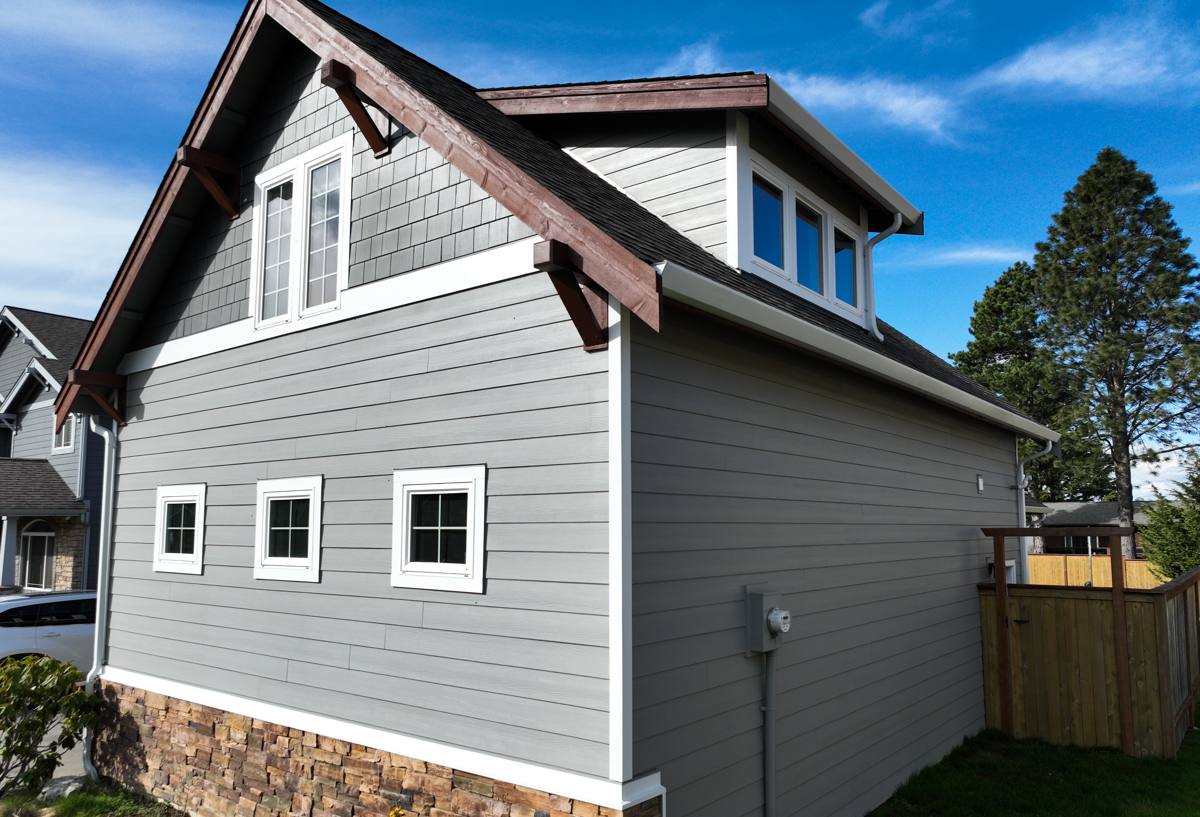
James Hardie offers several siding profiles — lap siding, board and batten, and shingle-style panels among them — plus a range of ColorPlus finishes. We help homeowners choose a profile and color that fits the home's style and the neighborhood, while making sure the underlying product is matched to the exposure level of each elevation.
What to Ask Any Contractor Bidding a Siding Job
- Are you a manufacturer-certified installer, and can you show proof of that certification?
- What's your plan for flashing and moisture barrier detail, not just the visible siding?
- Is the warranty backed by the manufacturer, the installer, or both — and what voids it?
- Will you address any rot or sheathing damage found once the old siding comes off, or is that a change order surprise later?
- Do you carry current liability insurance and workers' comp coverage in Washington State?
- Can you walk me through why you recommend this specific product for my home's exposure?
Beyond Siding: Roofing, Windows, and Decks
A siding replacement is a natural point to look at the rest of the exterior. A roof nearing the end of its service life, windows with failed seals or worn flashing, or a deck that's been absorbing Whatcom County's rain for a decade all interact with the same moisture-management system as the siding. We handle all four so a homeowner isn't coordinating between separate roofing, window, and siding crews with different opinions about how the details should tie together.
Roofing
Roof condition directly affects how water sheds off the house and past the siding at rooflines and transitions — a detail that causes real problems when it's overlooked.
Windows
Window flashing is one of the most common points of hidden moisture intrusion in older Whatcom County homes. When we're already opening up the wall for siding work, it's the right time to address failing window flashing rather than siding around a known problem.
Decks
Decks take the same driving rain and moss exposure as siding, with the added stress of standing surfaces and structural connections. Materials and fastening choices matter just as much here as they do on the walls.
Cost Factors for a Lynden Siding Project
| Factor | Why It Affects the Project |
|---|---|
| Home size and wall complexity | More corners, gables, and dormers mean more cutting, flashing detail, and labor time |
| Condition of existing sheathing | Rot or moisture damage found during tear-off adds repair scope before new siding goes on |
| Siding profile and finish selection | Lap, board-and-batten, and shingle-style panels carry different material and labor costs |
| Number of window and door openings | Each opening requires trim and flashing work, which adds labor |
| Site access and lot conditions | Tight lots, slopes, or landscaping close to the house can affect staging and labor time |
We provide a detailed, itemized estimate after walking the property — general ranges without seeing the house don't serve homeowners well, and we'd rather give an accurate number than a fast one.
Why a Local Crew Matters
A contractor who works Whatcom County regularly understands things that don't show up in a spec sheet: which sides of a house in this valley tend to hold moisture longest, how local permitting and inspection processes work, and what a realistic install timeline looks like around the region's wet season. That local knowledge shapes real decisions — where extra flashing attention goes, which elevations need the more moisture-resistant product line, and how to sequence a job around the weather instead of fighting it.
If you're planning a siding, roofing, window, or deck project in Lynden or the surrounding Ferndale area, we're happy to walk the property and put together a free, no-pressure estimate — no obligation, just an honest look at what your home needs.