 Ferndale Siding
 Every siding estimate is really an answer to a question the homeowner didn't ask out loud: what is this house going to need to survive the next 30 years? In Ferndale and the rest of Whatcom County, that question has a specific answer, because our climate is not gentle on exterior walls. Salt-laden air off Bellingham Bay, driving rain that comes in sideways during winter storms, and a moss season that can run eight or nine months out of the year all work on siding constantly, not occasionally. A cost breakdown that ignores that context is not a useful cost breakdown.
This page walks through the real factors that move a siding replacement estimate up or down, why two houses on the same street can get very different quotes, and why the product you choose ends up mattering more than almost anything else on this list.
The Factors That Actually Drive Cost
Homeowners often assume siding pricing is mostly about square footage. Square footage matters, but it is rarely the biggest swing factor. Here is what typically moves the number the most, in rough order of impact:
What's Underneath the Old Siding
This is the single biggest wildcard in any siding job. Once the old siding comes off, we're looking directly at the sheathing, the house wrap or building paper, and the framing behind it. In a marine climate like ours, it is common to find soft or delaminated sheathing around window corners, at butt joints, and near ground contact — especially on homes where the old siding was installed tight to grade or without adequate flashing. Repairing or replacing damaged sheathing is not padding on an estimate; it's the part of the job that actually protects the investment. A contractor who never finds rot on Whatcom County homes built before the 2000s is either not looking closely or not saying so.
House Complexity
Cut-up walls, multiple gables, dormers, and lots of window and door trim take more labor per square foot than a simple rectangular elevation. Two houses of identical size can differ by thousands of dollars in labor purely because one has four times the corners and cuts.
Story Height and Access
Two-story and three-story sections require staging, ladders, or lift access, plus more time and more caution around safety setup. Tight side yards, fences, and landscaping close to the foundation also slow the tear-off and disposal process.
Tear-Off vs. Overlay
Some contractors will install new siding directly over old siding to save labor cost. We don't do that, and it's worth understanding why it matters to you as the buyer: overlay traps moisture against the old material, hides existing damage instead of fixing it, and adds unnecessary load and thickness around windows and trim. A full tear-off costs more up front because it includes disposal and a real look at the wall assembly — but it's the only way to actually know what you're covering up.
Product Choice
This is the factor most homeowners underweight, and it's the one we think about the most. The material itself — vinyl, engineered wood, fiber cement, cedar — sets a floor and ceiling on lifetime cost, not just install-day cost. More on that below.
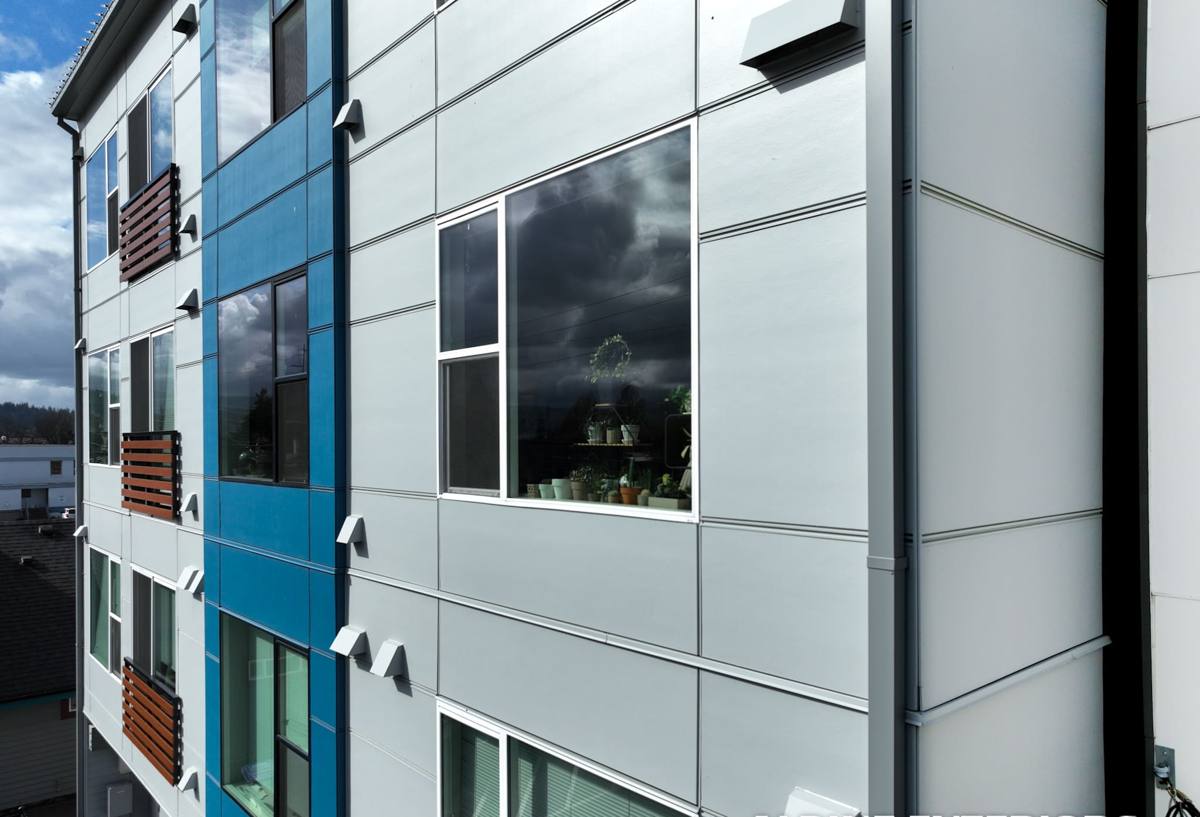
A Straightforward Look at Material Trade-Offs
We install James Hardie fiber cement siding exclusively. We didn't start out that way — we made the switch after enough years of service calls and re-siding jobs on other products to see a pattern. Here's an honest look at how the common options compare, without exaggerating anyone's downsides.
| Material | Typical Upfront Cost | What Tends to Show Up Over Time |
|---|---|---|
| Vinyl | Lowest | Fades and chalks in UV, can warp or crack in cold snaps, seams and buckling become visible within 10-15 years |
| Engineered wood (LP-type) | Low-Mid | Performs well when sealed and maintained; edge and seam moisture intrusion is the main long-term risk if caulking isn't kept up |
| Cedar / primed spruce | Mid-High | Beautiful when new; requires ongoing refinishing, is combustible, and is genuinely difficult to keep ahead of in a wet, moss-prone climate |
| Fiber cement (James Hardie) | Mid-High | Factory-cured finish resists moisture, moss, and UV; non-combustible; long transferable warranty when installed to spec |
None of these products are "bad." Vinyl is inexpensive and low-maintenance in the sense that it doesn't need painting. Engineered wood siding has genuinely improved its moisture engineering over the years. Cedar is real wood and some homeowners simply want that. But in a coastal, high-moisture, high-moss county, the products that rely on paint film, caulk joints, or wood fiber to keep water out are fighting an uphill battle every single year. That's the trade-off we stopped being willing to install around, and it's why fiber cement is the only product on our trucks now.
Why Fiber Cement Costs More Up Front — and What That Buys
James Hardie siding costs more per square foot than vinyl and is usually priced close to or slightly above quality engineered wood. What that premium buys:
- A factory-baked finish (ColorPlus) that's cured under controlled conditions rather than field-painted, which is a meaningfully different process than brushing or spraying paint onto a wall on-site
- Climate-specific engineering — Hardie's HZ product lines are formulated differently for different moisture zones, and our region falls into the wetter classification
- Non-combustible material, which matters for insurance conversations as much as for safety
- Resistance to moss and mildew growth on the material itself, which is a real, visible difference after a few Whatcom County winters
- A long transferable warranty that follows correct installation, which protects the next owner too if you sell
The honest way to think about it: vinyl and engineered wood can be the right call on a budget-driven project or an investment property with a short hold. On a home you plan to own and live in through Ferndale winters for the next decade or two, the lifetime-cost math tends to favor fiber cement even though the invoice is bigger on day one.
Labor: Where the Real Skill Shows Up
Fiber cement is unforgiving of shortcuts in a way vinyl generally isn't. It needs correct fastening patterns, proper clearance from grade and roofing, correctly lapped and sealed joints, and attention to manufacturer-specified gaps and flashing details. Installed wrong, any siding product will fail early — but fiber cement installed wrong tends to fail in ways that are expensive to catch late, because the problem is often hidden behind trim before anyone notices. That's a labor cost, not a material cost, and it's part of why we don't treat installation as a commodity step.
What a Ferndale Climate Adds to the Equation
A few things about our specific location change what "good siding" needs to do here compared to a drier or more inland climate:
- Proximity to salt air accelerates corrosion on unprotected fasteners and metal flashing, which is why fastener and flashing selection matters as much as the siding panel itself
- Wind-driven rain off the Strait pushes water into joints and laps that would stay dry in a calmer climate, which raises the stakes on proper overlap and sealant detail
- Extended damp, shaded seasons feed moss and algae growth on any surface that holds moisture, which is a maintenance burden on porous or paint-film products in particular
None of this means other products "fail" here. It means the margin for installation error or maintenance neglect is smaller than it would be somewhere drier, and that's worth factoring into both product choice and contractor choice.
A Simple Pre-Estimate Checklist
Before you call around for quotes, walking your own house with this list will help you understand your own project better and make quotes easier to compare apples-to-apples:
- Note any visible soft spots, bubbling paint, or staining on the current siding, especially near the bottom courses and window sills
- Count stories and note any areas with tight access (narrow side yards, close fencing, steep grade)
- Identify how cut-up the elevations are — number of corners, gables, and trim-heavy areas
- Decide whether you're comparing tear-off quotes only, or accepting overlay quotes too — these are not the same job and shouldn't be priced as if they were
- Ask every contractor directly what happens if they find damaged sheathing once old siding is removed, and get that answer in writing before work starts
How to Read a Siding Quote
A trustworthy quote should separate, at minimum: material cost, tear-off and disposal, any sheathing repair allowance or process, and labor. If a quote is a single lump number with no breakdown, ask for one. You're not being difficult — you're making sure you're comparing the same scope of work across bids, which is the only way a lower number actually means a better deal.
If you'd like a clear, itemized look at what your home specifically needs, we're happy to walk the property with you and put together a free, no-pressure estimate.