 Ferndale Siding
 Siding Built for Sudden Valley's Coastal Exposure
Sudden Valley sits close enough to the water and the marine air moving in off Bellingham Bay and the Strait of Georgia that homes here take a different kind of beating than houses further inland in Whatcom County. It's not one dramatic storm that does the damage — it's the steady, cumulative exposure. Salt-laden air corrodes metal fasteners and trim. Driving rain, pushed sideways by wind off the water, finds every gap in flashing and caulk. And the long, gray moss season that runs from fall through spring keeps north-facing walls and shaded siding damp for weeks at a stretch. Any exterior product installed here has to handle all three at once, not just one.
We're a Ferndale-based crew, and Sudden Valley is inside our regular service area — not a stretch job we drive an hour for once a year. That matters more than it sounds like it should. A contractor who works this specific stretch of Whatcom County knows which elevations catch the worst of the wind-driven rain, which lots stay shaded and mossy well into June, and which older siding systems in the area are starting to show their age. That local pattern recognition changes how we flash a wall, where we add extra drip cap, and which products we're willing to warranty here.
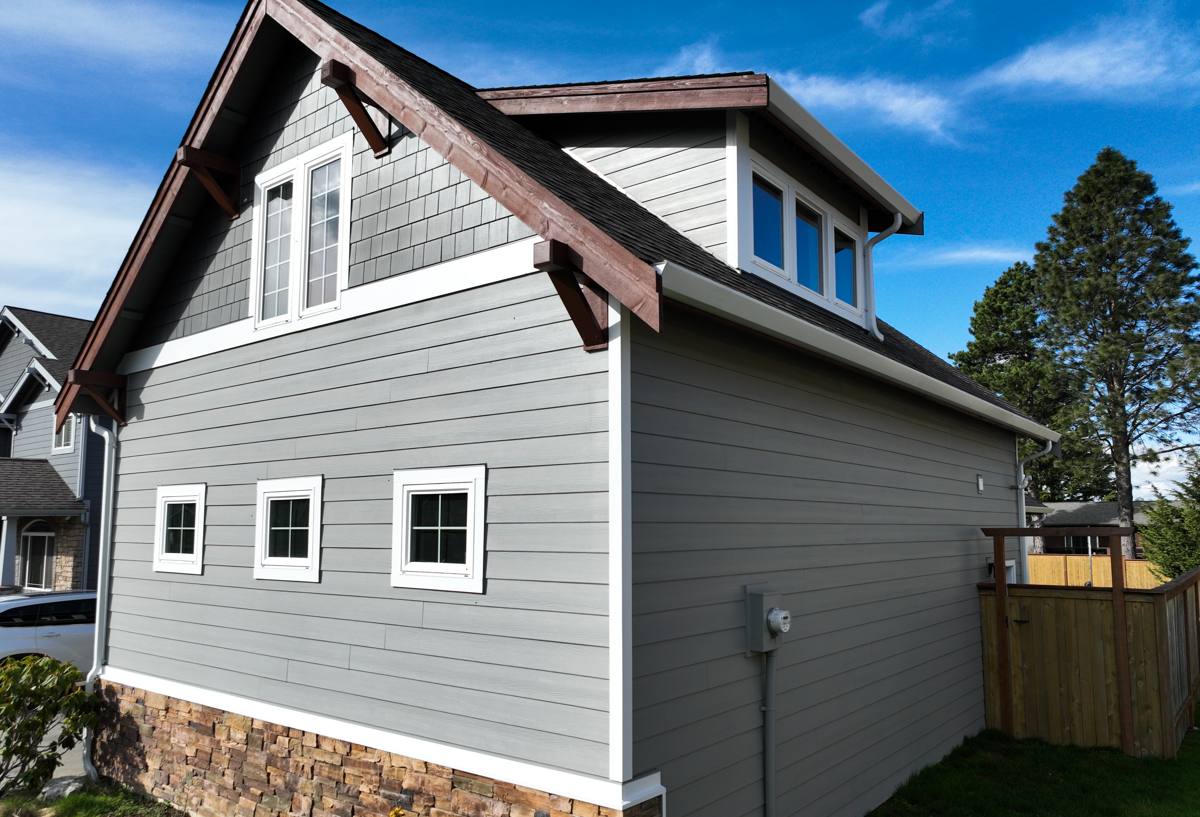
What Salt Air Actually Does to a House
Salt air isn't just a coastal cliché — it's a real chemical stressor on exterior materials. Airborne salt is hygroscopic, meaning it pulls moisture out of the air and holds it against whatever surface it lands on. On a home near the water, that means:
- Steel fasteners, flashing, and hardware corrode faster than the same materials would inland
- Paint and factory finishes break down sooner under repeated salt-moisture cycling
- Untreated or under-primed wood products absorb salt moisture and swell, crack, or rot from the inside out
- Metal trim pieces can streak rust down onto siding below them if they're not corrosion-resistant
This is why fastener choice and flashing detail matter as much as the siding material itself. We use corrosion-resistant fasteners and properly lapped flashing on every job in this area, and we spec siding that doesn't rely on a fragile surface coating to survive salt exposure.
Driving Rain and Wind-Driven Water
Sudden Valley's exposure to weather moving in off the water means rain here often doesn't fall straight down — it comes in at an angle, driven by wind, and hits vertical wall surfaces directly. That's a different load than a typical inland rain event. Wind-driven rain pushes water up under laps, into unsealed seams, and behind trim that isn't properly flashed. A siding system that performs fine in a sheltered inland neighborhood can fail here simply because the water is hitting the wall from a different angle and with more force.
The fix isn't a fundamentally different siding product — it's disciplined installation. Correct lap exposure, house wrap integration, window and door flashing that actually sheds water outward instead of trapping it, and caulking only where caulking belongs (not as a substitute for proper flashing) are what keep a wall dry through a wet Whatcom County winter.
The Long Moss Season
Western Washington's moss season is long, and Sudden Valley's tree cover and shaded lots make it worse in spots. Moss and algae need moisture and shade to establish, and once they take hold on a wall surface, they hold water against the siding continuously — which accelerates whatever underlying moisture problem already exists. On wood-based siding products, that sustained dampness is often where rot starts, usually at butt joints, corners, and anywhere caulk has failed.
Moss growth on siding is usually a symptom, not the root problem. It tells you a wall isn't drying out between rain events. Good original installation — proper clearance from grade, adequate roof overhangs where possible, and siding that doesn't wick and hold moisture — reduces how much moss becomes an issue in the first place. No siding is moss-proof if it stays wet long enough, but some products handle repeated wet-dry cycling far better than others.
Why We Install Only James Hardie Fiber Cement
We don't install vinyl, LP SmartSide, primed spruce, cedar, or other fiber cement brands like Cemplank or Allura. That's a deliberate standard, not a lack of options. In an environment with salt air, driving rain, and a long moss season, the material differences between products stop being marginal and start being the difference between a wall that holds up for decades and one that needs attention within a handful of years.
James Hardie fiber cement is cement, sand, and cellulose fiber — it doesn't absorb and swell the way wood-based products can, and it's non-combustible, which matters for wildfire-conscious insurance considerations even in a wetter climate. Hardie's HZ5 product line is engineered specifically for Pacific Northwest-style climates: freeze-thaw cycling, sustained moisture, and wind-driven rain. The factory-applied ColorPlus finish is baked on under controlled conditions, which holds up to UV and moisture exposure far better than field-applied paint, and it comes with its own dedicated finish warranty separate from the substrate warranty.
That said, we're straightforward about trade-offs. Fiber cement is heavier than vinyl or engineered wood, it requires specific fastening and cutting practices (including dust control), and it costs more upfront than vinyl siding. We think that upfront cost is the honest price of a product that doesn't need repainting every several years and doesn't have the moisture-related failure modes that wood-based siding can develop in this climate. For a homeowner planning to stay in a Sudden Valley home for the long haul, that math tends to work out in Hardie's favor.
Comparing Common Siding Options for This Climate
| Factor | Vinyl | Wood-Based (LP SmartSide, primed spruce, cedar) | James Hardie Fiber Cement |
|---|---|---|---|
| Moisture/rot resistance | Doesn't rot, but can warp and gap | Vulnerable if seals fail or moisture intrudes | Cement-based, doesn't rot or swell |
| Salt air / corrosion behavior | Panel itself resists salt; fasteners still a concern | Coatings can break down faster near salt air | Non-combustible substrate, factory finish holds up well |
| Moss/algae tolerance | Can trap moisture behind panels | Prolonged dampness accelerates decay | Handles repeated wet-dry cycling without structural harm |
| Finish longevity | Can fade/chalk over time | Repaint cycle typically every 5-10 years | ColorPlus factory finish, longer intervals before repaint needed |
| Upfront cost | Lowest | Mid-range | Higher upfront, lower lifecycle cost |
Roofing, Windows, and Decks in the Same Coastal Conditions
Siding doesn't work in isolation — the same salt air, wind-driven rain, and moss exposure that affects walls in Sudden Valley affects the roof, windows, and any deck attached to the house. We handle all of these because they're connected systems: a roof that isn't shedding water correctly overloads the wall flashing below it, windows that aren't properly integrated with the siding become the first place wind-driven rain gets in, and a deck ledger board attached without proper flashing is one of the more common rot points we see on homes in wetter parts of Whatcom County.
When we're on-site for a siding project, we look at the whole envelope — roof edges, window flashing, deck attachment points — because fixing siding while ignoring an adjacent problem just moves the water somewhere else.
What a Full Exterior Assessment Looks At
- Current siding material, condition, and how it's handling moisture and moss exposure
- Flashing at windows, doors, roof lines, and any deck ledger connections
- Trim and corner details where wind-driven rain tends to find gaps first
- Roof edge and gutter performance feeding water away from walls
- Overall drainage and grading around the foundation
What Correct Installation Looks Like Here
Product choice only gets a homeowner halfway. The other half is installation discipline, and it matters more in a climate like this than in a drier one. On Hardie installations in Sudden Valley and the rest of our Ferndale service area, that means following manufacturer-specified nailing patterns and clearances, using corrosion-resistant fasteners appropriate for coastal exposure, integrating house wrap and flashing so water sheds outward at every penetration, and maintaining proper clearance between the bottom of the siding and grade, decking, or roof lines to avoid trapping moisture.
These aren't optional refinements — they're what keeps a warranty valid and what actually determines whether a wall stays dry through twenty Whatcom County winters instead of five.
Planning a Siding Project in Sudden Valley
Homeowners in Sudden Valley typically come to us in one of a few situations: aging original siding starting to show moisture damage or persistent moss staining, a remodel or addition that needs matching or updated siding, or a straightforward desire to move to a lower-maintenance product before small problems become expensive ones. Whatever the starting point, the first step is the same — a walk-around assessment of the current exterior, honest talk about what we're seeing, and a plan that accounts for the specific exposure of that lot, not a generic quote.
If you're weighing a siding, roofing, window, or deck project on a Sudden Valley home, we're glad to come take a look and talk through what we're seeing and why. There's no pressure and no cost to get an estimate — just a straight assessment from a crew that works this part of Whatcom County regularly.