 Ferndale Siding
 Siding Built for Kendall's Corner of Whatcom County
Kendall sits inland from the coast but still gets the full package of Whatcom County weather: long, wet winters, a moss season that seems to stretch longer every year, and enough temperature swings between valley floor and foothill elevation to stress a house's exterior in ways that don't show up right away. Homes here range from older farmhouses to newer builds pushed out from Ferndale and Bellingham as those towns fill in, and a lot of them are carrying siding that was never really matched to this climate in the first place.
We're a local crew that works this stretch of the county regularly, not a company that shows up for one job and disappears. That matters more than most homeowners realize until they need a warranty call, a repair years down the road, or just an honest answer about what's actually going on with their siding.
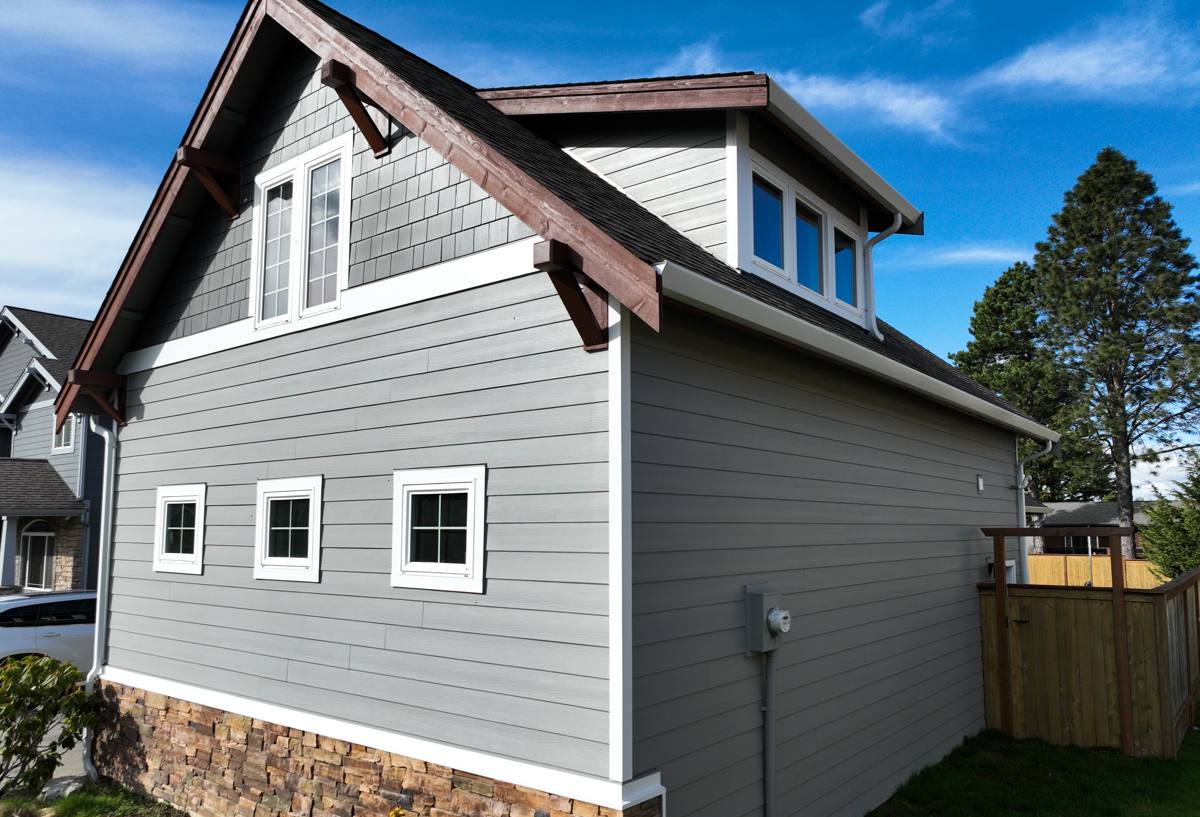
What Kendall's Climate Does to Exterior Siding
Kendall doesn't get hammered by direct salt spray the way waterfront Whatcom County properties do, but moisture is still the dominant force acting on every exterior surface here. Between the Nooksack valley's humidity, the near-constant fall-through-spring rain, and heavy morning dew that lingers under tree cover, siding in this area spends a large percentage of the year damp.
The Moss and Mildew Problem
Moss doesn't need standing water to take hold — it needs shade, moisture, and time, and Kendall's tree cover and long wet season provide all three. Once moss and algae get a foothold on a siding surface, they hold moisture against that surface even longer, which accelerates whatever damage process is already underway. On wood-based products, that's rot. On some engineered products, it's swelling and edge deterioration. On fiber cement, it's mostly cosmetic and comes off with routine cleaning, because the material itself isn't feeding on organic growth or absorbing water into its structure.
Freeze-Thaw and Temperature Swings
Kendall's inland, slightly higher-elevation position means it can see sharper overnight temperature drops than the immediate coast, especially in winter. Moisture that's worked into a seam, a fastener hole, or an unpainted cut edge can freeze, expand, and widen that opening. Do that enough winters in a row and small vulnerabilities become real ones — paint failure, soft spots, gaps that let water in behind the siding.
Why We Install Only James Hardie Fiber Cement
We made a decision a while back to standardize on James Hardie siding and stop installing everything else — not because every other product is bad, but because James Hardie is the one product line that consistently holds up to exactly the conditions Whatcom County throws at a house, with the least long-term maintenance burden for the homeowner.
What Fiber Cement Actually Solves
James Hardie siding is cement, sand, and cellulose fiber. It doesn't absorb water the way wood or wood-composite products do, it doesn't feed mold or insects, and it's non-combustible — a real consideration given how many Whatcom County properties border trees and brush. The factory-applied ColorPlus finish is baked on under controlled conditions, which gives it a more consistent, longer-lasting bond than field-applied paint, and it comes backed by a strong transferable warranty on both the substrate and the finish.
The HZ5 Climate Engineering
James Hardie engineers its products by climate zone, and our region falls into the HZ5 category, formulated for areas with significant moisture exposure and freeze-thaw cycling. That's a meaningful difference from a one-size-fits-all siding product — it means the material was designed with places like Kendall in mind, not just tested for a national average climate that doesn't really exist anywhere.
Why We Walk Away From Other Products
Homeowners in Kendall sometimes ask us to quote LP SmartSide, vinyl, or a cheaper fiber cement alternative, and we're upfront that we won't install those — here's the honest reasoning.
LP SmartSide
LP SmartSide is an engineered wood product — strand board with a resin-saturated overlay. It performs reasonably well when installation is flawless and maintenance stays on schedule, but any cut edge, fastener puncture, or caulking gap that isn't sealed and re-sealed on time gives wood-based material a path to swell and deteriorate. In a climate with Kendall's rainfall and moss season, that's a maintenance schedule most homeowners don't realize they've signed up for until the damage shows up.
Vinyl Siding
Vinyl is affordable and low-maintenance in the sense that it doesn't rot, but it's a thin plastic product that expands and contracts significantly with temperature swings, can crack or warp in sustained cold snaps, and has no real fire resistance. It also tends to look like what it is from close range, and it can't be repainted to change a home's look down the road without specialty products. For a long-term exterior investment, we don't think it holds up to Hardie's combination of durability and appearance.
Other Fiber Cement Brands
Products like Cemplank or Allura are also cement-based and share some of Hardie's core advantages over wood or vinyl. Our decision to install only James Hardie comes down to manufacturing consistency, the depth of the HZ climate-zone engineering, the ColorPlus finish process, and the warranty structure behind it — factors that matter over a 30-plus year service life, not just at installation.
How a Siding Project Works, Kendall to Finish
Every property is different, but the process generally follows the same sequence:
- On-site inspection — we look at the current siding, the wall sheathing underneath where accessible, moisture-prone areas (north sides, shaded sections, roof-to-wall transitions), and existing trim and window details.
- Written estimate — a clear scope, product line and color selection, and a realistic timeline based on current job load and weather windows.
- Tear-off and prep — removal of failing material, inspection and repair of sheathing, and installation of a proper weather-resistive barrier before any new siding goes up.
- Installation to manufacturer spec — correct fastening, clearances, flashing at penetrations, and joint treatment. This is where a lot of siding failures actually originate, regardless of the product used.
- Final walkthrough — trim, caulking, and touch-up review with the homeowner before we call it done.
Roofing, Windows, and Decks — Because Exteriors Don't Fail in Isolation
Siding rarely fails on its own. A roof leak at a wall intersection, a window that's no longer sealing properly, or a deck ledger board pulling moisture into the rim joist all put water where it doesn't belong, and siding usually takes the blame for damage that started somewhere else. Because we handle roofing, windows, and decks in addition to siding, we can look at a Kendall property as one connected system instead of four separate trades pointing fingers at each other. That matters most at transition points — where a deck meets the house, where a roof meets a wall, where a window is flashed into the siding plane — because those are exactly the spots where most real-world water intrusion problems start.
Siding Comparison for Kendall Homes
| Factor | James Hardie Fiber Cement | LP SmartSide | Vinyl |
|---|---|---|---|
| Moisture resistance | Does not absorb water into the material | Vulnerable at unsealed cuts and edges | Won't rot, but can warp/crack |
| Moss and algae impact | Cosmetic only; cleans off | Can accelerate edge deterioration | Cosmetic; can trap moisture behind panels |
| Fire resistance | Non-combustible | Combustible (wood-based) | Low; can melt/deform near heat |
| Finish longevity | Factory-baked ColorPlus finish, long warranty | Factory overlay, repaint eventually needed | Color molded in; fades over time, hard to repaint |
| Typical maintenance | Occasional wash, watch caulk lines | Regular edge/seam inspection and resealing | Low, but limited repair options if cracked |
What to Ask Any Contractor Before You Hire
Whether you go with us or someone else, these are the questions that separate a crew that'll do it right from one that won't:
- Are you licensed and insured to work in Whatcom County, and can you show proof?
- Who is actually on the crew doing the work — is it your employees or a subcontracted team?
- What's your plan for the weather-resistive barrier and flashing details, not just the visible siding?
- Is the manufacturer's installation instruction followed to the letter, including fastener spacing and clearances?
- What does the warranty actually cover — labor, material, or both — and for how long?
- Can you walk me through how you'll handle transitions at the roofline, windows, and any decks or porches?
Timing a Siding Project in Kendall
Late spring through early fall gives the most reliable dry-weather windows for tear-off and installation in this part of Whatcom County, though we work into the shoulder seasons when forecasts cooperate. Starting the estimate and scheduling process in winter or early spring is common — it gets a project queued ahead of the busier summer months and avoids the scramble that happens when moss season damage gets discovered too late.
Get an Honest Look at Your Siding
If you're in Kendall and dealing with siding that's showing moss buildup, soft spots, failing paint, or just age, we're happy to come take a look and give you a straight answer about what's going on and what it would take to fix it right. There's no pressure and no cost to get an estimate — fill out the form below and we'll get in touch.