 Ferndale Siding
 Two Fiber Cement Products, Two Different Track Records
If you've been pricing out siding in Ferndale, you've probably run into Cemplank. It shows up at building supply stores across Whatcom County, usually priced a bit below James Hardie, and on paper it looks like the same thing: fiber cement lap siding, panels, and trim. Both products are made from cement, sand, and cellulose fiber. Both are non-combustible. Both hold up better than vinyl or wood over the long haul. That much is true and worth saying plainly.
But "fiber cement" is a category, not a guarantee. Two products in the same category can differ in how they're manufactured, how they're finished, how they're backed, and how they perform after fifteen winters of Pacific storms rolling off Bellingham Bay. This page explains why, after years of installing siding in this specific climate, we made James Hardie our only fiber cement offering — and why we think that's the more honest answer for a Ferndale homeowner than pretending every fiber cement board is interchangeable.
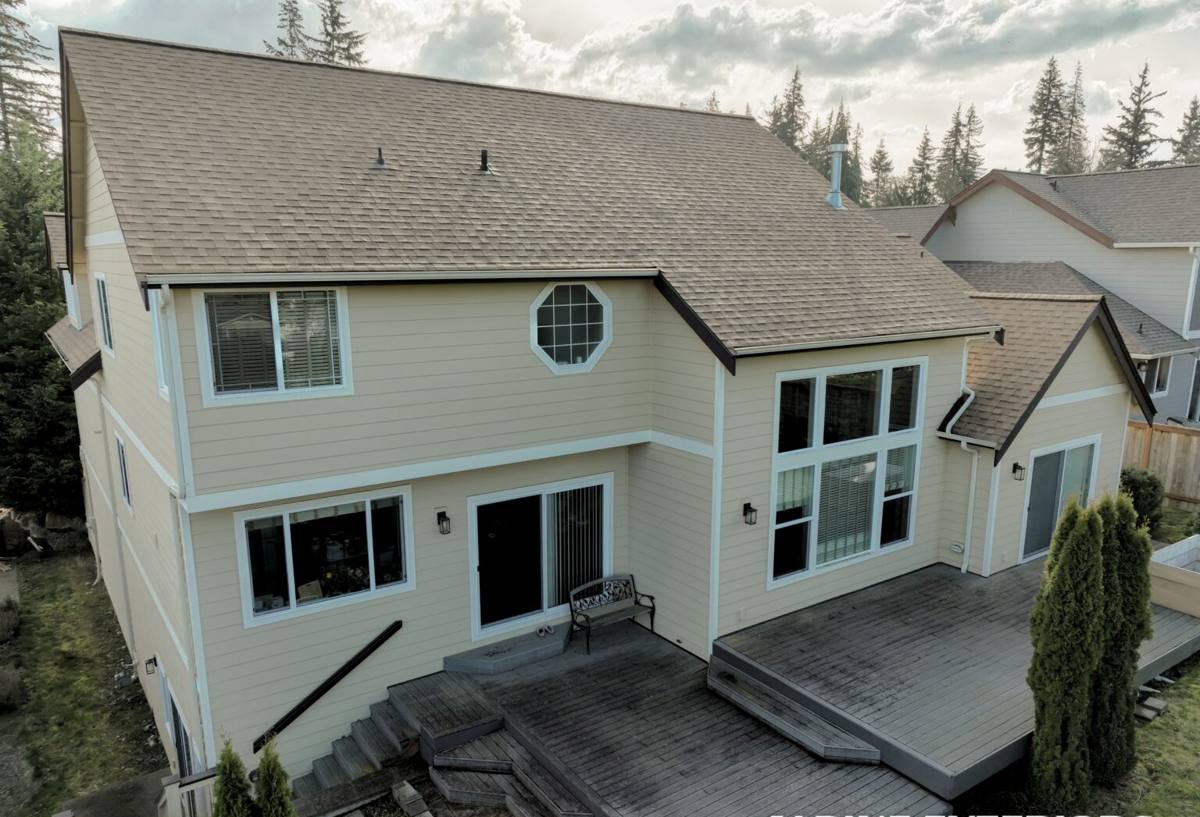
Why Ferndale's Climate Isn't a Minor Detail
Whatcom County sits in a spot that's harder on exterior building materials than most people realize. Ferndale gets salt-laden air moving in off the Strait of Georgia and Bellingham Bay, which accelerates corrosion on fasteners and finishes that aren't formulated for it. Winter storms bring driving, wind-blown rain that hits siding at an angle, not straight down — that matters because it drives moisture into laps, seams, and butt joints that a calmer climate would never stress-test. And then there's the moss season: long stretches of damp, shaded, low-sun conditions from fall through spring that let moss, algae, and mildew take hold on anything that stays damp too long.
None of that is exotic weather. It's just persistent. A siding product only has to fail once, in one weak spot, to let water behind the wall assembly — and in this climate, that weak spot gets tested every single winter, not once every few years. That's why we care less about how a product performs in a lab and more about how it's engineered for exactly this kind of exposure.
Where Cemplank Genuinely Gets It Right
We're not going to pretend Cemplank is junk, because it isn't. It's a real fiber cement product manufactured to recognized industry standards, and plenty of it is sitting on homes performing adequately. It costs less than James Hardie in most markets, which matters to a lot of homeowners, and for a buyer who understands the trade-offs and plans to manage maintenance closely, it's not an irresponsible choice. Our decision not to install it isn't a claim that it's defective — it's a decision about the standard we hold ourselves to and the level of confidence we want to have in what's on a customer's wall twenty years from now.
The Factory Finish Gap
This is where the products start to separate. James Hardie's ColorPlus finish is baked on in a factory-controlled process, cured with heat, and backed by a dedicated 15-year finish warranty that covers fading and peeling separately from the product warranty. That finish is engineered to handle UV exposure and moisture cycling before it ever leaves the plant.
Budget fiber cement brands, Cemplank included, more commonly rely on primed board that gets field-painted after installation, or a lighter factory coating without the same cure process. Field-applied paint is only as good as the painter, the weather on install day, and the number of coats actually applied — variables you can't control once the crew leaves. In a climate with this much moisture and salt air, a finish that's marginal on day one tends to show it early: chalking, fading, and touch-up work sooner than a homeowner expects to be doing it.
What This Looks Like in Practice
- Factory-cured finish resists fading and moisture intrusion from day one, with no dependence on installer paint technique
- Field-applied or lighter factory coatings put more of the long-term finish performance in the hands of whoever paints it, and when
- Touch-up and repainting costs are real costs — they just show up five to ten years later instead of on the original invoice
Warranty Structure: The Part Most Homeowners Never Read
Every siding brand advertises a warranty. Very few homeowners actually read what it covers, how it's prorated, and whether it transfers if the house sells. This is where the gap between products tends to matter most, because a warranty that shrinks in value over time isn't worth much by the time you'd actually need it.
| Factor | James Hardie | Cemplank |
|---|---|---|
| Product warranty length | 30-year, non-prorated on most siding products | Shorter, and typically prorated after an initial period |
| Finish warranty | Separate ColorPlus finish warranty (15 years) covering fade/peel | Finish coverage tied to paint system used, often installer- or paint-manufacturer-backed rather than the siding maker |
| Transferability to new owner | Transferable, adds resale value | Varies by product line and retailer |
| Regional manufacturing support | Dedicated engineered zone formulations (HZ5 for this climate) | Less climate-zone differentiation in the product line |
A non-prorated warranty means the coverage doesn't quietly lose value every year you own the house. A prorated warranty can look reassuring in a brochure and be worth very little by year twelve — right around when siding problems actually start showing up.
Climate-Engineered Formulations: What HZ5 Actually Means
James Hardie manufactures its siding in different formulations calibrated to regional climate zones — freeze-thaw cycling, moisture exposure, and humidity patterns differ a lot between, say, Arizona and the Pacific Northwest. The HZ5 formulation used in our region is engineered specifically for wet, moderate-freeze coastal climates like Whatcom County's. That's not a marketing footnote; it affects how the board handles moisture absorption and expansion over decades of exposure.
Budget fiber cement lines more commonly ship a single national formulation rather than a climate-zone-specific one. That doesn't automatically mean failure, but it does mean the product wasn't engineered with Ferndale's driving rain and salt air as a specific design input. We'd rather install something built for exactly the weather it's going to face.
Availability, Support, and What Happens in Year 15
Siding isn't a five-year decision. When a board gets cracked by a fallen branch or a piece of trim needs replacing after a decade, you need a matching product still in production, and you need a manufacturer with the distribution network and installer base to back a warranty claim without a fight. James Hardie has broad distribution and a large network of trained installers across Washington, which matters when you need service years down the road, not just at installation.
Smaller or regional fiber cement brands can be harder to match years later, and warranty claims can take longer to resolve when the manufacturer's support network is thinner. It's a practical concern more than a brand-loyalty one: we want a homeowner to be able to get a matching repair board or a warranty answer in 2036, not just in 2026.
Why We Only Install James Hardie
We made a decision, early on, to install one fiber cement system and know it thoroughly rather than stock several products and generalize across all of them. James Hardie's combination of a factory-cured finish, a non-prorated warranty, a climate-specific formulation for this region, and a manufacturer support network we can rely on made it the product we're willing to put our name behind on every job — from a single wall repair to a full re-side. It's also the product we can install to spec with the most confidence, because our crews are trained specifically on Hardie's fastening, clearance, and joint-treatment requirements, which matters as much as the board itself.
That's the honest version of "why not Cemplank": it's not that the product is disqualifying, it's that we'd rather stand fully behind one system we know inside and out than split our expertise — and our warranty confidence — across several.
Questions Worth Asking Before You Sign a Siding Contract
- Is the warranty non-prorated, and for how many years does full coverage last?
- Is the color a factory-cured finish, or will it be field-painted after installation?
- Is the product formulated for this climate zone, or is it a single national spec?
- Will replacement boards still be available from the manufacturer in 15-20 years?
- Is the installer specifically trained and certified on the product they're proposing?
- Does the warranty transfer to a future buyer if you sell the home?
If you're weighing siding options for a home in Ferndale or elsewhere in Whatcom County, we're happy to walk through what we see holding up in this climate and what doesn't. Reach out for a free, no-pressure estimate — there's no obligation, just a straight answer about what we'd recommend for your house.