 Ferndale Siding
 Sumas Sits at the Edge of a Tough Climate for Siding
Sumas is about as far inland as you get in Whatcom County, but "inland" here doesn't mean dry. The same weather systems that soak Bellingham and the coastline push east and pile up against the foothills, and Sumas gets its share of long, driving rain events every fall and winter. Add in the valley's damp, shaded pockets along the Nooksack drainage and tree-lined properties, and you get a textbook moss and mildew climate — north-facing walls and anything under a fir canopy stay wet for days after a storm passes.
Homes here don't need siding that just looks good on a dry August afternoon. They need a cladding system engineered for months of saturation, freeze-thaw swings in a cold snap, and constant exposure to airborne moisture that drifts in off the Salish Sea and settles into low-lying farmland. That's a specific set of demands, and it's why we only install James Hardie fiber cement on Whatcom County homes — including in Sumas.
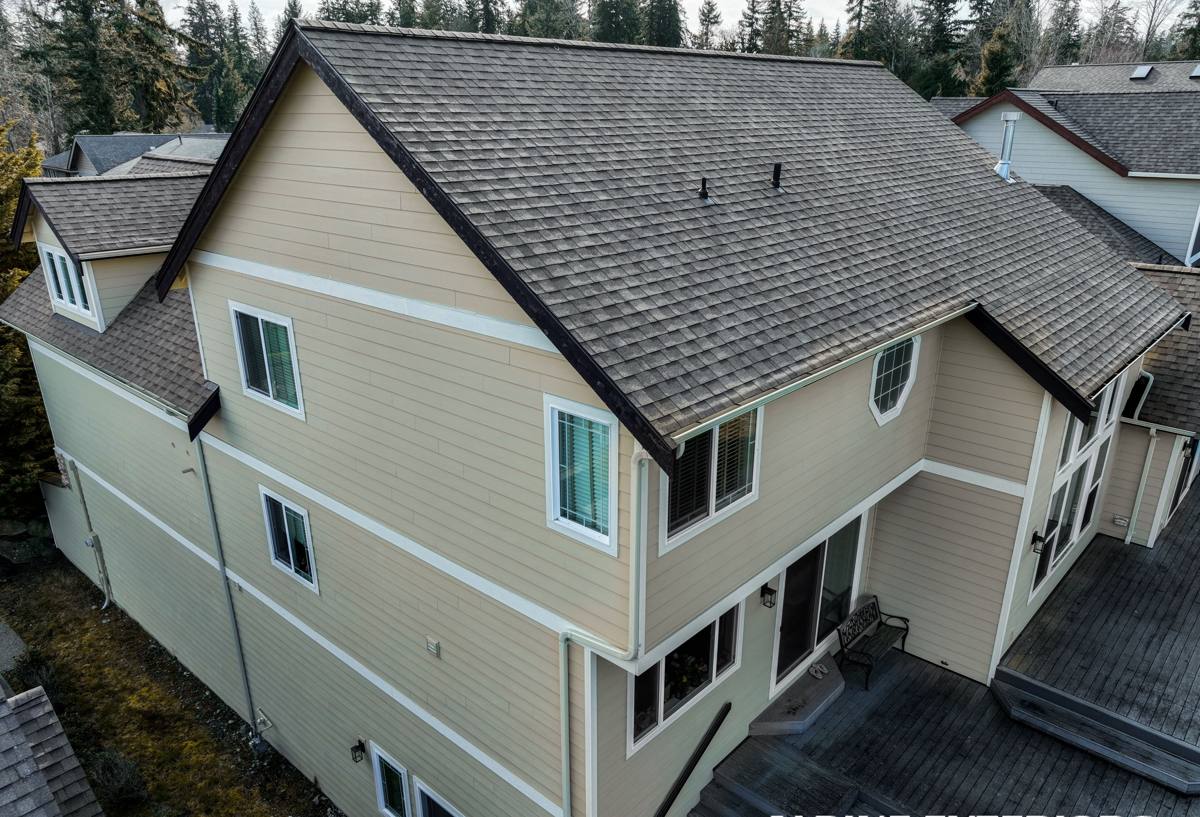
What Sumas Homes Actually Need From Their Siding
Break down the local climate into what it does to a wall assembly over 20-30 years, and three problems show up again and again:
- Sustained moisture exposure — long rain events, not just quick showers, that give water time to find gaps, laps, and fastener penetrations
- Moss and algae growth — shaded, damp siding faces that never fully dry between storms, especially on north and east elevations
- Temperature swings — occasional hard freezes following wet stretches, which stress any material that has already absorbed moisture
Materials that swell, wick water, or rely on a factory coating that degrades in UV and moisture over time struggle in this combination. Fiber cement doesn't swell or rot, and James Hardie's ColorPlus finish is baked on with a process built to hold up under exactly this kind of repeated wet-dry cycling — which matters more in Sumas than it would somewhere with a drier, more even climate.
Moss Season Is a Maintenance Issue, Not Just a Cosmetic One
Moss on siding isn't only unattractive — it holds moisture against the surface longer than bare siding would, which accelerates whatever degradation process is already happening underneath. On wood-based products, that moisture retention is a real problem. On James Hardie, moss can still grow (nothing stops moss from landing and taking root on any exterior surface in this region), but the substrate underneath doesn't feed off that trapped moisture the way organic materials do. A homeowner can wash it off on a normal schedule without worrying they're uncovering rot.
Why We Standardized on James Hardie Instead of the Alternatives
We get asked why we don't offer vinyl, LP SmartSide, cedar, or other fiber cement brands. The honest answer is that we looked at how each performs specifically in a marine-influenced, high-rainfall climate like ours, and James Hardie was the one product line built for it from the ground up.
| Factor | James Hardie | Common alternatives |
|---|---|---|
| Moisture response | Engineered fiber cement, doesn't swell or rot when saturated | Wood-based products can swell at cut edges and fastener points; vinyl can trap moisture behind it |
| Finish durability | ColorPlus baked-on finish, factory warranty backs fading/chipping | Field-applied paint or thinner factory coatings wear faster under repeated wet-dry cycling |
| Fire resistance | Non-combustible fiber cement | Wood-based and vinyl products are combustible |
| Long-term maintenance | Wash and repaint on a normal exterior schedule | Wood-based products often need more frequent caulk, patch, and repaint work in wet climates |
None of this means those other products can't be installed correctly, or that they fail overnight. It means that after years of servicing homes in this region, we decided the trade-offs weren't worth carrying forward, and we'd rather stand behind one system we know performs than offer a menu of options with different long-term risk profiles.
Which James Hardie Line Fits Sumas
James Hardie makes climate-specific product lines, and the HZ5 line is engineered for regions like ours — freeze-thaw cycling combined with high moisture exposure. That's the baseline we work from on any Whatcom County project, Sumas included. Within HZ5, the choice between lap siding, panel siding, and shingle-style products comes down to the home's architecture and the homeowner's preference, not the climate — all of them carry the same underlying substrate engineering.
ColorPlus vs. Field-Applied Paint
We push customers toward ColorPlus finish options whenever the color selection works for the project. A factory-applied, baked-on finish holds color and resists chipping far better than paint applied on site after installation, especially through repeated wet winters. It also means touch-up work, if it's ever needed, uses a matched product rather than guessing at a paint mix years later.
What a Correct Installation Actually Involves
Fiber cement siding is only as good as the install behind it. Most of the problems homeowners eventually run into with any siding brand trace back to installation shortcuts, not the material itself. In a climate like ours, a few details matter more than they would somewhere drier:
- Proper water-resistive barrier and flashing details at every window, door, and penetration — this is where driving rain finds its way in if it's rushed
- Correct fastener spacing and placement per James Hardie's published fastening schedules, not a generic nailing pattern
- Adequate clearance between siding and grade, decks, and roof lines so water has somewhere to go instead of wicking up into the bottom course
- Proper caulking and sealant at butt joints and trim, sized and placed to move with the material rather than crack in the first cold snap
- Rainscreen or drainage gap detailing where the wall assembly calls for it, so moisture that does get behind the siding can actually drain and dry
None of this is exotic. It's just detail work that takes longer to do right, and it's the difference between siding that performs for its full service life and siding that develops problems in five or six wet seasons.
A Simple Pre-Installation Checklist for Homeowners
- Confirm the crew is using James Hardie's climate-specific HZ5 product, not a generic or lower-grade line
- Ask what water-resistive barrier and flashing approach they use around windows and doors
- Ask how they handle the bottom starter course and clearance from grade or hardscape
- Get the fastening schedule in writing — it should match James Hardie's published specifications
- Confirm whether ColorPlus or field-applied paint is being quoted, and understand the warranty difference between the two
Our Process on a Sumas Project
Every project starts with an on-site look at the home's exposure — which walls take the worst of the weather, where moss has already established itself, where old caulk or trim has failed. That tells us where extra flashing attention or drainage detailing is worth the added time. From there we walk the homeowner through product line, color, and finish options before any tear-off starts, so there are no surprises about what's being installed and why.
During installation, we follow James Hardie's fastening and clearance specifications as a minimum, not a target — in this climate, cutting corners on flashing or gapping shows up as a callback within a couple of wet seasons, and we'd rather do it right the first time. We also walk the finished job with the homeowner before we consider it done, checking sealant lines, trim, and transitions.
Why Local Experience in Sumas and Ferndale Matters
A crew that's worked across Whatcom County knows which details actually matter here versus which ones are boilerplate from a manufacturer's national installation guide. That means knowing which elevations on a typical Sumas property see the worst moss buildup, how much clearance actually holds up against a wet fall, and how the valley's damp pockets differ from a more exposed site closer to the water. It also means being available for warranty questions or a maintenance wash recommendation years down the road, not just for the install itself.
Warranty and Long-Term Ownership
James Hardie backs its siding with a transferable limited warranty, and ColorPlus finishes carry their own finish warranty on top of that. Warranty terms and coverage specifics vary by product line, so we go over the exact documentation for whatever's being installed rather than quoting generic numbers — but the structure is built around the idea that this siding is meant to last as long as the home owns it, through multiple owners if it changes hands.
Keeping that warranty valid starts with correct installation, which is another reason installation quality matters as much as the product choice itself. A warranty on a product that wasn't installed to spec doesn't do a homeowner much good if a claim ever comes up.
Get a Straight Answer for Your Home
If your siding in Sumas is showing moss buildup, failing caulk lines, or just isn't holding up the way it should through another wet Whatcom County winter, we're happy to take a look and give you an honest read on what's going on and what it would take to fix it right. Reach out for a free, no-pressure estimate — no obligation, just a straight assessment of your home's siding and what James Hardie would look like on it.