 Ferndale Siding
 Siding Replacement Built for How Sumas Weather Actually Behaves
Sumas sits at the edge of Whatcom County where the terrain funnels weather in ways that are harder on siding than people expect. Homes here deal with the same moisture-heavy pattern that moves across the county for much of the year — driving rain that hits siding at an angle instead of falling straight down, long stretches of damp, low-light conditions that keep moss and algae established on north-facing walls, and salt-tinged marine air that works its way inland and slowly degrades paint films, fasteners, and anything with a seam or a joint. None of that is unique to any one street or subdivision. It's a regional condition, and it means siding replacement in Sumas has to be approached differently than it would be in a drier inland climate.
We work throughout Ferndale and the surrounding Whatcom County communities, and Sumas is a regular part of that service area. A siding job done right here isn't just about picking a product and nailing it up — it's about understanding how water moves across a wall system in this climate and building in the redundancy to handle it.
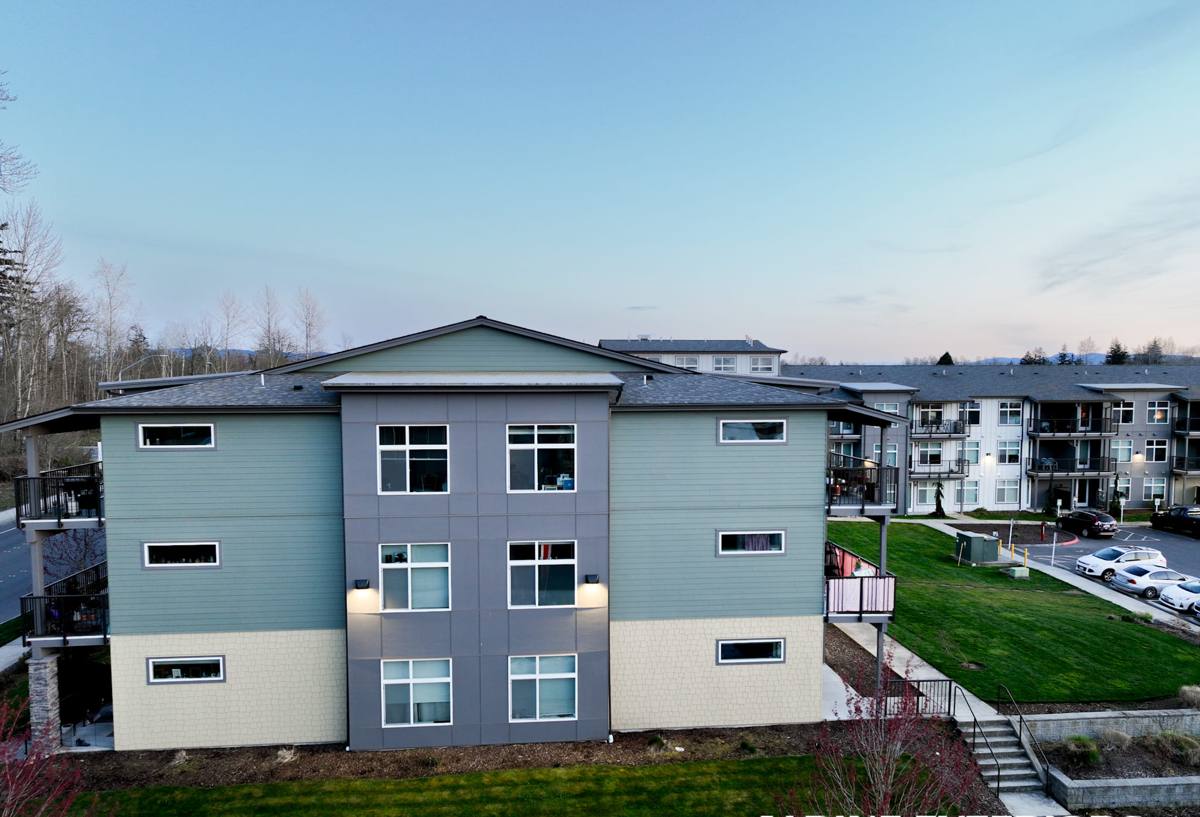
What Driving Rain, Moss, and Marine Air Do to Siding Over Time
Driving Rain and Wind-Driven Moisture
Straight-down rain is easy for any siding to shed. Wind-driven rain is a different problem — it pushes moisture sideways and upward into laps, seams, and butt joints that were never designed to be submerged. Over years, that repeated wetting finds any weakness in the water-resistive barrier, flashing, or caulk joints underneath the siding. The siding itself might look fine from the curb while the sheathing behind it is quietly absorbing moisture.
Moss and Algae on Shaded, North-Facing Walls
Whatcom County's overcast stretches mean siding on shaded sides of a house — especially north- and east-facing walls under tree cover — rarely gets a chance to fully dry out between rain events. That constant low-level dampness is exactly what moss, algae, and mildew need to take hold. On some siding materials, that's mostly cosmetic. On others, particularly wood-based products, sustained surface moisture can lead to softening, delamination, or rot at the point of contact.
Salt-Influenced Marine Air
Even inland from the Sound, Whatcom County's marine-influenced air carries enough salt content to accelerate corrosion on fasteners, hardware, and unprotected metal flashing, and to break down lower-quality paint and coating systems faster than they'd fail in a drier climate. A siding product's finish — how it's applied, how well it's bonded, and what it's warrantied to resist — matters more here than in most parts of the country.
Signs a Sumas Home Needs Replacement, Not Just Repair
Not every siding problem calls for a full tear-off. But there's a point where patching stops making financial sense and replacement becomes the smarter long-term move. Walk your exterior and look for:
- Soft or spongy spots when you press on the siding, especially near the bottom courses and around window trim
- Visible warping, cupping, or bowing boards, particularly on shaded or north-facing walls
- Paint that's failing repeatedly in the same spots within a couple years of repainting
- Persistent moss or algae growth that comes back within months of cleaning
- Cracked, delaminating, or swollen panel edges, especially at seams and corners
- Visible gaps at butt joints, trim, or window and door casings that let daylight or drafts through
- Interior signs — musty smells, peeling interior paint, or soft drywall near exterior walls — that suggest moisture is getting past the siding entirely
What a Correct Siding Replacement Job Actually Involves
Siding is a system, not just a surface layer, and in a climate like this the system underneath the visible siding matters as much as the siding itself. A replacement done to spec includes:
Tear-Off and Substrate Inspection
Removing the old siding down to the sheathing and actually looking at what's underneath — rot, soft spots, or compromised framing need to be addressed before anything new goes up. Covering up a problem with new siding just hides it for a few more years.
Water-Resistive Barrier and Flashing
A properly lapped house wrap or building paper, correctly integrated with window and door flashing so water is directed out and down rather than trapped behind the cladding. This is the layer that does the real work of keeping wind-driven rain out of the wall assembly — it matters more than the siding product itself.
Proper Fastening and Clearances
Correct nailing patterns, fastener spacing, and clearances at grade, roof lines, and decks so the siding isn't sitting in standing water or trapped moisture. Manufacturer installation specs exist for a reason, and skipping them is one of the most common ways a siding job fails early — regardless of which product is used.
Trim, Caulking, and Finish Detailing
Tight, properly caulked joints at trim, corners, and penetrations, plus a factory or field finish that's actually rated for this climate's UV and moisture exposure.
Why We Install Only James Hardie Fiber Cement
We made the decision to standardize on James Hardie fiber cement siding and stop installing vinyl, LP SmartSide, and other engineered wood or composite products. That wasn't a marketing decision — it was a response to what we consistently saw play out on homes in this climate over the years.
Vinyl can warp and become brittle with age, its seams are a known path for water intrusion, and it doesn't hold up structurally the way a rigid material does. Engineered wood and OSB-based products depend heavily on an intact factory coating; once that coating is compromised at a cut edge or a fastener hole, the substrate is vulnerable to the kind of sustained moisture exposure this area gets for months at a time. Both are legitimate products with a place in drier climates or on budget-driven projects — they're just not what we're willing to put our name behind here.
James Hardie fiber cement is non-combustible, dimensionally stable, and doesn't rot, swell, or provide a food source for moss and mildew the way wood-based products can. Its ColorPlus factory finish is baked on and warrantied specifically against fading and peeling, which matters in a marine climate where lesser coatings fail early. Hardie's HZ5 product line is engineered for climates with more moisture exposure, and the company backs it with a strong, transferable limited warranty.
| Factor | James Hardie Fiber Cement | Vinyl / Engineered Wood |
|---|---|---|
| Moisture resistance | Non-combustible, doesn't swell or rot | Vulnerable at seams, cut edges, or coating breaks |
| Moss/algae resistance | Cement substrate isn't an organic food source | Wood-based substrates more susceptible to growth-related decay |
| Finish durability | Factory-baked ColorPlus, warrantied against fade/peel | Field or lighter factory coatings, more prone to early wear |
| Fire resistance | Non-combustible material | Combustible (vinyl and engineered wood) |
| Structural rigidity | Resists warping, cupping, impact damage | Can warp, crack, or dent over time |
Our Siding Replacement Process for Sumas Homeowners
- Free on-site estimate — we walk the exterior, look at current siding condition, and check for underlying moisture or substrate issues before quoting anything.
- Written scope and product selection — you'll get a clear breakdown of the Hardie product line, profile, and color, along with a firm quote.
- Tear-off and substrate assessment — old siding comes off, sheathing is inspected, and any repairs are addressed before moving forward.
- Water management installation — house wrap, flashing, and trim detailing installed to manufacturer spec, built for this climate's wind-driven rain.
- Hardie siding installation — installed to James Hardie's fastening and clearance specifications, which is what keeps the manufacturer's warranty valid.
- Final walkthrough — we go over the finished job with you before we consider it done.
What Siding Replacement Costs in Sumas
Every home is different, and we don't quote real numbers without seeing the house, but the biggest cost drivers on a siding replacement project are consistent:
| Cost Factor | Why It Matters |
|---|---|
| Home size and wall complexity | More square footage and more corners, dormers, or gables mean more material and labor |
| Substrate condition | Rotted or damaged sheathing found during tear-off adds repair scope |
| Siding profile and accessories | Lap width, trim style, and corner details affect material cost |
| Access and site conditions | Steep grades, tight lot lines, or limited equipment access affect labor time |
| Existing siding removal | Multiple layers of old siding or extensive prep work add time |
Broadly speaking, a full siding replacement is a mid-to-major exterior investment — closer to a roof replacement in scale than a paint job — but it's also one of the few exterior projects that directly protects the structure underneath it, not just the appearance.
Why Hiring a Crew That Already Works in Sumas Matters
A crew that regularly works Whatcom County jobs already knows how wind-driven rain behaves on exposed walls in this area, which wall orientations tend to hold moss longest, and how to detail flashing so it actually performs through a wet season instead of just passing a quick visual inspection. That's not something you get from a general contractor who occasionally does siding, or from a crew based somewhere with a drier, more forgiving climate. Local, siding-specific experience shows up in the details — the flashing laps, the caulk joints, the clearances at grade — that you can't see once the job is finished but that determine whether it holds up for the next twenty or thirty years.
If your Sumas home's siding is showing its age or you're just not sure whether repair or replacement makes sense, we're happy to take a look. Reach out for a free, no-pressure estimate using the form below — we'll walk the exterior with you and give you an honest read on where things stand.