 Ferndale Siding
 Why Semiahmoo's Coastal Location Changes the Window Equation
Homes near the water in this part of Whatcom County deal with a different set of conditions than a house fifteen minutes inland. Salt-laden air moves through window hardware and frame seams year-round. Wind-driven rain off the Strait doesn't just fall straight down — it gets pushed sideways into wall assemblies and window openings, testing every seal and flashing detail a window has. And the long, damp moss season that stretches through much of the fall, winter, and spring keeps trim, sills, and shaded elevations wet for weeks at a stretch. None of this is exotic. It's just consistent, and it adds up faster than most homeowners expect. A window that would perform fine for a couple decades in a drier, more sheltered location can start failing early here if it wasn't specified or installed with these conditions in mind.
That's the lens we bring to every energy-efficient window job in Semiahmoo: not just "will this cut the heating bill," but "will this hold up to what this specific site sees."
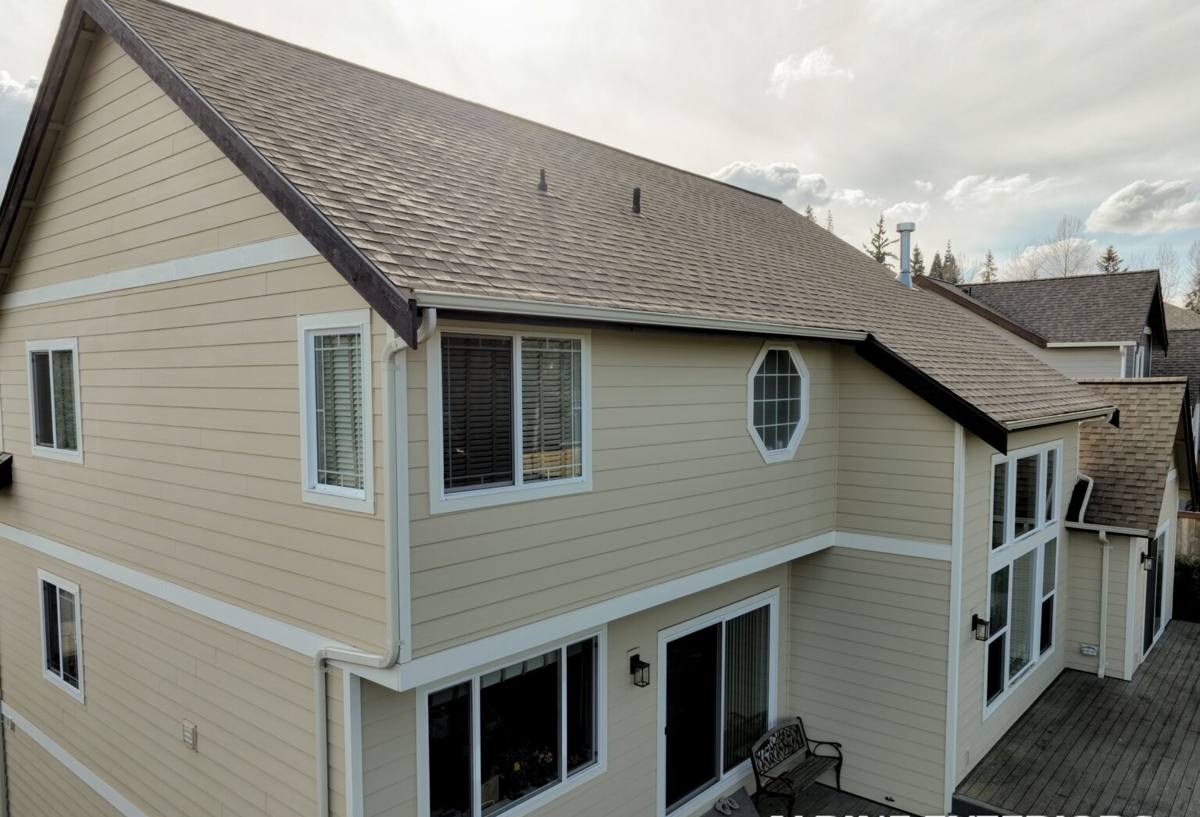
What "Energy-Efficient" Actually Means for a Coastal Whatcom County Home
Energy efficiency in a window comes down to a handful of physical properties working together — the glass package, the gas fill between panes, the frame material, and how well the whole unit is sealed into the wall. Marketing language varies by manufacturer, but the underlying numbers don't.
Reading the Label: U-Factor, SHGC, and What Matters Here
Every code-compliant window carries an NFRC label with two numbers worth understanding:
- U-factor — how well the window resists heat loss. Lower is better. This is the number that matters most for our climate, where the priority is keeping heat inside during long stretches of cool, wet weather.
- SHGC (Solar Heat Gain Coefficient) — how much solar heat passes through the glass. Less critical here than in a sunnier climate, but still worth matching to the window's orientation — a south- or west-facing unit behaves differently than one facing north.
Double-pane windows with a low-E coating and argon gas fill are the practical baseline for this area. Triple-pane adds incremental performance and is worth discussing for north-facing rooms, additions with a lot of glass, or homeowners specifically chasing the lowest possible U-factor — but it's a real cost jump, and for most Semiahmoo homes a well-installed double-pane, low-E, argon-filled window delivers the bulk of the efficiency gain for less money.
Frame Materials: What Holds Up Near Salt Air and Driving Rain
The frame matters as much as the glass in a coastal setting. Salt air is mildly corrosive to certain metals and hardware over time, and constant moisture exposure punishes anything prone to swelling, rotting, or trapping water.
| Frame Material | How It Handles This Climate | Maintenance |
|---|---|---|
| Vinyl | Doesn't corrode or rot; handles salt air and moisture well; can expand/contract with temperature swings | Low — occasional cleaning |
| Fiberglass | Very stable dimensionally, strong resistance to moisture and corrosion, holds paint well if color changes are wanted later | Low |
| Wood (unclad) | Excellent insulator but vulnerable to moisture intrusion and rot if any seal fails — a real risk given how much rain this area sees | High — regular painting/sealing |
| Aluminum-clad wood | Combines wood's interior warmth with a weather-resistant exterior shell; cladding needs to be properly detailed at the corners and sill to avoid trapping moisture | Moderate |
| Bare aluminum | Conducts heat and cold efficiently, which works against energy-efficiency goals; also more prone to condensation | Low, but poor thermal performance |
We don't push one frame material as universally "best" — each has real trade-offs in cost, appearance, and upkeep. For most Semiahmoo homeowners prioritizing energy performance with minimal long-term maintenance, vinyl or fiberglass frames make the most sense. Where a homeowner wants the look of real wood on the interior, aluminum-clad or fiberglass-clad options let us get that appearance without exposing bare wood to the weather side.
Signs Your Current Windows Are Costing You Money
Before recommending replacement, we look for real evidence the windows are underperforming — not just their age. Common signs we see on coastal Whatcom County homes:
- Visible condensation or fogging between panes (a sign the seal has failed and the gas fill is gone)
- Drafts you can feel near the frame, especially during wind events
- Soft or discolored wood at the sill or lower corners of the frame
- Difficulty opening, closing, or latching — often a sign the frame has warped or settled
- Visible corrosion on hardware, cranks, or latches
- Noticeably higher heating costs compared to similarly sized homes nearby
- Persistent moss or algae growth on the sill or exterior trim that won't stay clean
One or two of these doesn't automatically mean full replacement — sometimes it's a resealing or hardware fix. We'll tell you honestly which situation you're in rather than defaulting to "replace everything."
What a Correct Installation Involves
In this climate, the window unit itself is only part of the story. Most window failures we get called out to investigate aren't a bad window — they're a flashing or sealing mistake made during installation, and driving rain finds that mistake eventually.
A correct installation includes:
- Removing the old window and inspecting the rough opening and sheathing for hidden rot or moisture damage before anything new goes in
- Installing water-resistive barrier and flashing tape in the correct shingle-lap order, so any water that gets past the exterior cladding is directed out, not trapped behind the window
- Setting the new window level, plumb, and square, with proper shimming so it operates correctly for years, not just on install day
- Sealing and insulating the gap between the window frame and rough opening — done wrong, this is one of the most common sources of drafts and moisture problems
- Exterior sealant and trim work that sheds water rather than holding it against the frame
- A final operational check on every window — opening, closing, and locking smoothly
Skipping or rushing any one of these steps is how a good window ends up with a rot problem five years later. This is where hiring an installer matters more than which window brand you choose.
How Our Process Works
1. On-Site Assessment
We look at your existing windows, the condition of the surrounding wall and trim, sun exposure, and which elevations take the worst of the weather. Windows on the water-facing or prevailing-wind side of a Semiahmoo home often warrant different attention than sheltered elevations.
2. Measurement and Product Selection
We measure precisely and walk through frame material, glass package, and grille or hardware options based on your priorities — energy performance, budget, maintenance tolerance, or matching existing trim.
3. Installation
Old windows come out, openings get inspected and repaired if needed, and new units go in with proper flashing and sealing as described above. We work to minimize the time your wall is open to weather.
4. Final Walkthrough
Every window gets checked for smooth operation and a clean, sealed exterior finish before we consider the job done.
Moss, Mildew, and Long-Term Window Maintenance in This Climate
Even a correctly installed, high-quality window benefits from a little seasonal attention here. Sills and lower trim on shaded or north-facing elevations are the most common spots for moss and mildew to take hold over a wet fall and winter. Keeping weep holes clear, rinsing sills periodically, and trimming back vegetation that shades a window and keeps it damp all help extend the life of both the window and the surrounding trim. We're happy to point out any elevations on your home that are more exposed to this than others during the estimate visit.
What Affects the Cost of a Window Replacement Project
| Factor | Why It Matters |
|---|---|
| Number and size of windows | The most straightforward driver of total project cost |
| Frame material | Vinyl is typically the most budget-friendly; fiberglass and clad-wood options cost more upfront |
| Glass package | Double-pane low-E/argon is the standard baseline; triple-pane adds cost for incremental gain |
| Condition of the rough opening | Hidden rot or moisture damage found during removal adds repair scope before the new window goes in |
| Access and elevation | Upper-story or hard-to-reach windows take more time to install safely |
| Custom sizing or shapes | Non-standard openings cost more than stock sizes |
We give straight numbers during the estimate rather than a vague range up front — every home and window count is different, and we'd rather quote what your project actually needs.
Why a Crew That Already Works Semiahmoo Matters
Window installation isn't just about the product — it's about correctly reading a specific building envelope and the weather it has to stand up to. A crew that regularly works this stretch of Whatcom County has already seen how salt air affects hardware over time, how driving rain finds a gap in flashing, and where moss tends to take hold on local homes. That's not something you get from a general handyman or an out-of-area installer doing a one-off job. It shows up in details — flashing sequence, sealant choice, attention to the elevations that take the worst weather — that don't show up on a spec sheet but do show up in how the window performs five and ten years down the road.
If your windows are drafty, fogged, hard to operate, or just due for an honest look, we're glad to come out, walk the house with you, and give you a straightforward assessment. The estimate is free, there's no pressure to sign anything on the spot, and you'll get a clear answer on what your windows actually need — use the form below to get started.