 Ferndale Siding
 Why Lummi Island Is a Harder Environment for Siding Than Most of Whatcom County
Lummi Island sits out in the marine air of the Salish Sea, and that changes what a house needs from its exterior. Homes here take on salt-laden wind off the water, long stretches of driving rain through the fall and winter, and a moss and algae season that can run most of the year on shaded or north-facing walls. Add in the tree cover common to island lots, and you get siding that stays damp longer between dry spells than a comparable house a few miles inland in Ferndale or Bellingham. None of that is exotic — it's just a more demanding version of the same wet, mild Pacific Northwest climate the rest of Whatcom County deals with, concentrated by proximity to the water.
That combination — salt exposure, sustained moisture, and shade-driven moss growth — is exactly the profile that separates siding materials that hold up from ones that quietly fail from the inside. It's also why we install James Hardie fiber cement exclusively and don't offer vinyl, LP SmartSide, or unfinished wood siding on island or waterfront-adjacent properties. This page covers what a correct Hardie install looks like specifically for a Lummi Island home, not siding in general.
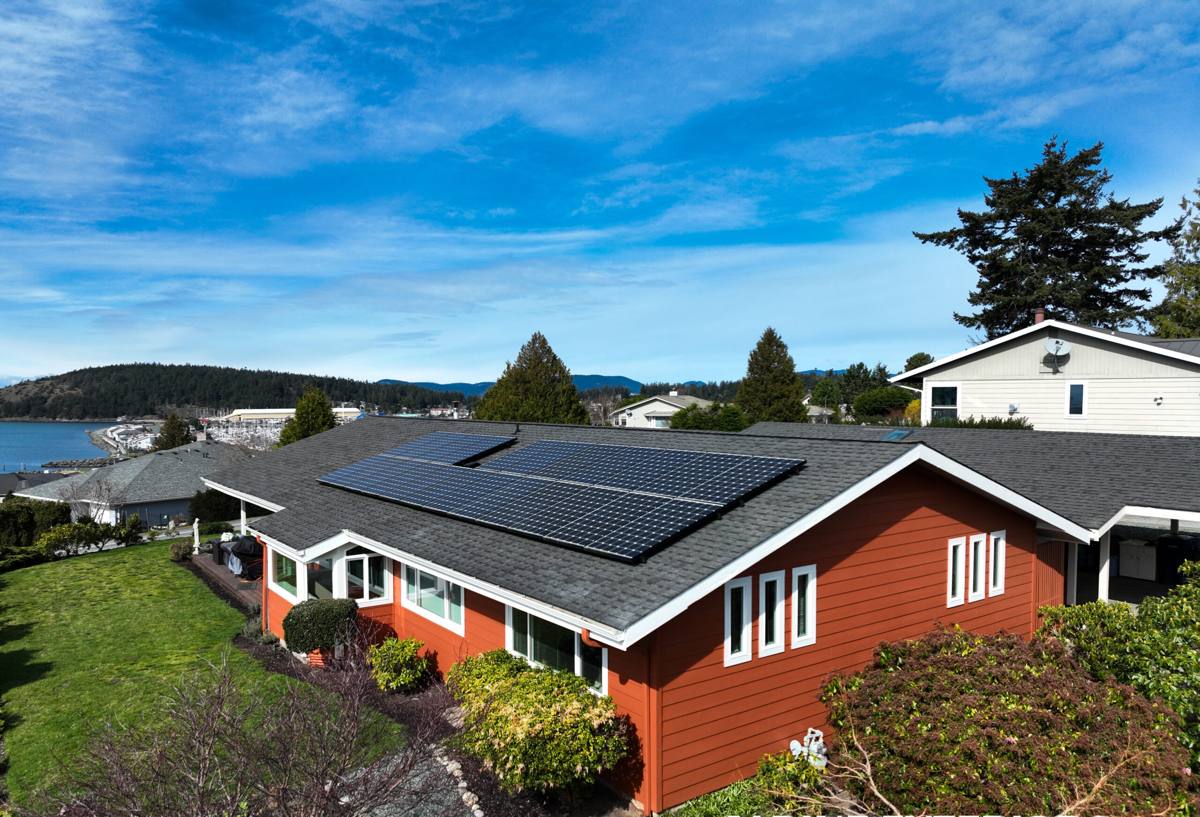
What Salt Air Actually Does to a House Exterior
Salt air isn't just "humid air." It carries fine airborne salt that settles on exterior surfaces and accelerates corrosion of anything metal — fasteners, flashing, trim connectors — and it can degrade some paint and coating systems faster than a plain rain-and-humidity environment would. A siding system that's marginal on fastener quality or finish durability inland can fail noticeably sooner on an island lot exposed to open water.
Where This Shows Up First
- Corroding or bleeding fasteners at panel and trim lines, well before the siding itself shows wear
- Premature fading or chalking on lower-quality paint finishes, especially on water-facing elevations
- Rust staining running down from steel flashing or trim that wasn't spec'd for coastal exposure
- Caulk and sealant joints drying out and cracking faster in sun-and-salt combination exposures
These are install-detail and materials-selection issues, not something any siding product fixes automatically just by being fiber cement. The product matters, but so does what fasteners, flashing, and finish system go with it.
Why We Standardized on James Hardie for Exposed Coastal Sites
James Hardie fiber cement is engineered for climate zones, and the HZ5 product line — Hardie's designation for the Pacific Northwest and other wet, moderate-freeze regions — is formulated to resist moisture absorption and hold dimensional stability through repeated wet-dry cycles better than the standard formulation sold in drier parts of the country. That matters on Lummi Island, where "dry" periods are shorter and less complete than they are further from the water.
Just as important is the ColorPlus factory finish. It's baked on in a controlled environment rather than field-applied, which gives it more consistent coverage and better long-term color retention than site-painted siding — a real advantage on a wall that's going to see salt air and UV for years between any touch-up. Hardie also backs the product with a transferable limited warranty, which matters if the home changes hands, as many island properties eventually do.
We don't say this to knock every alternative outright — vinyl and engineered wood products have their place. But for a home taking direct exposure off the water, we don't think the trade-offs (impact and heat sensitivity in vinyl, moisture-edge vulnerability in engineered wood) are worth it, and we'd rather turn down that install than warranty a job we don't believe in.
Choosing the Right Hardie Product Line for an Island Home
Hardie makes several distinct profiles, and the right one depends on the home's style and how much of the wall is exposed to weather versus sheltered by roof overhang, trees, or neighboring structures.
| Product | Best Fit | Island Consideration |
|---|---|---|
| HardiePlank lap siding | Traditional and craftsman-style homes | Most common choice; wide range of reveals and textures |
| HardieShingle | Cottage or shingle-style homes | Good match for older island architecture; more detail work at install |
| HardiePanel (vertical) | Modern builds, accent walls, gable ends | Fewer horizontal joints to seal on high-exposure walls |
| HardieTrim | Corners, window and door surrounds, fascia | Should always match the field siding's climate rating |
On a lot with real wind and salt exposure, we generally lean toward larger, simpler panel layouts with fewer joints on the water-facing side, plus trim detailing that keeps water moving away from seams rather than pooling at them.
The Long Moss Season: Ventilation and Drainage Matter as Much as the Siding
Salt air gets the attention, but on a lot of Lummi Island homes, shade and moisture retention from tree cover is the bigger day-to-day issue. A long moss season means north-facing and heavily shaded walls stay damp far longer after a rain, which is exactly the condition moss and algae need to establish. Siding material choice affects how visible and how damaging that growth becomes, but it doesn't eliminate the underlying moisture problem — the assembly behind the siding does.
What a Correct Assembly Includes
- A drainage plane (weather-resistive barrier) installed and lapped correctly, not just stapled up as an afterthought
- A rainscreen gap where wall orientation and shading call for it, so siding can dry on both faces instead of trapping moisture against the sheathing
- Proper flashing at every penetration, window, and horizontal trim break — the details that actually stop bulk water intrusion
- Kickout flashing at roof-wall intersections, a detail that's easy to skip and expensive to fix later
Hardie siding resists moss staining and rot better than untreated wood, but it still needs to dry out between rain events. An install that ignores drainage detailing on a shaded, damp wall will grow moss and hold moisture regardless of what siding is on the surface.
Fasteners, Flashing, and Finish: The Details That Decide Coastal Longevity
This is where most of the difference between a siding job that lasts and one that doesn't actually lives — not in the siding board itself.
- Fasteners: corrosion-resistant, coastal-rated fasteners set to Hardie's specified pattern and depth — not standard interior-grade nails or screws that will bleed rust through a factory finish within a few seasons near salt air
- Flashing: non-corroding flashing material at window heads, sills, and horizontal joints, lapped shingle-fashion so water sheds outward rather than behind the siding
- Caulking: used only where Hardie's installation instructions call for it — over-caulking joints that should be left to drain is a common mistake that traps water instead of shedding it
- Cut edges: factory-primed and field-sealed at every cut, since an unsealed cut edge is the fastest path for moisture into the board
Skipping any of these doesn't show up on install day. It shows up two, five, or ten years later as staining, swelling at joints, or premature fastener failure — right when it's expensive to fix.
How We Approach a Lummi Island Siding Project
1. On-Site Assessment
We walk the exterior, note sun and wind exposure by elevation, check the condition of existing sheathing and trim, and identify any moisture or moss patterns already showing on the walls.
2. Product and Detail Plan
We spec the Hardie product line, reveal, and trim package for the home's style and exposure, and flag where rainscreen or extra flashing detail is needed based on shading and orientation.
3. Tear-Off and Sheathing Check
Old siding comes off, and we inspect the sheathing underneath for rot or moisture damage before anything new goes up — a step that matters more on a house that's had years of coastal exposure.
4. Weather Barrier and Flashing Install
Drainage plane, flashing, and rainscreen furring (where called for) go in before a single piece of siding is hung. This stage is what determines how the house performs in year eight, not just year one.
5. Hardie Installation to Spec
Panels or planks go up with the correct fastener type, spacing, and gap tolerances per Hardie's published installation guide — not a generic "close enough" approach.
6. Trim, Caulk, and Touch-Up
Cut edges get sealed, factory finish touch-up is applied where needed, and joints are finished according to spec rather than over-caulked.
7. Final Walkthrough
We review the finished elevations with you, point out any maintenance items specific to your home's exposure, and answer questions before we call the job done.
Why Local Experience on Lummi Island Matters
Working on Lummi Island isn't the same logistics as a job in downtown Ferndale. The island is ferry-served, which means material deliveries, crew scheduling, and dumpster or debris hauling all have to account for ferry timing rather than just driving up with a truck whenever it's convenient. A crew that hasn't planned around that will either burn your project timeline on delays or cut corners to avoid them. We plan Hardie material orders and crew days around the ferry schedule up front so the job moves at a normal pace instead of stalling waiting on a boat.
There's also a practical familiarity factor: a crew that's already worked several island homes has a feel for which elevations on a given lot take the worst of the wind and rain, and adjusts the flashing and fastener detailing accordingly rather than treating every wall the same.
What Affects the Cost of a Hardie Siding Project Here
| Factor | Why It Matters on Lummi Island |
|---|---|
| Home size and wall complexity | More corners, dormers, and trim details mean more labor and material per square foot |
| Existing sheathing condition | Rot or moisture damage found at tear-off adds repair scope before siding can go on |
| Product line and reveal choice | Plank, shingle, and panel profiles carry different material and labor costs |
| Rainscreen and flashing detail | Shaded or high-exposure walls may need more drainage detailing than a standard install |
| Logistics and ferry scheduling | Delivery and crew scheduling around ferry access is a real planning factor, not just a formality |
We won't quote a number without seeing the house — anyone who does hasn't accounted for what your specific walls and access actually require. What we can tell you honestly up front is that a correct install with proper flashing and fastener detail costs more than a bare-minimum job, and on a salt-exposed island lot, that difference is what determines whether the siding is still performing well in fifteen years.
Maintenance: What a Homeowner Should Actually Check
- Rinse salt residue off exterior walls periodically, especially water-facing elevations, with a garden hose — no pressure washer directly against joints or edges
- Check caulked joints annually for cracking or separation, particularly after the first couple of winters
- Watch shaded, north-facing walls for early moss or algae growth and address it before it spreads
- Look at fastener heads and trim corners for any rust bleed, which can signal a fastener issue worth addressing early
- Keep gutters and downspouts clear so water isn't running down the siding face from an overflow point
None of this is heavy maintenance — it's a once- or twice-a-year walk around the house. But on an island lot, staying ahead of small issues is a lot cheaper than catching them late.
If you're planning a siding project on Lummi Island, we're glad to come take a look, walk the exposure on your specific lot, and give you a straightforward, no-pressure estimate for James Hardie siding done right. Use the form below to get started.