 Ferndale Siding
 Decks in Point Roberts Take a Different Kind of Beating
Point Roberts sits out on its own point of land, wrapped by Boundary Bay and the Strait of Georgia, and that waterfront exposure changes what a deck goes through year to year. Salt-laden air corrodes fasteners and hardware faster than it does a few miles inland. Driving rain off the water drives moisture into end grain, ledger connections, and any spot where flashing was skipped or done half right. And the long, wet moss season common across Whatcom County doesn't spare horizontal wood surfaces — a deck that isn't cleaned and sealed on schedule will grow a slick green film on the boards and in the gaps between them within a year or two.
None of that means a deck in Point Roberts is doomed to fail early. It means the materials, fasteners, and construction details matter more here than they would in a dry climate, and a deck that was built to a generic spec — rather than one built for marine, high-moisture conditions — tends to show problems years before it should.
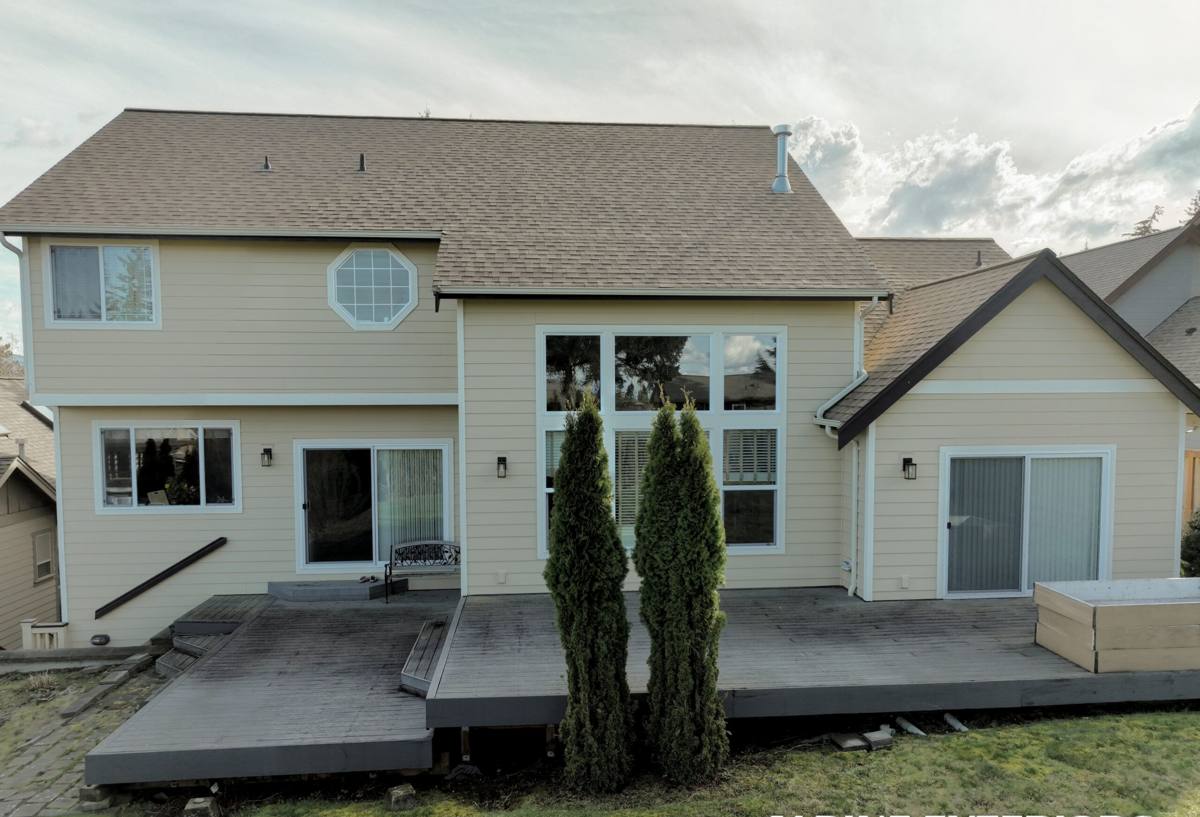
Signs a Deck Needs Replacement, Not Just Repair
Homeowners often call us thinking they need a few boards swapped, and sometimes that's true. But there's a point where patching a deck costs nearly as much as replacing it, and doesn't solve the underlying problem. Here's how we sort one from the other.
Repairable Issues
- A handful of cupped, splintering, or discolored boards on an otherwise sound frame
- Loose railing balusters or a single wobbly post
- Surface mildew or moss that hasn't penetrated the wood fibers
- Isolated fastener pops where the framing underneath is still solid
Replacement-Level Issues
- Soft or spongy decking across multiple areas, especially near the ledger board or stair stringers
- Visible rot, cracking, or rust at the ledger-to-house connection
- Support posts or footings that have shifted, heaved, or show rot at the base
- A deck built without proper flashing between the ledger and the house — a common shortcut on older builds that eventually lets water into the wall framing itself
- A structure old enough, or built to a code cycle old enough, that bringing it up to current fastening and connection standards means rebuilding most of the frame anyway
That last point matters more than most homeowners expect. Deck-building codes have tightened up considerably over the past couple of decades, particularly around ledger attachment and joist hangers. A deck that was "fine" when it was built twenty years ago may not meet the standard we'd sign off on today, and in a lot of cases the honest answer is that repair work would just be patching a structure that needs to come off entirely.
Choosing Materials for a Marine Environment
There's no single "right" decking material — it depends on budget, maintenance appetite, and how close the deck sits to open water. What we won't do is install a product in a way that ignores how it actually behaves in wet, salty conditions.
| Material | How It Handles This Climate | Maintenance |
|---|---|---|
| Pressure-treated fir/hem-fir | Affordable, structurally solid; needs sealing regularly or moisture and moss take hold fast | Annual cleaning, resealing every 1–2 years |
| Cedar | Naturally rot- and insect-resistant, ages well visually; still needs periodic sealing near salt air | Cleaning plus sealant/stain every 2–3 years |
| Composite decking | Doesn't absorb moisture or rot; resists moss buildup better than wood, though surfaces still need cleaning | Periodic washing, no sealing or staining |
| PVC/cellular decking | Fully moisture-proof board material; performs well right at the waterline in salt air | Washing only |
Framing is a separate decision from the decking surface, and it's the part that fails first if it's wrong. We frame with pressure-treated lumber rated for ground contact where it's warranted, and we pair it with fasteners and connectors rated for the corrosion exposure the site actually has — not the minimum the code technically allows.
What a Correct Deck Replacement Actually Involves
Tear-Out and Structural Assessment
We don't just pull decking boards and rebuild on the same frame. Full tear-out lets us inspect the ledger connection, the posts, and the footings — the parts that don't get looked at again for years once the new surface is down. If there's rot in the rim joist or the house sheathing behind the ledger, that gets addressed before anything new goes up, not covered over.
Ledger and Flashing
The ledger-to-house connection is the single most common failure point on decks in wet climates, and it's almost always a flashing problem rather than a fastener problem. Proper flashing routes water away from the house band joist instead of letting it wick in behind the ledger board. We install it correctly the first time — it's not a step that can be shortcut and fixed later without pulling the deck apart again.
Footings and Framing
Footings need to sit below frost depth and bear on undisturbed or properly compacted soil. In areas with poor drainage — common on lower-lying lots near the water — we look at footing placement and post-base hardware that keeps wood off standing moisture, rather than just matching whatever was there before.
Fasteners and Hardware
Salt air is hard on standard galvanized hardware. For coastal and near-coastal work we use corrosion-resistant fasteners and connectors rated for the exposure — stainless steel or heavy-coat hardware in the areas most exposed to salt spray and standing moisture, rather than the cheapest fastener that technically meets code minimums.
Surface, Gaps, and Drainage
Board spacing and airflow underneath the deck matter as much as the material choice. Decking laid too tight traps moisture and speeds up moss growth; decking without adequate ventilation underneath stays damp longer after every rain. We build in the airflow and drainage details that keep the surface drying out between storms instead of staying wet through the whole season.
Our Process, Start to Finish
- On-site evaluation: We assess the existing deck, ledger, footings, and any moisture damage to the house structure itself, and give you a straight answer on repair vs. replacement.
- Material and design walkthrough: We go over decking and framing options against your budget and how the deck will actually be used — entertaining, grilling, waterfront lounging, or just a place to get from the door to the yard.
- Permitting: Deck replacements typically require a permit through Whatcom County; we handle that process as part of the job rather than leaving it to the homeowner.
- Tear-out and structural repair: Old decking, framing, and any compromised ledger or sheathing come out and get replaced before anything new is installed.
- Build: Framing, flashing, ledger reattachment, decking, and railings go in to spec, with corrosion-appropriate hardware throughout.
- Final walkthrough: We check the finished deck with you, cover basic maintenance for the material you chose, and make sure everything's sound before we consider the job done.
Building in Point Roberts: The Logistics Nobody Else Mentions
Point Roberts is geographically separated from the rest of Whatcom County — it's a pocket of the U.S. that's reached by land only by crossing through Canada, or by water. That's not a small detail for a construction project. It affects how materials get delivered, how long lead times run for anything that isn't stocked locally, and how a crew schedules a multi-day job without losing time to border crossings for every trip back for supplies.
A crew that hasn't worked in Point Roberts before often underestimates this and either pads the timeline heavily or gets caught mid-project waiting on materials. A crew that already works the area plans deliveries and crew logistics around it from the start, so the schedule you're quoted is one that actually holds.
Keeping a New Deck Sound Once It's Built
Even the right materials and construction won't hold up forever without basic upkeep, especially with a long moss season working against you. A little regular attention adds years to the life of a deck.
- Sweep debris off the deck regularly — trapped leaves and needles hold moisture against the surface
- Clean moss and algae off boards and railings at least once a year, before it gets a foothold
- Check and reseal or restain wood decking on the schedule appropriate to the product (typically every 1–3 years)
- Rinse salt residue off composite or PVC decking periodically, especially after storms with wind off the water
- Inspect railings, stairs, and ledger flashing once a year for loose hardware or early signs of moisture damage
- Keep gutters and downspouts near the deck clear so roof runoff isn't dumping extra water onto the structure
Cost Factors to Expect
Every deck is different, so exact numbers depend on size, material, height off the ground, and how much of the existing structure needs to come out. In general terms, the factors below move the price the most.
| Factor | Effect on Cost |
|---|---|
| Decking material (pressure-treated vs. cedar vs. composite/PVC) | Composite and PVC cost more upfront, less over time in maintenance |
| Deck height and stair complexity | Taller decks and multi-run stairs add framing, railing, and labor time |
| Condition of existing framing and ledger | Hidden rot found during tear-out can add scope once it's uncovered |
| Footing and post condition | Footings that don't meet current depth or bearing standards need replacing, not reusing |
| Site access and material delivery | Point Roberts' access via Canada can affect lead time more than final price, if planned for |
Why Hire a Crew That Already Works Point Roberts
A deck built by someone unfamiliar with this stretch of Whatcom County's coastline is a deck built to a generic spec, hoping it holds up against conditions it wasn't really designed for. We've done siding and exterior work across the area long enough to know which details actually matter here — the flashing behind the ledger, the fastener grade near open water, the framing choices that keep moss and moisture from winning early. That's the difference between a deck that needs attention again in five years and one that's still solid in twenty.
If you're weighing repair versus replacement, or just want an honest look at what your current deck needs, we're happy to come take a look. Reach out for a free, no-pressure estimate — use the form below to get started.