 Ferndale Siding
 Why Siding Repair Looks Different in Blaine
Blaine sits right on the water at the top of Whatcom County, close enough to Semiahmoo Bay and the Strait of Georgia that salt-laden air is a daily fact of life, not an occasional event. That air moves inland on every onshore breeze, settles on exterior surfaces, and works on fasteners, caulk joints, and paint film year-round. Add Whatcom County's driving winter rain, which comes in sideways more often than straight down, and a shaded, damp lot that stays wet through a long moss season, and you have three separate stresses hitting the same wall assembly at once. A siding repair in Blaine has to account for all three, not just patch whatever is visibly cracked.
We see a lot of siding problems here that would be minor cosmetic issues somewhere drier and further from salt water. In Blaine they're usually a sign that moisture has already gotten behind the cladding. Repairing the surface without addressing what let the water in is the single most common mistake we get called to fix after someone else's patch job.
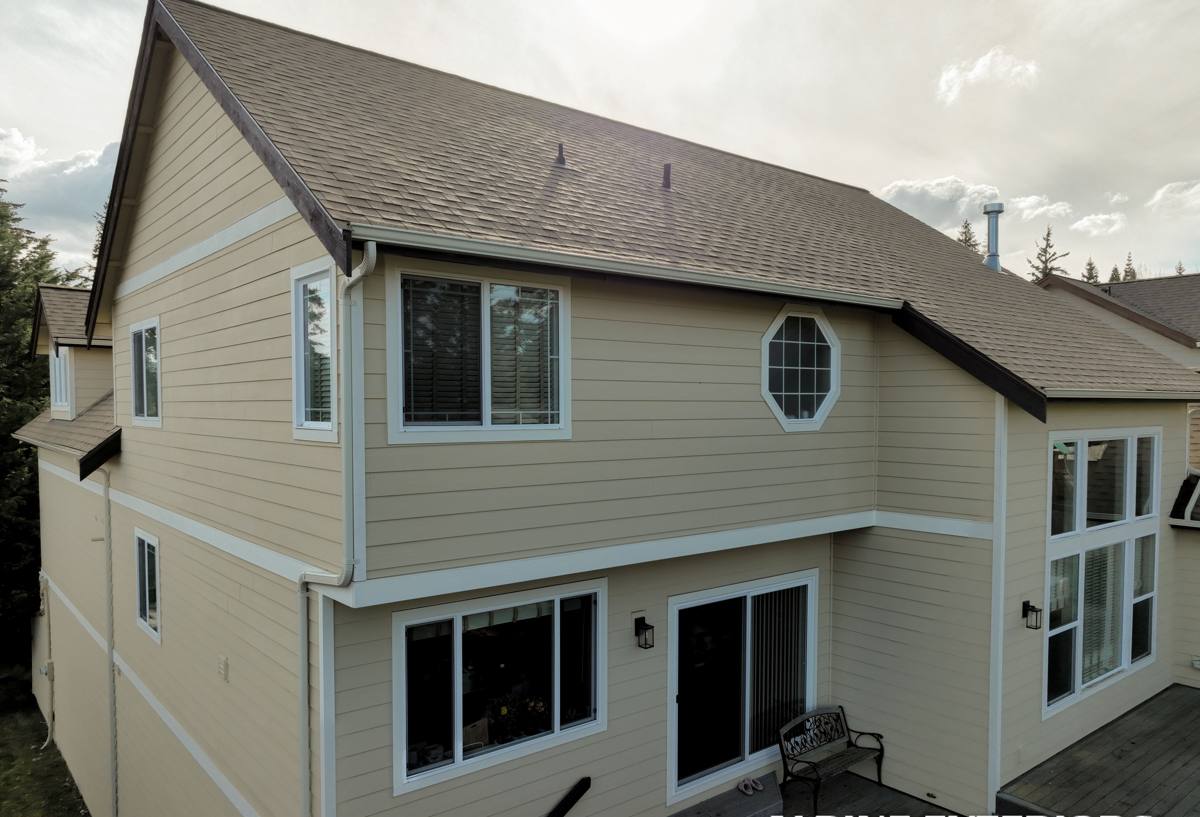
What Salt Air, Rain, and Moss Actually Do to Siding
Salt air
Airborne salt is mildly corrosive and hygroscopic — it pulls moisture out of the air and holds it against whatever surface it lands on. Over years, that means faster breakdown of paint and caulk films, accelerated corrosion on exposed nail heads and metal trim, and a chalky residue that can mask early cracking until it's already widespread. Homes closer to the water take this harder than homes a mile or two inland, but Blaine as a whole gets more of it than most Whatcom County communities.
Driving rain
Wind-driven rain doesn't just run down a wall — it gets pushed sideways and upward into laps, seams, and butt joints that were only ever designed to shed water moving straight down. Any siding with an open seam, a failed caulk joint, or a lap that's lost its proper overlap becomes a direct path for water intrusion during a storm, even if the same seam looks fine on a calm, dry day.
Long moss season
Whatcom County's wet season stretches long, and shaded north- and west-facing walls in Blaine can stay damp for months at a stretch. Moss and algae need exactly that — sustained moisture and low sun exposure. Once established, moss holds water against the siding surface far longer than open air would, which keeps the substrate wet and accelerates rot in any wood-based product and finish breakdown in almost anything else.
Signs a Blaine Home Needs Siding Repair
- Soft or spongy spots when you press on the siding, especially near the bottom courses or below windows
- Visible cracking, bubbling, or peeling paint that keeps coming back in the same spot after repainting
- Dark staining or streaking that isn't just surface dirt and doesn't wash off
- Gaps opening up at butt joints, corners, or where siding meets trim, window casings, or the foundation
- Moss or algae buildup that's thick enough to hold visible moisture against the wall
- Nail heads that are rusting, popping out, or leaving rust streaks below them
- Any musty smell or visible staining on interior walls that back up to exterior siding
- Warping, buckling, or panels that no longer sit flat against the wall
Any one of these can be minor. Several at once, especially clustered on a shaded or water-facing wall, usually means moisture has been getting behind the siding for a while.
What a Correct Siding Repair Involves
A repair that only addresses what's visible from the street is not a repair — it's a delay. Here's what we consider non-negotiable on every siding repair we do in Blaine:
Find out why it failed first
Before any siding comes off or goes back on, we want to know why that section failed. Was it a caulk joint that gave out? A flashing detail that was never installed correctly? A trim gap that let wind-driven rain in? Repairing the siding without fixing the underlying cause just buys a few more years before the same spot fails again.
Check what's behind the siding
Once siding is off, we look at the water-resistive barrier and any framing underneath. If the sheathing or framing is wet or has started to rot, that has to be addressed before new siding goes back on — patching over damaged sheathing is how small repairs turn into much bigger problems two or three years later.
Match the material correctly
Patch repairs only look and perform right if the new material matches the existing siding in profile, exposure, and finish. Mismatched repairs are one of the most common cosmetic complaints we hear about work done by crews that don't specialize in this.
Detail the flashing and joints properly
Every seam, corner, and penetration needs to be flashed and sealed to shed water outward and downward, not trap it. This is the step that's easiest to shortcut and the one that determines whether a repair lasts five years or fifteen.
Use exterior-grade sealants rated for the exposure
Caulk quality matters more here than in drier inland climates. A low-grade sealant that's fine in eastern Washington can fail within a couple of seasons against Blaine's combination of salt air and sustained moisture.
Common Siding Materials We Find on Blaine Homes
Blaine's housing stock includes a mix of older wood-clad homes, vinyl-sided homes from various remodel eras, and a growing number of fiber cement installations. Each behaves differently once water gets behind it, which changes what a real repair looks like.
| Material | How it typically fails here | Repair reality |
|---|---|---|
| Cedar or primed wood | Absorbs moisture, rots from the back, moss and algae take hold quickly in shaded areas | Rotted sections must be fully cut out; repainting alone doesn't stop trapped moisture |
| Vinyl | Cracks in cold snaps, warps near heat sources, seams open under wind-driven rain | Discontinued colors and profiles make seamless patch repairs difficult |
| LP SmartSide / OSB-based products | Edge and seam swelling once moisture gets in, especially at cut ends and butt joints | Swollen sections generally need full panel replacement, not spot patching |
| James Hardie fiber cement | Failures are almost always installation-detail issues (flashing, caulk, fastening), not the material itself | Repairs hold their match well over time since the ColorPlus finish is factory-baked and consistent |
We're a James Hardie-only installer, which means when we repair non-Hardie siding we're doing our best with the material that's there, matching it as closely as we can. When a wall section has failed repeatedly or the damage is extensive enough that full-wall or full-home replacement makes more sense than another round of patching, we recommend James Hardie fiber cement — it's what we stand behind, and it's built for exactly the salt air, driving rain, and moss exposure Blaine deals with.
Repair or Replace: How We Help You Decide
| Factor | Leans toward repair | Leans toward replacement |
|---|---|---|
| Extent of damage | Isolated to one or two wall sections | Recurring failures across multiple walls or elevations |
| Underlying structure | Sheathing and framing are dry and sound | Rot has spread into sheathing or framing |
| Age of existing siding | Siding is mid-life and otherwise performing well | Siding is near or past its expected service life |
| Repair history | First repair needed in this area | Same spot has already been patched once or twice before |
| Material match | Matching material is readily available | Discontinued color, profile, or product line |
We'll always tell you honestly which side of that table your situation falls on. A lot of jobs really are a straightforward repair, and we'd rather do the right-sized job and earn the next call than talk you into more than you need.
Our Repair Process
- On-site inspection of the affected area and a check of nearby walls for related issues, since siding problems in Blaine rarely stay isolated once moisture is involved
- Moisture check behind the siding where damage suggests water intrusion, not just a visual look
- A straight explanation of what we found, what caused it, and whether repair or a larger scope makes sense
- A written estimate before any work starts, with the scope spelled out
- Repair work done to match existing material where reasonable, with proper flashing and sealant detailing at every seam we touch
- A final walk-through so you can see exactly what was done and why
Why Hiring a Crew That Already Works Blaine Matters
Siding repair is a small-margin-for-error trade, and the margin gets smaller in a coastal, high-moisture climate like this one. A crew that works Blaine regularly already knows which elevations take the worst of the wind-driven rain, how fast moss reestablishes on shaded walls here, and which older repair techniques simply don't hold up against sustained salt exposure. That local pattern recognition is the difference between a repair that's still solid in ten years and one that's back on the schedule in eighteen months.
It also means we're not guessing at code requirements, permitting norms, or what Whatcom County's coastal exposure actually demands from flashing and sealant details — we're applying what we've already seen work, and not work, on homes like yours.
Maintenance That Extends a Repair's Life
- Rinse salt residue and grime off exterior walls once or twice a year, especially on water-facing elevations
- Keep gutters clear so overflow doesn't run down the siding face during heavy rain
- Trim back vegetation and tree cover that keeps a wall shaded and damp longer than it needs to be
- Address moss and algae growth early, before it thickens and holds moisture against the surface
- Walk the exterior once a year and press-test any spot that looks discolored or soft
- Re-caulk joints proactively if you notice cracking, rather than waiting for water to get behind them
None of this prevents every problem, but it buys meaningful time between repairs and helps catch small issues before they become sheathing or framing damage.
Get an Honest Look at Your Siding
If you're seeing soft spots, staining, cracked caulk, or moss buildup on your Blaine home, it's worth having someone look at it before another wet season sets in. We'll tell you plainly whether you're looking at a straightforward repair or something bigger, and why. Reach out for a free, no-pressure estimate — there's a form right below.