 Ferndale Siding
 Semiahmoo's Marine Climate and What It Does to Siding
Homes along the Semiahmoo waterfront near Blaine sit right at the edge of Semiahmoo Bay, and that location comes with a specific set of conditions that inland Whatcom County homes simply don't deal with the same way. Salt-laden air moves off the water and settles on every exterior surface, wind-driven rain hits siding at an angle instead of falling straight down, and the shaded, damp stretches of the year — which in this part of Washington run long — give moss and algae plenty of time to take hold. None of this is dramatic on any given day. It's cumulative. A siding system that would hold up fine forty minutes inland can start showing real wear here years earlier, simply because it's fighting salt, moisture, and shade at the same time, every day, for years.
Salt air is corrosive to metal fasteners and trim, driving rain finds every gap in a poorly flashed installation, and moss holds moisture against the siding surface longer than open, sunny conditions would. Any siding replacement done on a Semiahmoo home needs to be planned around these three things specifically — not installed the same way a contractor would approach a job in a drier, more sheltered part of the county.
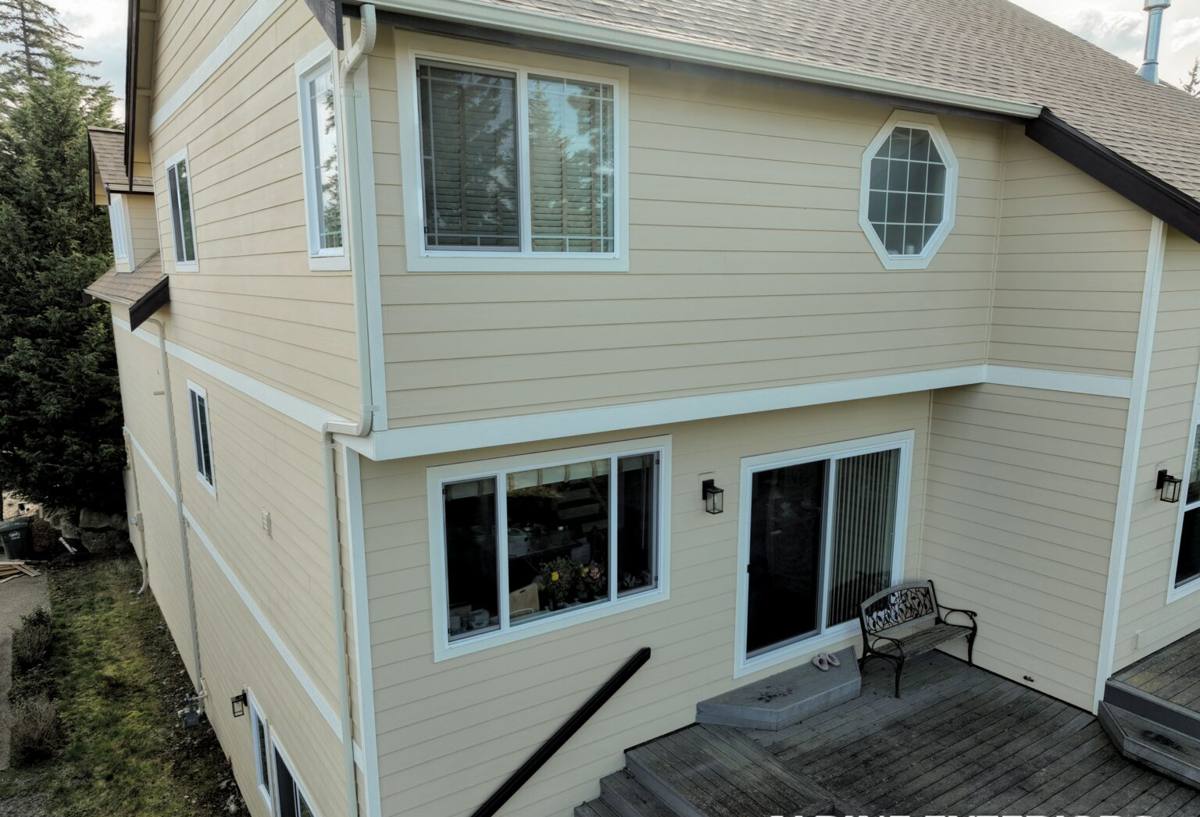
Signs Your Semiahmoo Home Is Due for Replacement, Not Just Repair
Coastal siding failure is often quieter than people expect. It doesn't always show up as an obvious crack or a missing panel — it shows up as soft spots, discoloration, and small details that add up to a bigger moisture problem underneath.
What to check for
- Soft or spongy spots when you press on siding, especially near the bottom courses and around windows
- Rust streaking below nail heads or trim fasteners — a direct sign of corrosion from salt exposure
- Persistent moss or dark algae staining that returns within a season or two of cleaning
- Bubbling, peeling, or chalky paint that keeps failing no matter how often it's repainted
- Visible warping, cupping, or separation at panel seams and butt joints
- Musty smell or visible staining on interior walls that back up to exterior siding
Any one of these on its own might be a repair. Several of them together, especially on a home that's original to its construction or has vinyl or untreated wood siding, usually means the underlying weather barrier and sheathing have already been absorbing moisture for a while. At that point, patching the visible siding just covers up a problem that's still active underneath.
Moisture damage isn't always cosmetic
The real risk in a marine climate like Semiahmoo's isn't the siding itself failing — it's what happens to the wall assembly behind it once water gets past a compromised surface. Sheathing that stays damp for extended periods can rot, lose structural value, and become a mold source long before any of that is visible from the outside. That's why a proper siding replacement always starts with an honest look at what's behind the old siding, not just what's replacing it.
Why Coastal Conditions Change How the Job Should Be Done
Fastener and hardware selection
Standard fasteners corrode faster in salt air. On a Semiahmoo project, the fasteners, flashing, and trim hardware need to be rated for coastal or marine exposure — otherwise you end up with rust streaking and weakened attachment points well before the siding material itself is due for replacement.
Drainage and rain-screen detailing
Wind-driven rain off the bay doesn't behave like a straight downpour. It gets pushed sideways and upward under eaves and around window and door openings. That means flashing details, kick-out flashing at rooflines, and the drainage gap behind the siding matter more here than they would on a sheltered, inland lot. A correctly built drainage plane gives any water that does get past the siding surface a way out instead of a place to sit.
Caulk and sealant choices
Not every exterior sealant holds up to constant salt and UV exposure at a waterfront property. Sealants used at butt joints, trim, and penetrations need to be rated for the kind of sustained coastal weathering Semiahmoo homes see, not just general-purpose exterior use.
What a Correct Siding Replacement Involves, Start to Finish
A siding replacement is only as good as what happens before the new siding ever goes up. On a coastal property, skipping steps here is where premature failure starts.
Tear-off and inspection
Removing the old siding is also the only real chance to see the condition of the sheathing, framing, and existing weather barrier. Any soft, rotted, or delaminated sheathing needs to be replaced before new siding goes on — covering it up just hides the problem for the next owner to find.
Weather-resistive barrier and flashing
A new, continuous weather-resistive barrier gets installed with properly lapped and sealed seams, and flashing gets integrated at every window, door, and roofline transition. This is the layer doing the real waterproofing work — the siding on top of it is the first line of defense, not the only one.
Installation to manufacturer specification
Fiber cement siding has specific nailing patterns, gap and clearance requirements, and fastener depth tolerances. Installed off-spec, it can still look fine on day one and still fail early — through cracking at fastener points, moisture intrusion at seams, or warranty coverage that no longer applies. Correct installation isn't a finishing touch; it's the difference between siding that lasts and siding that doesn't.
Why We Install Only James Hardie Fiber Cement Here
We standardized on James Hardie fiber cement siding for every home we work on, including Semiahmoo waterfront properties, and we don't install vinyl, LP SmartSide, primed spruce, cedar, or other fiber cement brands. That's not a marketing position — it's a practical one, based on what actually holds up in this specific climate.
Fiber cement is non-combustible, dimensionally stable, and doesn't absorb and release moisture the way wood-based products do, which matters directly in a climate with this much sustained dampness. James Hardie's HZ5 product line is engineered specifically for climate zones with higher moisture exposure, including the Pacific Northwest, and the ColorPlus finish is a factory-applied, baked-on finish rather than a field-applied paint job — which matters a great deal in an environment where paint failure from salt exposure is a real, recurring problem. Hardie also backs its siding with a strong, transferable limited warranty, which carries real value on a coastal property where buyers and inspectors alike tend to ask pointed questions about exterior condition.
None of this means other products are unusable everywhere. It means that for the specific combination of salt air, driving rain, and moss exposure that Semiahmoo homes deal with year-round, we've concluded fiber cement engineered for this climate is the material that holds up with the least maintenance burden and the fewest surprises down the road.
Comparing Siding Materials in a Salt-Air, High-Moss Climate
| Material | Salt air / moisture resistance | Maintenance | Typical lifespan |
|---|---|---|---|
| James Hardie fiber cement | Engineered for moisture exposure; non-combustible; factory finish | Low — occasional wash, no repainting for many years | Decades, with strong transferable warranty |
| Vinyl siding | Doesn't rot, but can warp, fade, and crack under sustained wind and UV exposure | Low, but seams and panels can trap moisture behind them | Variable; often shorter effective life in harsh coastal exposure |
| Cedar / untreated wood | Absorbs moisture; prone to rot and moss growth in shaded, damp conditions | High — regular sealing, staining, and moss treatment needed | Shorter without consistent upkeep |
| LP SmartSide (engineered wood) | Improved over raw wood, but still wood-based and sensitive to sustained moisture at cut edges and seams | Moderate — edge sealing and finish maintenance matter | Depends heavily on installation quality and upkeep |
The pattern across this table is consistent: wood-based products need more ongoing attention to perform in a climate like this one, and that maintenance burden tends to show up fastest exactly where Semiahmoo homes are most exposed — low walls, shaded north sides, and areas that catch wind-driven rain directly off the bay.
Cost Factors for Siding Replacement in Semiahmoo
Every project is different, but the same handful of factors drive most of the cost variation we see on coastal siding replacements in this area:
- Amount of hidden sheathing repair — this often isn't known until tear-off, and it's the single biggest source of cost variation
- Home size and complexity — dormers, multiple gables, and detailed trim work add labor time
- Existing siding removal — some materials come off faster and cleaner than others
- Siding profile and trim selection — lap width, trim details, and accessory pieces affect material cost
- Accessibility of the home — waterfront lots with steep grades or limited staging area can add time
We give a broad range on the phone, but an accurate number only comes from a walk-around of the actual house — sight unseen estimates on a coastal home are guesses, not quotes.
Our Process, From Estimate to Final Walkthrough
- On-site assessment — we walk the exterior, check for soft spots and existing moisture damage, and talk through what we're seeing with you directly
- Written estimate — a clear scope of work and cost, with sheathing repair called out as a contingency if we can't fully assess it until tear-off
- Tear-off and sheathing inspection — old siding comes off, damaged sheathing gets identified and replaced
- Weather barrier and flashing installation — the waterproofing layer goes in correctly before any new siding is hung
- Hardie siding installation — installed to manufacturer specification, including fastener type and spacing appropriate for coastal exposure
- Final walkthrough — we go over the finished work with you before calling the job complete
Why a Crew That Already Works This Coastline Matters
Siding installation isn't identical from one part of Whatcom County to another, even though the county code and permitting process are the same. A crew that regularly works waterfront properties near Semiahmoo and Blaine already knows to spec coastal-rated fasteners without being asked, already builds in extra attention to flashing at wind-exposed corners, and already recognizes what early-stage moss and moisture damage looks like on this type of exposure before it becomes a bigger problem. That familiarity shows up in fewer surprises during tear-off and a finished job that's built for the conditions it actually has to survive, not just a generic installation standard.
It also matters after the job is done. A local crew is who you call if a question comes up two years down the road, not a name from out of the area you have to track down. For a coastal property where exterior conditions get tested constantly, that kind of ongoing accountability is worth as much as the installation itself.
If your Semiahmoo home is showing signs of wear, or you just want an honest read on where your siding actually stands, we're happy to take a look. Reach out for a free, no-pressure estimate — there's a form right below to get started.