 Ferndale Siding
 Siding Replacement Built for Birch Bay's Waterfront Exposure
Birch Bay sits directly on the water in northern Whatcom County, and that location changes what a siding job actually needs to hold up. Homes here take salt-laden air off the bay almost daily, driving rain that comes in sideways during fall and winter storms, and a moss season that can run most of the year on shaded or north-facing walls. Siding that would be perfectly adequate a few miles inland can start showing real problems out here in a fraction of the time. When a Birch Bay home needs a full re-side rather than a patch job, the material choice and the installation detail both matter more than they would almost anywhere else in the county.
We install James Hardie fiber cement siding exclusively, and on a full replacement project that decision carries more weight than it does on a small repair. A whole-house re-side is the one chance to get the material, the flashing, and the drainage details right for another 25-plus years — which is exactly why we treat every step of the process, not just the finished appearance, as the actual job.
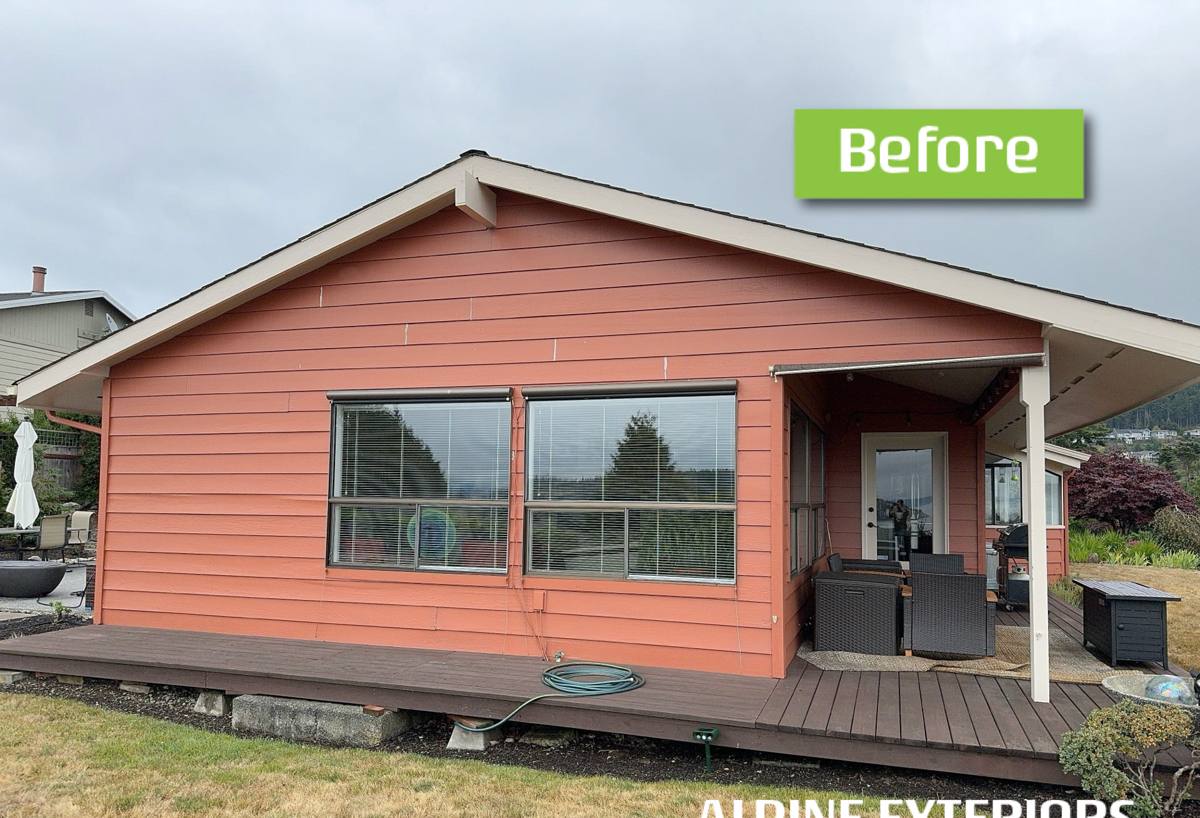
How the Birch Bay Climate Wears Down Siding
Salt Air and Fastener Corrosion
Direct exposure to salt-laden marine air accelerates corrosion in ways that inland Whatcom County homes rarely deal with. Nails, staples, flashing, and trim hardware that would last decades in a drier climate can start failing years earlier out here, and once a fastener corrodes, the siding it's holding loses its grip on the wall. Replacement siding on a bay-facing home needs fastener and hardware specs chosen for that corrosion risk from the start, not upgraded later after something fails.
Driving Rain, Not Just Rainfall
Waterfront wind means rain rarely falls straight down here — it gets pushed sideways into walls, seams, and window trim. That matters for replacement siding because a lot of siding damage isn't a leaking roof problem, it's water finding its way in horizontally at a butt joint, a corner, or a poorly lapped seam. Old siding on a Birch Bay home often shows its worst damage at exactly those horizontal entry points, and a replacement job needs to detail every one of them differently than a sheltered inland property would.
A Moss and Mildew Season That Runs Long
Mild temperatures, shade, and near-constant moisture add up to organic growth that shows up on shaded walls for much of the year in this part of the county. Moss and mildew are more than cosmetic — sustained growth holds moisture directly against the siding surface, and on an older or lower-grade product that constant dampness is often what finally pushes a wall from "needs cleaning" to "needs replacing."
Signs a Birch Bay Home Needs Full Replacement, Not Repair
Not every siding problem calls for tearing the whole wall off. But on a waterfront property, a few signs usually mean the underlying material or the original installation has failed broadly enough that patching won't hold.
- Soft, spongy spots when you press on the siding, especially near the bottom courses or around window trim
- Persistent staining, bubbling, or peeling that keeps coming back after cleaning
- Visible warping, cupping, or separation at seams across multiple sections of wall, not just one isolated spot
- Siding that's original to a home built more than 20 to 25 years ago, particularly if it's not fiber cement
- Rising energy bills with no other clear cause, which can point to a wall assembly that's no longer sealing properly
- Interior signs — musty smell, discoloration on interior walls near exterior corners — that suggest moisture has been tracking behind the siding for a while
If the damage is limited to one section — storm impact, a single failed board, isolated trim rot around one window — a targeted repair and matched-in Hardie section is often the right call. We'll tell you honestly which situation you're looking at rather than defaulting to the bigger job.
Why James Hardie for a Full Re-Side Here
We used to install a wider range of siding products before narrowing to one system. That change came from what we kept seeing on tear-offs in exactly this kind of coastal, wet climate — not from a supplier relationship. On a full replacement, where the whole exterior is being redone at once, the case for fiber cement is strongest.
- Non-combustible core: Fiber cement doesn't feed a fire the way wood-based siding can, which matters for household safety and can matter for insurance underwriting.
- Factory-applied ColorPlus finish: Color baked on under controlled factory conditions holds up against fading and chalking far longer than site-applied paint, which matters on a wall that's going to see salt air and direct sun for decades.
- Climate-engineered HZ product lines: Hardie's HZ5 formulation is built for regions with heavy moisture exposure and freeze-thaw cycling — a real match for a bay-facing property.
- Dimensional stability: Fiber cement doesn't swell, warp, or cup the way engineered wood siding can after repeated wet-season moisture cycles.
- Strong transferable warranty: Hardie backs the product with a solid warranty structure when installed to spec, which is real protection on a full-home investment rather than a marketing line.
We don't install LP SmartSide, vinyl siding, Cemplank, Allura, primed spruce, or cedar. Each has a place in the broader market, and plenty of homeowners elsewhere are satisfied with them. But on a full re-side facing this kind of salt and wind exposure, we've made a professional call: one system we trust completely, installed correctly, is worth more than a cheaper option that quietly shifts maintenance risk back onto the homeowner within a decade.
Matching the Hardie Product to a Birch Bay Home
| Product Line | Best Use | Why It Fits This Location |
|---|---|---|
| HardiePlank lap siding | Most single-family homes, full re-sides | Traditional lap profile sheds wind-driven rain effectively with correct overlap and flashing |
| HardiePanel vertical siding | Accent walls, gables, modern coastal designs | Clean lines that pair well with the contemporary and craftsman styles common near the water |
| HardieShingle siding | Craftsman-style homes, accent sections | A textured look without the moisture absorption and upkeep of real wood shingle |
| HardieTrim boards | Corners, window and door casing, fascia | Factory-finished trim resists the same salt and moisture exposure as the field siding |
What a Correct Replacement Job Actually Involves
Full Tear-Off and Substrate Inspection
On a waterfront home, we don't recommend siding over existing material. Tear-off is what lets us see what's actually happened to the sheathing and framing underneath — and on an older Birch Bay home, that's often where the real story is. Trapped moisture behind failing siding can rot sheathing quietly for years without showing obvious signs from the outside. Any soft or damaged substrate gets repaired before a single new panel goes up, because new siding installed over compromised sheathing just hides the problem instead of fixing it.
House Wrap and Drainage Detailing
A weather-resistant barrier and, where called for, a drainage plane behind the siding give the wall assembly a way to shed any moisture that does get past the outer layer — which matters more here than in a sheltered inland location. This is the layer that does the real work; caulk and trim are the last line of defense, not the first.
Fastening and Flashing to Coastal Spec
Fastener type, spacing, and corrosion resistance all get specified for salt air exposure, not a generic inland standard. Flashing at every window, door, and roof-to-wall transition gets lapped correctly so water sheds down and out rather than getting trapped behind the new siding — the single most common failure point we see on siding replacements that don't hold up.
Trim, Joints, and Finish Work
Joints are lapped and properly sealed rather than simply butted together, corners get factory-finished trim instead of field-cut lumber, and the finished wall gets a final inspection against Hardie's installation spec before we consider the job done. On a full re-side, this is where a rushed crew starts cutting corners that won't show up as problems until the first hard winter storm.
Cost Factors for a Birch Bay Siding Replacement
| Factor | What It Affects | Why It Matters Here |
|---|---|---|
| Substrate condition under old siding | Repair costs before new siding goes on | Long-term trapped moisture from wind-driven rain can rot sheathing and framing on older bay-facing walls |
| Home size and wall complexity | Material and labor volume | More corners, gables, and transitions mean more flashing detail work, which takes longer to do right |
| Fastener and hardware grade | Material cost, long-term corrosion resistance | Salt air calls for corrosion-rated fasteners rather than standard-grade hardware |
| Trim and accent choices | Material selection and finish labor | Factory-finished HardieTrim adds upfront cost but avoids the maintenance burden of field-finished wood |
| Site access | Labor time and staging | Waterfront lots can have tighter access, slope, or setback considerations that affect scaffolding and material staging |
Exact pricing depends on the specific property and what tear-off reveals underneath, which is why we walk the home in person before giving a real number rather than quoting off a generic price sheet.
Why a Local, Water-Experienced Crew Matters
A crew that works Birch Bay regularly already knows how salt exposure, wind-driven rain, and a long moss season behave on real homes here over a full year — not just how a product performs on a spec sheet. That experience shows up in specific decisions: which wall faces need the most attention to flashing, where corrosion-resistant hardware is worth the added cost, and how much drainage detailing a given property's exposure actually calls for. Birch Bay's direct waterfront setting puts more demand on a siding system than most of the rest of Whatcom County, and a crew with hands-on local experience treats that difference seriously instead of applying a one-size-fits-all approach built for a calmer, drier lot.
Siding Replacement Readiness Checklist
- Walls checked for soft spots, staining, or gaps at seams and corners across the whole exterior
- Trim and flashing around every window and door inspected for cracking, rust, or separation
- North-facing and shaded walls checked for moss, mildew, or persistent dark staining
- Grade clearance confirmed so new siding won't sit too close to wet ground
- Interior walls near exterior corners checked for signs of long-term moisture intrusion
- Current siding age and material confirmed against manufacturer service-life expectations
Our Process for a Full Re-Side
We start with an on-site walk of the exterior to assess the current siding's condition and figure out honestly whether the home needs full replacement or a targeted repair. If it's a full re-side, we put together a clear written scope covering material, trim selection, and timeline before any tear-off begins. Once work starts, substrate inspection, house wrap, flashing, and fastening all get handled to coastal spec as standard practice — not as optional upgrades quoted separately. We walk the finished job with the homeowner before calling it done.
If your Birch Bay home's siding is showing its age or you're not sure whether you're looking at a repair or a full replacement, we're glad to take a look and give you an honest read. Reach out using the form below to schedule a free, no-pressure estimate.