 Ferndale Siding
 Siding Repair in Sumas: What Whatcom County Weather Does to a Home's Exterior
Homes in and around Sumas take a steady beating from weather that never really lets up. Moisture-laden systems roll in off the Salish Sea for months at a time, driving rain sideways into wall assemblies that were never designed to take it head-on. Shaded lots, tree cover, and the long stretch of gray, damp weather that defines a Whatcom County fall through spring give moss and algae exactly the conditions they need to take hold on siding, trim, and fascia. Add in the freeze-thaw swings that show up most winters, and small cracks or gaps in siding don't stay small for long — they become entry points for water that works its way behind the cladding and into the wall itself.
That's the core problem with siding damage in this climate: it's rarely just cosmetic. A cracked board, a popped fastener, or a gap where trim meets siding is an invitation for moisture to get behind the water-resistive barrier. Once that happens, the damage keeps compounding quietly — sheathing, framing, and insulation can be soaking up water for months before it ever shows up as a stain or soft spot on the surface. Siding repair done right in Sumas isn't about patching what's visible; it's about stopping water intrusion before it turns a $400 repair into a $4,000 one.
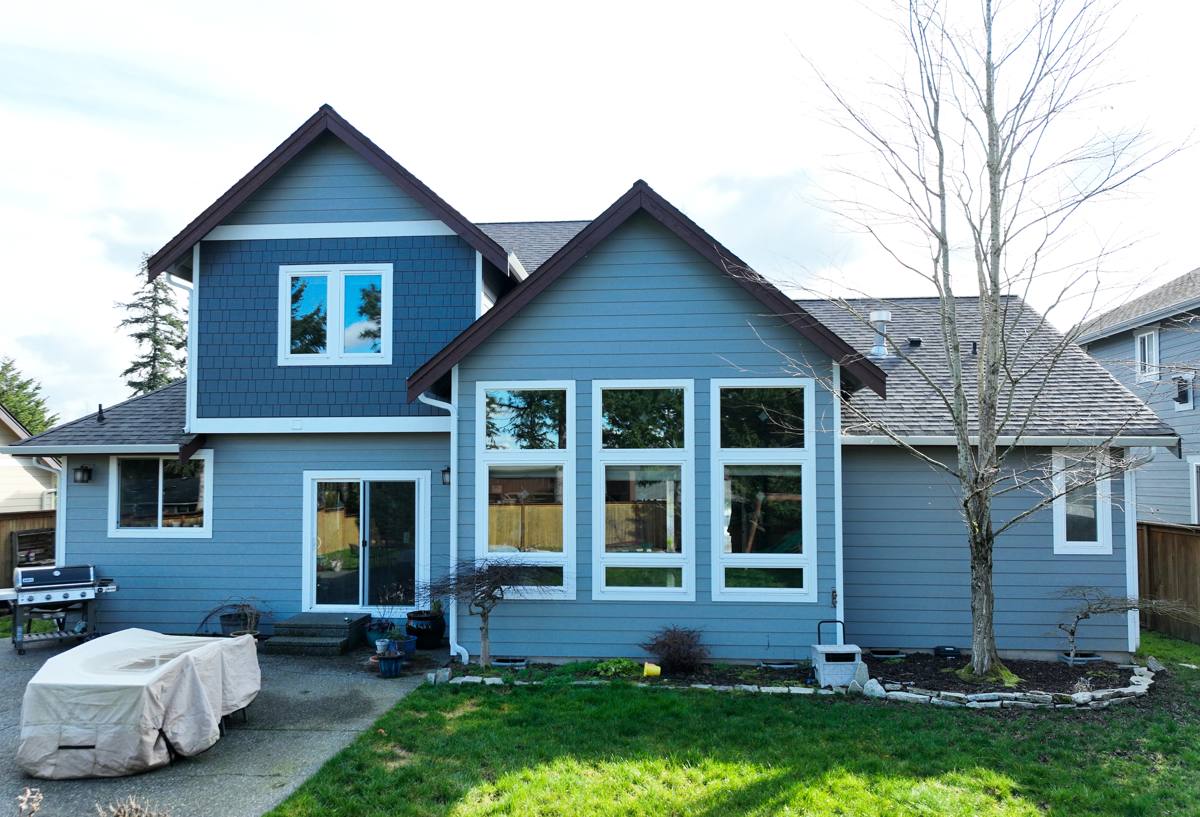
Signs Your Sumas Home Needs Siding Repair
Most siding problems announce themselves quietly before they become expensive. Walk your exterior a couple of times a year — especially after a stretch of hard rain — and look for:
- Soft, spongy, or bubbling spots when you press on the siding
- Paint that's peeling, blistering, or cracking in a way that's isolated to one section
- Dark streaking, staining, or a musty smell near an exterior wall on the inside of the house
- Visible gaps or separation where siding meets window trim, corner boards, or the foundation
- Persistent moss, algae, or black mold growth that keeps coming back after cleaning
- Cracked, warped, or bowing boards, particularly on north-facing or shaded walls
- Siding that's pulling away from the wall or fasteners that have backed out or rusted through
- Insect activity — carpenter ants especially — around siding edges and low corners
Any one of these on its own might be minor. Several together, or any sign paired with softness underneath, usually means water has already gotten past the surface.
Why Waiting Costs More Here Than Elsewhere
In a drier climate, a small crack might sit for a season without doing real harm. In Whatcom County, with rainfall spread across most months of the year and moss season running long, that same crack has far more opportunities to let water in before you ever get around to fixing it. We see this pattern often: homeowners who put off a small repair for a year or two end up dealing with rotted sheathing that a simple patch could have prevented.
What a Correct Siding Repair Actually Involves
A repair that just covers up damage without addressing what caused it isn't a repair — it's a delay. Done properly, siding repair involves several steps most homeowners never see:
Diagnosis Before Demolition
Before anything is removed, we look at the pattern of damage and ask why it happened there. Is it a flashing failure above a window? A caulk joint that failed at a butt seam? Splashback from a downspout dumping water against the wall? Fixing the siding without fixing the cause just guarantees the same repair again in a few years.
Checking What's Behind the Siding
Once the damaged section is removed, we check the housewrap or building paper, the flashing details, and the sheathing underneath for soft spots or rot. If water has gotten into the wall assembly, that gets addressed before any new siding goes back on — closing up a wall over hidden rot is one of the most common mistakes in low-quality repair work.
Matching Material and Finish
Replacement siding needs to match the existing product in profile, exposure, and color — not just be "close enough." A mismatched patch is easy to spot from the street and can also create a seam where water collects.
Repair, Patch, or Replace? Weighing the Options
Not every damaged section needs a full re-side, but not every problem is a quick patch either. Here's how we generally think through it:
| Situation | What's Involved | Typical Timeframe | When It Makes Sense |
|---|---|---|---|
| Spot repair | Removing and replacing a few damaged boards or a small section, resealing joints and trim | Same day to a couple of days | Isolated damage, sound sheathing underneath, siding elsewhere still in good shape |
| Section replacement | Re-siding one wall or elevation, often where sun and weather exposure differ from the rest of the house | A few days | Damage concentrated on one side of the house, or older material that's failing faster there |
| Full re-side | Removing all existing siding, addressing any wall damage, installing new siding house-wide | One to two weeks, weather dependent | Widespread failure, siding at or past its service life, or repeated repair costs adding up |
We'll always tell you honestly which category your home falls into rather than upselling a full re-side when a targeted repair will hold up fine.
Why We Repair With James Hardie Fiber Cement — Not Vinyl, LP, or Cedar Patches
We install and repair exclusively with James Hardie fiber cement siding. We don't carry vinyl, LP SmartSide, Cemplank, Allura, or wood siding, and that's a deliberate standard, not an oversight. When a house is already sided in one of those products and needs a repair, patching it with more of the same material is sometimes the practical short-term answer — but it's worth understanding the trade-offs:
- Vinyl is inexpensive to patch but expands and contracts with temperature, which can leave repaired sections looking slightly different or fitting loosely over time, and it offers little resistance to impact damage.
- LP SmartSide and other engineered wood products are more moisture-sensitive at cut edges and seams than fiber cement, which matters in a climate where those edges stay damp for long stretches.
- Cedar and other wood siding look great when new but require ongoing maintenance — refinishing, caulking, pest treatment — to keep moisture out, and a repaired section needs to be maintained on the same schedule as the rest.
When we do repair or replace sections on a Hardie-sided home, we can match the existing ColorPlus factory finish closely, since it's a defined product line with consistent profiles and colors rather than a one-off custom order. Fiber cement doesn't swell, rot, or attract pests the way wood-based products can, and it holds up to the driving rain and constant moisture cycling that Whatcom County throws at an exterior. When a full re-side is the right call, Hardie is what we put on the house — for the reasons above and because it's what we can stand behind with a workmanship guarantee we trust.
Our Siding Repair Process in Sumas
- Inspection and diagnosis — We look at the damaged area and the surrounding siding, checking for the underlying cause, not just the visible symptom.
- Moisture check — Where damage suggests water intrusion, we open up the section to check sheathing and framing before quoting a fix.
- Written scope and estimate — You get a clear explanation of what's being repaired, why, and what it involves — no vague line items.
- The repair itself — Damaged material removed, any wall issues addressed, new material installed with correct flashing and fastening.
- Cleanup and walkthrough — We clear debris and walk the repair with you before calling the job done.
Why It Matters to Hire a Crew That Already Works in Sumas
Siding repair in this part of Whatcom County isn't the same job as siding repair in a dry inland climate. A crew that regularly works Sumas and the surrounding Ferndale area already knows what moss buildup on a north wall usually means, how far water can travel behind siding before it shows up as a stain, and which details — flashing above windows, kick-out flashing at rooflines, clearance at grade — tend to fail first under sustained rain. That local pattern recognition is the difference between a repair that solves the problem and one that just covers it up until it reappears.
It also means faster response. A local crew isn't driving in from across the region to give an estimate or come back for a follow-up — we're already working in the area on a regular basis.
Timeline and What's Covered
Most spot and section repairs are completed in a matter of days, weather permitting — we don't install siding in the middle of a downpour, and we won't schedule a repair that leaves a wall open ahead of a heavy rain forecast. Every repair comes with our workmanship guarantee. When new Hardie material is installed as part of the repair, it also carries James Hardie's own product warranty, which is transferable if you sell the home — one more reason a mismatched patch job can end up costing more in the long run than it saves upfront.
If you're seeing any of the warning signs above on a Sumas-area home, it's worth getting eyes on it before the next stretch of rain. We offer free, no-pressure estimates — use the form below and we'll take a look and give you a straight answer on what your siding actually needs.