 Ferndale Siding
 Siding Installation in Sudden Valley
Sudden Valley sits in a setting most homeowners in Whatcom County would love to have and few contractors fully understand: a heavily wooded, lake-adjacent community where tree canopy, shade, and moisture combine to create conditions that are harder on exterior siding than most people realize. Add in the driving rain and long moss season that define this part of Washington, and you have a climate that rewards correct siding installation and punishes shortcuts. We install James Hardie fiber cement siding exclusively, and we've done work throughout Whatcom County long enough to know what actually holds up out here versus what looks fine for a season or two before the problems start.
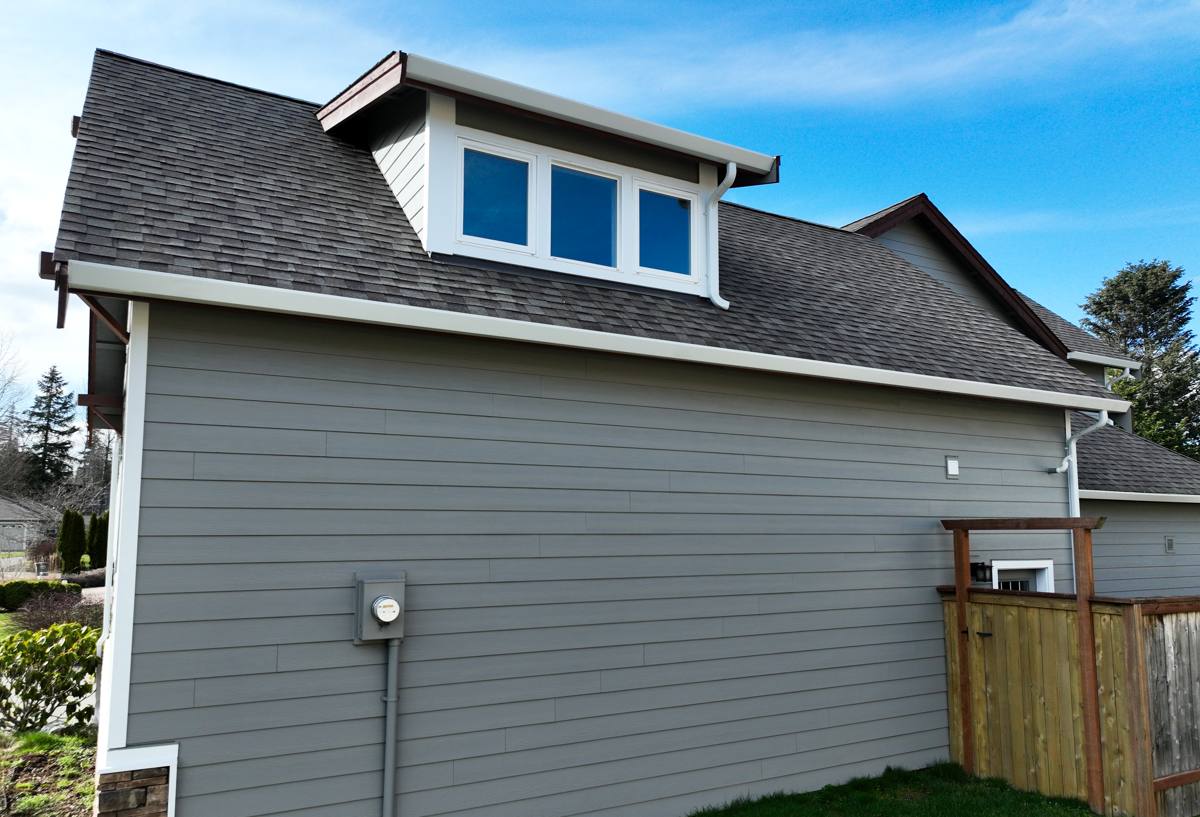
What Sudden Valley's Climate Actually Does to Siding
Every siding page on every contractor's website mentions "the Pacific Northwest is wet." That's true but not specific enough to be useful. Here's what actually matters for a home in Sudden Valley:
Shade and Moisture Retention
Mature tree cover around Lake Whatcom is one of the best things about living in Sudden Valley — and one of the toughest things on exterior materials. Shaded walls dry far slower after rain than walls in full sun. Siding on the north side of a home, or tucked under overhanging fir and cedar, can stay damp for days after a storm has passed everywhere else in the county. That extended dry-out time is exactly what moss, algae, and mildew need to establish themselves, and it's exactly what causes wood-based and engineered-wood siding products to swell, delaminate, or rot at the edges over time.
Driving Rain and Wind-Driven Moisture
Storms coming off the water don't just fall straight down — wind pushes rain sideways into wall assemblies, seams, and trim joints. On a home with sloppy flashing or gaps at butt joints, that driving rain finds its way behind the siding, not just onto it. Once moisture gets behind cladding in a shaded, slow-drying environment like Sudden Valley, it can sit there for a long time before anyone notices a problem.
The Regional Marine Air Factor
Whatcom County's climate is shaped by its proximity to the Salish Sea — the same marine-influenced weather pattern that brings salt-tinged air and near-constant humidity to coastal areas like Ferndale also pushes inland across the county. Sudden Valley doesn't sit on saltwater the way Ferndale does, but it shares the same humid, marine-conditioned air mass, and that humidity — combined with lake moisture and heavy shade — is what drives the long moss season here more than anything else.
Freeze-Thaw and Seasonal Swings
Sudden Valley sits at a slightly higher, more inland elevation than the immediate coast, which means it can see a few more frost mornings and a bit more temperature swing through fall and winter. Materials that absorb moisture and then freeze are prone to cracking, checking, and joint failure over repeated cycles — another reason material choice matters as much as installation quality.
What a Correct Siding Installation Involves
Siding failures in this climate are almost never about the siding brand alone — they're about the assembly behind it. A correct installation is a system, and every layer matters:
- Weather-resistive barrier: A properly lapped and sealed housewrap or building paper behind the siding, installed so water is directed out and down, not trapped against the sheathing.
- Rainscreen or drainage gap: In a shaded, slow-drying environment like Sudden Valley, a ventilated gap between the siding and the wall assembly gives moisture a path to escape instead of sitting against the wall.
- Flashing at every penetration: Windows, doors, vents, hose bibs, and any other wall penetration need proper head flashing and kickout flashing where rooflines meet walls — this is where driving rain finds its way in when it's skipped.
- Correct fastening: James Hardie siding has specific nailing patterns, fastener types, and blind-nail versus face-nail requirements depending on the product line and exposure. Getting this wrong voids warranty coverage and creates long-term problems.
- Proper joint and gap spacing: Manufacturer-specified gaps at butt joints, trim, and inside/outside corners allow for expansion and give caulking a joint that will actually hold instead of splitting open in year two.
- Factory-finished, field-caulked correctly: ColorPlus factory finish holds up far better than field-painted siding, but the caulking and touch-up at cut edges and joints still has to be done right to protect that finish long-term.
Skip any one of these steps and the siding itself — regardless of brand — becomes the least important factor in how the wall performs over the next 15 years.
Our Process for Sudden Valley Homes
We approach every Sudden Valley project the same methodical way:
- On-site assessment: We walk the home, note tree cover and shade patterns on each elevation, check existing moisture damage, and evaluate the current wall assembly before quoting anything.
- Tear-off and sheathing check: We remove old siding and inspect the sheathing underneath. Any soft, rotted, or compromised sheathing gets flagged and repaired before new siding goes on — covering damage instead of fixing it just delays the same problem.
- Weather barrier and drainage installation: A new, correctly lapped weather-resistive barrier goes on, with a drainage gap where the wall assembly and elevation call for it — particularly important on shaded, north-facing, or heavily treed walls.
- Flashing at every opening: Windows, doors, and roof-to-wall intersections get flashed to shed water outward before the siding ever goes up.
- Hardie installation to manufacturer spec: Correct fastener type, nailing pattern, joint gaps, and trim details, installed by a crew trained on James Hardie's specific requirements — not generic siding methods borrowed from other products.
- Final caulk, touch-up, and walkthrough: We seal joints and cut edges with the right sealant, touch up factory finish where needed, and walk the finished job with the homeowner.
Why a Crew That Already Works Sudden Valley Matters
Sudden Valley isn't a typical suburban subdivision, and that changes how a siding job actually gets done. Lots here are often wooded and sloped, driveways and access points aren't always straightforward for material delivery and staging, and some homes have limited clearance around the structure that affects scaffolding and material handling. A crew that's already worked in the community knows how to plan logistics before the trucks show up, rather than figuring it out on day one at the homeowner's expense.
Just as important, a crew familiar with this specific microclimate — shade patterns, moss growth rates, how long walls stay wet after a storm — makes better on-the-spot decisions about drainage details and where extra attention to flashing is worth the time. That's the kind of judgment that only comes from having done the work here before, not from a general siding checklist.
Material Comparison: Why We Only Install James Hardie
We get asked why we don't offer vinyl, LP SmartSide, or other engineered wood options. In a climate like Sudden Valley's — shaded, slow-drying, and wet for a large part of the year — the differences between materials aren't cosmetic. They show up as maintenance burden and long-term durability.
| Factor | James Hardie Fiber Cement | Engineered Wood (LP-type) | Vinyl |
|---|---|---|---|
| Moisture/rot resistance | Non-combustible, doesn't absorb and swell like wood-based products | Engineered to resist moisture but relies on intact factory coating and correct sealing at every cut | Doesn't rot, but seams and moisture behind panels can trap water against sheathing |
| Performance in shaded, slow-drying walls | Stable in prolonged damp conditions when installed correctly | More sensitive to sustained moisture exposure and edge swelling | Not moisture-absorbent, but can trap moisture behind it if drainage details are poor |
| Moss and algae resistance | Cleanable, factory finish holds color under regular washing | Coating can degrade faster under constant moss/mildew exposure | Resistant to moss itself but can look chalky or faded over time |
| Fire performance | Non-combustible material | Combustible, wood-based core | Combustible, can deform under heat |
| Installation sensitivity | Requires manufacturer-spec training; forgiving once installed correctly | Sensitive to field cuts and sealing; failures often trace to installation | Generally more forgiving to install but limited on wind and impact ratings |
| Warranty | Strong transferable manufacturer warranty backing the product | Warranty often has moisture and maintenance exclusions | Warranty coverage varies widely by product tier |
None of these other products are junk — plenty of homes around the country wear them fine. But in a climate defined by driving rain, long moss seasons, and shaded, slow-drying walls, the trade-offs stack up against them. That's why we standardized on James Hardie: it's engineered specifically for climates like this one, backed by a strong warranty, and it holds its factory finish under the conditions Sudden Valley actually sees.
Signs Your Sudden Valley Home May Need New Siding
- Persistent moss or algae growth that returns quickly after cleaning, especially on shaded walls
- Soft spots, bubbling, or visible swelling at panel edges or seams
- Paint that's peeling or bubbling in a pattern that follows shaded or north-facing walls
- Visible gaps opening at trim joints or corners
- Rising energy bills that suggest air or moisture infiltration through the wall assembly
- Siding that's more than 20-25 years old, especially wood-based or older composite products
- Any known history of moisture intrusion, staining, or repairs at window and door flashing
What to Expect on Cost
Siding installation cost depends on the size of the home, the number of stories, roofline complexity, how much of the existing wall assembly needs repair before new siding goes on, and the Hardie product line and trim details chosen. Homes with more elevations exposed to shade and slow drying sometimes warrant extra drainage detailing, which adds labor but pays off in fewer moisture problems down the line. We don't quote a number without seeing the home — anyone who does hasn't accounted for what's actually behind your walls.
Ready for an Estimate?
If your Sudden Valley home is showing moss buildup, soft or swelling siding, or you're just planning ahead for a wall assembly that can handle this lake-adjacent, shaded climate for the long haul, we're glad to take a look. Fill out the form below for a free, no-pressure estimate — we'll walk the exterior, tell you honestly what we see, and explain what a correct James Hardie installation would involve for your specific home.