 Ferndale Siding
 Marietta's Location Makes Siding Choice and Installation Quality Matter More
Marietta sits close enough to the water that homes here take a different kind of weathering than siding a few miles inland in Ferndale proper. Salt-laden air off Bellingham Bay works on fasteners, trim, and paint film in ways dry-side siding never has to deal with. Add Whatcom County's long wet season — months of driving rain pushed sideways by wind off the water — and a moss and algae season that can run from fall through spring on shaded north and west walls, and you have a climate that finds every weak point in a siding system within a few years, not a few decades.
None of this means Marietta homes need anything exotic. It means the installation has to get the ordinary things right: drainage behind the cladding, flashing at every penetration, fastener spacing and type, and a finish that can shed salt and moisture without chalking or peeling. Most siding failures we get called out to inspect in this area aren't material failures — they're installation shortcuts that the local climate exposed faster than it would somewhere drier.
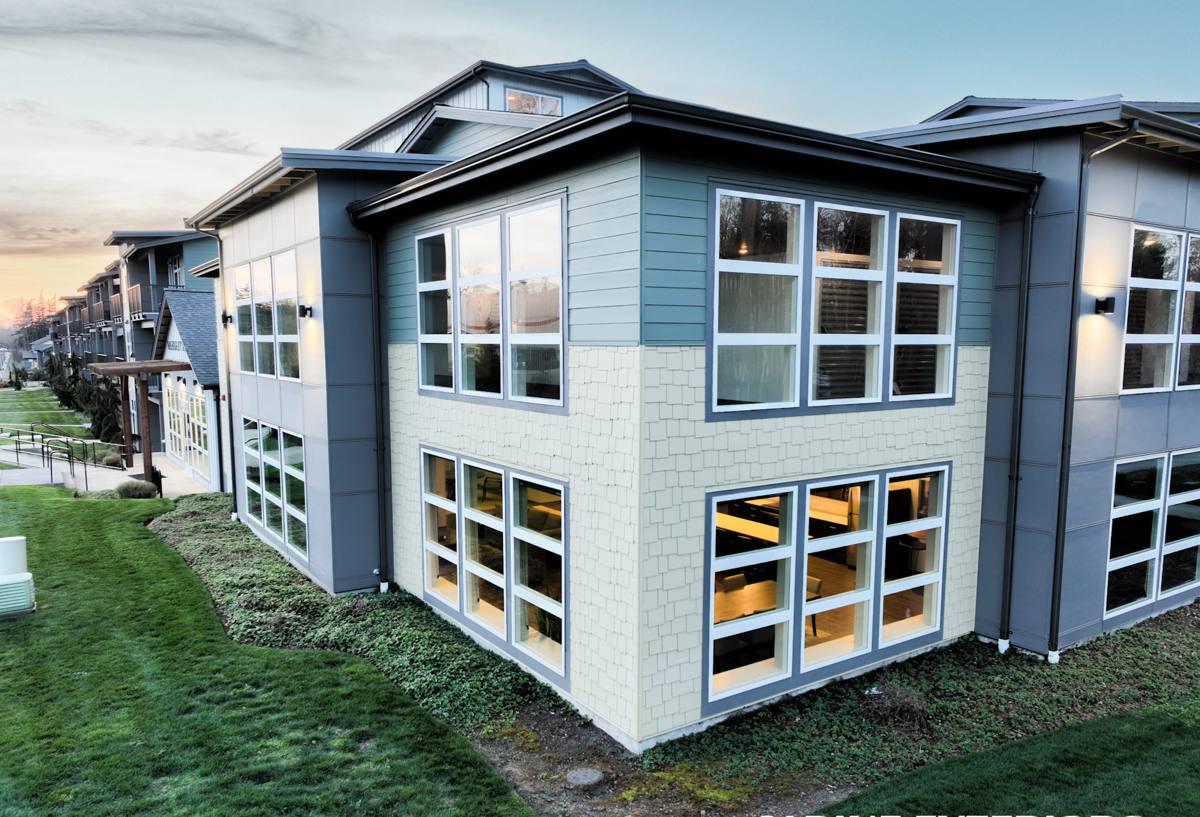
What Correct Siding Installation Actually Involves Here
A Drainage Plane, Not Just a Weather Barrier
Every wall needs a water-resistive barrier, but in a salt-air, high-rainfall area like Marietta, that barrier needs a real drainage gap behind the siding — not just housewrap stapled flat to the sheathing. A rainscreen gap lets any moisture that gets past the cladding drain and dry instead of sitting against the wall assembly. This matters more here than in drier parts of Whatcom County because the wall simply gets wetter, more often, for longer.
Flashing at Every Penetration
Windows, doors, hose bibs, light fixtures, deck ledgers — every place something breaks the plane of the wall is a place wind-driven rain will find. Correct flashing detail at each penetration, integrated with the drainage plane rather than just caulked over it, is what actually keeps water out. Caulk is a backup, not a strategy.
Fastener Material and Placement
Salt air accelerates corrosion on the wrong fastener. Stainless or hot-dip galvanized fasteners rated for the application, driven at the manufacturer's specified spacing and depth, are non-negotiable this close to the water. Overdriven or underdriven fasteners are one of the most common defects we find on re-siding jobs — they void warranty coverage and create the first point of water entry.
Clearances That Respect Moss and Moisture
Proper ground clearance, gutter and downspout coordination, and gapping at trim and inside corners all give a wall room to dry. Tight against grade, buried in landscaping, or shaded and never touched by direct sun — those are the wall sections in Marietta where we see moss and mildew establish first, and clearance during installation is the cheapest defense against it.
Why We Install Only James Hardie Fiber Cement
We standardized on James Hardie fiber cement siding for every home we side, including here in Marietta, and we don't install vinyl, LP SmartSide, or other engineered wood or fiber cement alternatives. That's a professional standard, not a knock on every other product on the market — it's a decision based on how materials perform specifically in this wet, salt-exposed, moss-prone climate over the long run.
Fiber cement doesn't absorb water the way engineered wood products can, so it doesn't swell, delaminate, or invite the fungal growth that wood-based sidings are more prone to when they stay damp for extended stretches — a real risk during a Whatcom County winter. It's also non-combustible, which matters for insurance and long-term peace of mind. Hardie's ColorPlus factory finish is baked on under controlled conditions and holds color and adhesion better against salt air and UV than field-applied paint typically does, which means fewer repaint cycles over the life of the siding. The HZ5 product line is engineered specifically for wet, freeze-prone climates like ours, and the transferable warranty backs the product for the length of ownership most homeowners actually care about.
None of that replaces correct installation — a Hardie job installed with the wrong fasteners or no drainage gap will still fail early. But starting with a material engineered for this climate, then installing it to spec, is what actually produces siding that looks and performs well fifteen and twenty years out.
Our Installation Process for Marietta Homes
- On-site assessment — we walk the exterior, check current siding and sheathing condition, note trouble spots (shaded walls, low clearance areas, existing moisture damage) specific to the home's exposure.
- Tear-off and sheathing inspection — old siding comes off and we inspect the sheathing underneath for rot or hidden moisture damage before anything new goes up. This is where problems from a prior installation usually surface.
- Water-resistive barrier and rainscreen — housewrap or building paper installed correctly, with a drainage gap system behind the cladding.
- Flashing at every penetration — windows, doors, and any wall-mounted fixtures get flashed and integrated into the drainage plane before siding closes over them.
- Hardie panel or lap installation — installed to manufacturer fastening specs, with the correct fastener type and spacing for a coastal-exposure home.
- Trim, caulking, and final finish check — joints sealed where specified, ColorPlus finish inspected for any touch-up needed at cut ends.
- Walkthrough — we go over the finished work with the homeowner before calling the job complete.
Comparing Siding Materials Against Marietta's Climate
| Material | Salt Air Exposure | Wind-Driven Rain | Moss/Algae Season | Long-Term Maintenance |
|---|---|---|---|---|
| James Hardie Fiber Cement | Handles well; non-corrosive substrate | Excellent with proper flashing/drainage | Resists moisture absorption that feeds growth | Low; factory finish holds up for years |
| Vinyl | Can become brittle and discolor faster near salt air | Prone to water intrusion at seams if not detailed carefully | Surface growth still occurs; harder to repaint if faded | Low upfront, but limited repair/refinish options |
| Engineered Wood (LP SmartSide) | More vulnerable if moisture penetrates edges | Sensitive to prolonged wetting at joints and bottom edges | Wood-based substrate more susceptible to fungal growth if damp | Moderate to high; edge sealing and repainting matter more |
| Cedar / Primed Wood | Requires diligent finish maintenance near salt exposure | Needs consistent sealing to resist wind-driven moisture | Natural wood is a food source for moss and mildew | High; regular refinishing required |
What Drives the Cost of a Marietta Siding Installation
| Factor | Why It Matters Here |
|---|---|
| Sheathing condition | Water damage found during tear-off adds repair scope before new siding can go on |
| Wall exposure | Sides facing prevailing wind and rain often need more careful flashing detail and drainage work |
| Home size and complexity | Dormers, multiple gables, and trim-heavy elevations take more labor per square foot |
| Siding profile chosen | Lap, panel, and shingle-style Hardie products differ in material and labor cost |
| Trim and accessory work | Fascia, soffit, and trim replacement done alongside siding avoids re-mobilizing later |
We give a written, itemized estimate after the on-site walkthrough rather than a ballpark over the phone — every home's exposure and existing wall condition changes the scope enough that a real number requires seeing the house.
Signs a Marietta Home May Need New Siding Soon
- Persistent moss or algae staining that returns quickly after cleaning
- Soft spots, bubbling, or visible warping, especially on north- and west-facing walls
- Paint that's peeling or chalking faster than expected between repaints
- Gaps opening at seams, corners, or trim boards
- Visible rust streaking from fasteners
- Rooms that feel drafty or damp near exterior walls
- Siding that's original to a home built more than 20-25 years ago
Why Hiring a Crew That Already Works in Marietta Matters
Marietta's exposure isn't identical to every neighborhood in Ferndale or the rest of Whatcom County — homes closer to the water get more salt and wind, while inland lots deal more with shade and moss from tree cover. A crew that already installs siding in this specific area knows which walls typically need extra flashing attention, which fastener spec holds up best given the exposure, and what the county's permitting and inspection process looks like for exterior work. That local pattern recognition shows up in fewer surprises during the job and fewer callbacks after it.
It also means we're not guessing at Whatcom County's building code requirements or a jurisdiction's inspection expectations — we've been through them on other homes nearby. For a homeowner, that translates into a smoother project with less back-and-forth.
Ready for an Estimate?
If your Marietta home's siding is showing its age, or you're planning ahead before the wet season turns small problems into bigger ones, we're happy to take a look. The estimate is free, there's no pressure, and you'll get a straight answer about what your home actually needs — just fill out the form below to get started.