 Ferndale Siding
 Sandy Point's Waterfront Exposure Is Harder on Siding Than Most of Whatcom County
Sandy Point sits right on the water, and that location is exactly why siding here wears differently than siding a few miles inland in Ferndale or Bellingham. Homes facing the Strait of Georgia take a steady mix of salt-laden air, wind-driven rain, and prolonged damp shade from surrounding trees and canal banks. That combination shortens the life of siding that would otherwise hold up fine in a drier, more sheltered part of Whatcom County. If you're planning a siding replacement on a Sandy Point property, the product choice and installation details matter more here than almost anywhere else we work.
We've replaced siding on enough waterfront and canal-front homes in this community to know the failure patterns before we even get up on a ladder: soft trim at the corners, moss creeping up the north-facing wall, caulk lines that gave up years ago, and paint that's chalking or peeling faster than the homeowner expected. None of that is a surprise once you understand what this specific microclimate does to a wall system over time.
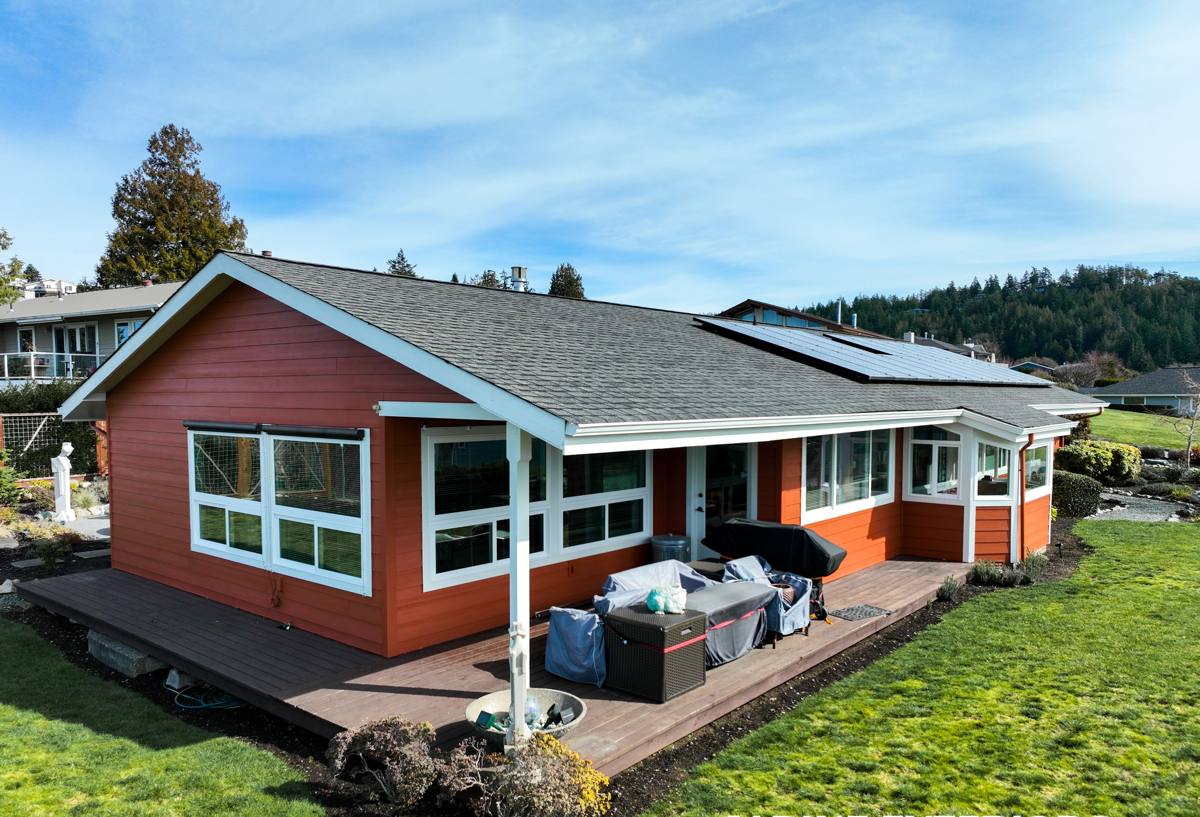
What Salt Air, Driving Rain, and Moss Actually Do to a Wall
Salt Air
Airborne salt from the Strait doesn't just sit on the surface — it's corrosive to exposed metal fasteners, flashing, and hardware, and it accelerates the breakdown of paint film on wood-based siding products. Over years, that means faster fading, chalking, and adhesion failure on anything not engineered to resist it.
Driving Rain
Storms coming off the water hit siding at an angle, not straight down. That wind-driven rain forces moisture into laps, seams, and butt joints that a calmer rain would never reach. Any siding product with weak seams, absorbent edges, or a installation that skimps on flashing and caulking will eventually let water behind the wall — and once water gets behind siding, the damage happens where you can't see it.
Moss and Prolonged Dampness
Whatcom County's long wet season is bad enough on its own; Sandy Point's shaded, close-to-water lots make it worse. Moss and algae holding moisture against a wall for months at a time is one of the fastest ways to rot wood trim, degrade paint, and stain a finish that isn't factory-sealed all the way through.
None of these three forces is unique to Sandy Point in isolation, but the combination — all three, most of the year — is what separates this neighborhood from a typical inland Ferndale lot.
Why We Standardized on James Hardie Fiber Cement for Homes Like These
We install James Hardie fiber cement siding exclusively. We don't install vinyl, LP SmartSide, primed spruce or cedar, or other fiber cement brands like Allura or Cemplank — not because those products have no merit, but because after years of doing this work in exactly the conditions Sandy Point sees, Hardie is the product we trust to hold up without turning into a maintenance project for the homeowner.
Here's the honest reasoning:
- Fiber cement resists moisture swelling and rot in a way wood-based products cannot, because it isn't wood — engineered wood siding is still an organic substrate that can absorb water at cut edges and fastener penetrations if the install or caulking isn't perfect, which matters a lot on a house facing constant wind-driven rain.
- Vinyl siding can warp, fade, and crack under UV and temperature swings, and it doesn't offer the same rigidity or fire resistance — and in a coastal-adjacent environment, its seams and J-channels give wind-driven rain more paths to work with.
- Hardie's ColorPlus factory finish is baked on under controlled conditions, which holds color and resists chalking far longer than field-applied paint, a real advantage where salt air accelerates paint breakdown.
- It's non-combustible — a genuine safety benefit regardless of what's driving the decision.
- It carries a strong, transferable warranty when installed to Hardie's spec, which protects the resale value of a waterfront property as much as it protects the homeowner living there now.
We're not going to tell you other products are junk — plenty of homes around the country wear them fine. We're telling you that for a Sandy Point wall taking this much punishment year after year, we won't put our name on anything less than the product we're confident will still look right in fifteen years.
Choosing the Right Hardie Product Line for a Waterfront Lot
James Hardie makes climate-engineered product lines, and the HZ5 formulation is built specifically for wetter, harsher climates like ours — it's a different engineering than what Hardie sells in the dry Southwest. For Sandy Point specifically, we typically talk homeowners through:
- Lap siding (the most common choice) in a smooth or cedar-textured finish, run with correctly sized reveals for the home's exposure.
- Panel or board-and-batten siding for homes wanting a more modern or vertical look, common on some of the newer waterfront builds in this area.
- Trim and soffit systems matched to the siding — mixing brands here is one of the most common corner-cutting shortcuts we see, and it's exactly where moisture problems start.
- A ColorPlus finish in a color engineered to resist the fading that salt air and sun exposure cause faster here than inland.
What a Correct Siding Replacement Actually Involves
Replacing siding on a Sandy Point home isn't just swapping old boards for new ones. Done right, it's a full wall-system job:
- Full tear-off and inspection — removing the old siding is when we find out what the wall has actually been dealing with: soft sheathing, rot at window and door openings, failed old flashing.
- Sheathing repair — any water-damaged sheathing gets replaced before anything new goes up. Covering rot with new siding just hides the problem.
- Weather-resistive barrier — a correctly lapped, sealed house wrap is the layer that actually keeps bulk water out, working together with the siding rather than relying on the siding alone.
- Flashing at every penetration — windows, doors, vents, and hose bibs are where wind-driven rain finds its way in if flashing is missing or installed backward.
- Correct fastening and clearances — Hardie specifies exact nailing patterns, gaps from grade, roofing, and decks, and minimum clearances that keep moisture and moss from wicking up from below.
- Finish and caulking — sealing joints and trim with the right products, not just whatever's on the truck, especially at seams facing prevailing weather off the water.
Skipping any one of these steps is how a siding job that looks great on installation day turns into a moisture problem five years later — which is a lot of what we get called out to fix on older Sandy Point homes.
Our Process for a Sandy Point Siding Replacement
We keep the process straightforward and communicate at each stage:
- On-site assessment — we walk the exterior, check for rot and moisture damage, and look specifically at north- and west-facing walls where moss and driving rain hit hardest.
- Written scope and estimate — what's being torn off, what sheathing repair is likely, which Hardie product and color, and a clear price range.
- Material order and scheduling — we plan around Whatcom County's weather windows, since siding installation needs dry conditions to do properly.
- Tear-off, repair, and install — done in the sequence above, with photos of anything hidden once it's covered (like sheathing repairs or new flashing).
- Final walkthrough — we go over the finished work with you before calling the job done.
Cost Factors for Siding Replacement in Sandy Point
Every home is different, but these are the factors that actually move the price on a Sandy Point job:
| Factor | Why It Matters Here |
|---|---|
| Existing sheathing condition | Waterfront homes with a history of moisture intrusion often need more sheathing repair than inland homes |
| Home size and wall complexity | More corners, gables, and trim detail mean more labor and material |
| Product selection | Lap vs. panel siding, smooth vs. textured finish, and trim package all affect material cost |
| Access and site conditions | Canal-front and beachfront lots can have tighter access than a standard street lot, affecting staging and disposal |
| Removal and disposal | Full tear-off of old siding, especially older wood or asbestos-era products, adds labor and disposal cost |
| Trim, flashing, and paint detail | Getting these right the first time costs more up front but avoids callback repairs later |
We give a written, itemized estimate before any work starts so there are no surprises once tear-off begins.
Why Hiring a Crew That Already Works in Sandy Point Matters
A contractor unfamiliar with this specific stretch of Whatcom County waterfront doesn't know what to expect before the tear-off starts. We do. We know what moss damage typically looks like on a shaded canal-facing wall here, what condition to expect in old trim on beachfront homes, and how to sequence a job around this area's wet season and site access. That familiarity shows up in a tighter estimate, fewer surprises mid-project, and a finished wall system built for the exposure it's actually going to face — not a generic install that happens to be located near the water.
Before hiring anyone for a Sandy Point siding job, it's worth checking a few things:
- Do they carry proper licensing and insurance for exterior work in Washington?
- Will they put the full scope — tear-off, sheathing repair allowance, product, and finish — in writing?
- Do they have experience specifically with waterfront or coastal-adjacent exposure, not just general siding work?
- Are they installing to the manufacturer's actual specifications, including fastening patterns and clearances, so the warranty stays valid?
- Will they show you what they find once the old siding comes off, rather than just covering it up?
If you're weighing a siding replacement on a Sandy Point home, we're happy to take a look and walk you through what we'd recommend and why. Reach out for a free, no-pressure estimate — there's a form right below this page.