 Ferndale Siding
 Why Lummi Island Roofs Age Differently
A roof on Lummi Island doesn't fail the same way a roof twenty miles inland does. The island sits out in the marine air of the Salish Sea, which means every shingle, nail, and flashing detail is exposed to salt-laden moisture almost year-round. Add the driving, wind-pushed rain that comes off the water during fall and winter storms, and a long, shaded moss season that starts early and never seems to fully quit, and you've got a roofing environment that punishes shortcuts. We've replaced roofs across Whatcom County long enough to know that a roof built for a dry inland subdivision and a roof built for Lummi Island are not the same job, even if the shingle on the shelf looks identical.
This page is specifically about roof replacement for Lummi Island homes — what the local climate demands, what a correct installation actually involves, how we run the job on an island, and why experience with this specific stretch of coastline matters more than it does almost anywhere else in the region.
Salt Air and Coastal Exposure
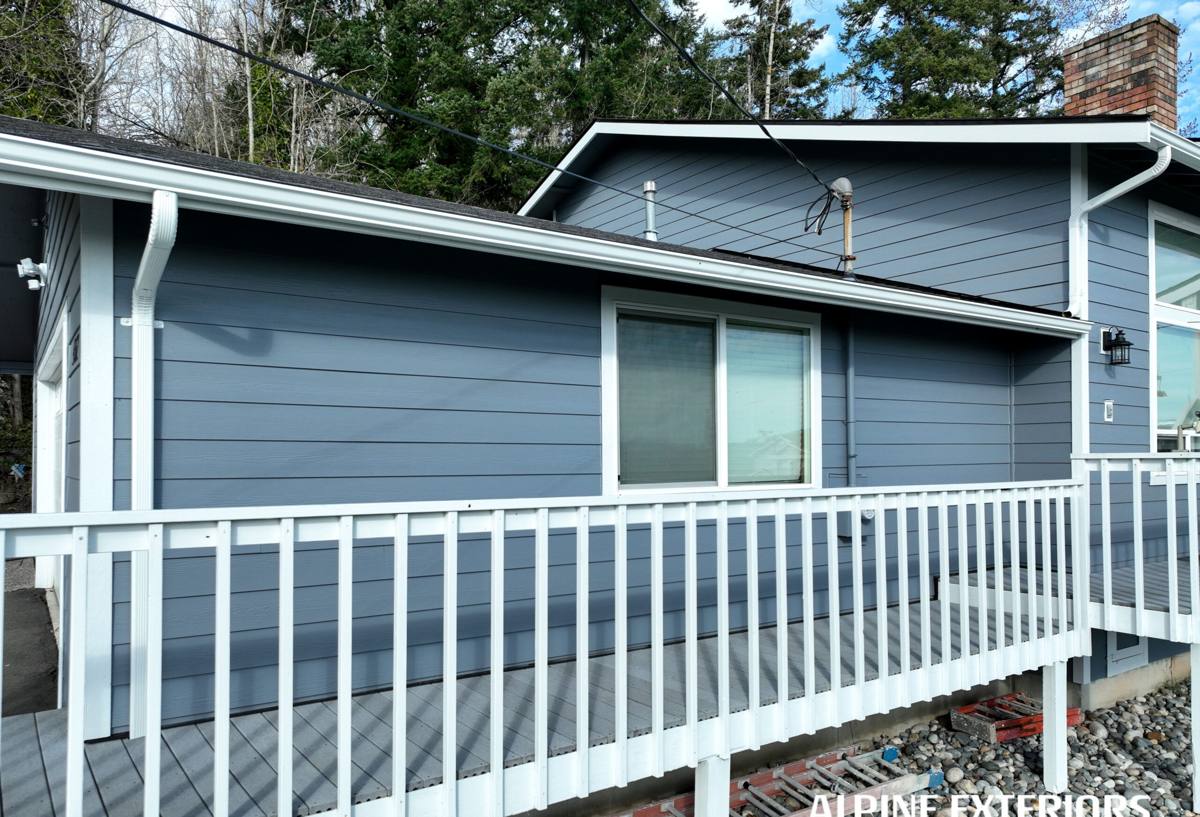
Salt air doesn't just affect boats and railings. It settles on roofing metal — flashing, valleys, drip edge, fasteners, vent stacks — and accelerates corrosion in anything that isn't rated for a marine or near-marine environment. On a lot of older roofs we inspect on the island, the shingles themselves still have life left, but the exposed metal has rusted, streaked, or started to fail at the fastener heads years before it should have.
What this means for material choices
For homes on or near Lummi Island, we default to corrosion-resistant flashing and fastener packages rather than standard galvanized components, and we're deliberate about metal-to-metal contact points where dissimilar metals can accelerate corrosion. It costs a little more upfront. It's also the difference between flashing that's still doing its job at year fifteen and flashing that's already staining and leaking at year seven.
Driving Rain and Wind-Driven Water
Rain that falls straight down is the easy case. Rain that's being pushed sideways by wind off the water is a different problem — it finds its way under laps, around fasteners, and into any seam that was cut a little short. This is where a lot of roof failures on exposed island and shoreline properties actually start: not on the open field of the roof, but at valleys, wall-to-roof transitions, chimney flashing, and low-slope sections where wind-driven water has time to work its way backward under the material.
Where we pay extra attention
- Valleys get self-adhered ice-and-water membrane, not just felt, regardless of season
- Wall and chimney flashing is step-flashed and counter-flashed, not just caulked
- Fastener patterns are matched to the manufacturer's high-wind spec, not the minimum spec
- Low-slope or transition areas get upgraded underlayment rather than standard shingle-only coverage
None of this is exotic. It's just not optional here the way it might be on a sheltered, low-wind lot inland, and skipping it is exactly how a roof that looks fine from the ground starts leaking at the first real storm.
Moss, Shade, and Moisture
Lummi Island's tree cover and marine humidity add up to a long moss season — often longer than what homeowners see just a few miles inland, because shaded, north-facing slopes near the water stay damp for extended stretches. Moss isn't just cosmetic. As it establishes, it lifts shingle edges, holds moisture directly against the roofing material, and creates a foothold for the granule loss and mat degradation that shorten a roof's real service life.
Building moss resistance into the replacement, not just the maintenance plan
Algae- and moss-resistant shingle products — the ones with copper or zinc granule blends built into the shingle — genuinely help slow regrowth on shaded roofs, and we'll usually recommend them for Lummi Island homes with significant tree cover. We also look hard at attic ventilation during a replacement. A roof deck that's staying warm and damp from below, because of poor intake or exhaust ventilation, will grow moss and ice-dam faster than one that's properly vented, no matter what shingle is on top of it.
Choosing the Right Roofing System
There's no single "best" material for every Lummi Island home — it depends on tree cover, roof pitch, budget, and how long you want to go before the next major roof project. Here's how the common options stack up for this specific climate.
| Material | Typical Lifespan | Salt Air / Moss Performance | Cost Factor |
|---|---|---|---|
| Architectural asphalt shingle (algae-resistant) | 25–30 years | Good with proper ventilation; moss-resistant granules slow regrowth | Lowest upfront cost |
| Standing seam metal | 40–50+ years | Excellent once properly detailed with marine-rated fasteners and coatings | Higher upfront, lower lifetime cost |
| Synthetic composite shake/slate | 30–50 years | Very good; resists moisture absorption better than natural wood | Mid-to-high |
| Natural cedar shake | 20–30 years with upkeep | Requires the most ongoing maintenance in damp, shaded conditions | Mid-to-high, plus ongoing care |
We're honest with homeowners about trade-offs. Cedar can look great on the right house, but in a shaded, damp, salt-air setting it demands more upkeep than most owners want to keep up with. Standing seam metal costs more going in but largely sidesteps the moss problem entirely once it's installed correctly. For most Lummi Island homes, a quality algae-resistant architectural shingle with correct ventilation and flashing detailing is the right balance of cost and performance — metal earns its premium on homes with heavy shade, steep pitch, or an owner planning to stay long-term.
Our Roof Replacement Process
A roof replacement is only as good as the parts nobody sees once it's done. Here's how we run the job.
1. Inspection and scope
We walk the roof (or use appropriate access where pitch or safety requires it), check the attic for ventilation and moisture signs, and identify problem areas — soft decking, prior repair patches, undersized flashing — before we ever write a number.
2. Tear-off and deck check
Full tear-off lets us actually see the deck. Any soft, rotted, or delaminated sheathing gets replaced — this is not an area to patch around, especially on a roof that's going to face another two or three decades of coastal weather.
3. Underlayment and ice-and-water protection
Valleys, eaves, and any vulnerable transition get upgraded membrane. The rest of the deck gets a synthetic underlayment suited to the exposure.
4. Flashing and ventilation
New flashing at every penetration and wall transition, corrosion-resistant hardware, and ventilation corrected or upgraded where the attic inspection flagged a problem.
5. Roofing material installation
Installed to manufacturer spec for wind exposure, not the bare minimum — this is what keeps warranty coverage intact and keeps the roof performing in actual island wind conditions.
6. Cleanup and final walk-through
Magnetic sweep for stray fasteners, full site cleanup, and a walk-through so you know exactly what was done and why.
Working on the Island: Logistics That Matter
Roofing on Lummi Island isn't logistically the same as roofing in downtown Ferndale. Material deliveries, dumpster drop-off and pickup, and crew scheduling all have to account for ferry timing, and a crew that hasn't planned around that ends up with wasted days, idle trailers, or jobs that drag on longer than they should. We plan material staging and crew scheduling around the ferry from the start of the job, not as an afterthought discovered mid-project. That planning is a big part of why hiring a crew that already works this area matters — it's the difference between a tight, well-run project and one that stretches out because logistics weren't thought through in advance.
Permitting also runs through Whatcom County for island properties, and we handle that coordination as part of the job so homeowners aren't left figuring out code and inspection requirements on their own.
Signs Your Lummi Island Roof May Need Replacement, Not Repair
- Granule loss heavy enough that shingles look bald or patchy in sun-exposed areas
- Moss establishing in mats rather than light surface growth, especially on shaded or north-facing slopes
- Rust staining or visible corrosion at flashing, valleys, or fastener heads
- Curling, cupping, or cracked shingles, particularly on wind-exposed faces
- Daylight visible through the roof deck from inside the attic
- Recurring leaks in the same area despite prior repairs
- The roof is approaching or past the expected lifespan for its material
One or two of these can often be addressed with a targeted repair. Several at once, especially combined with an aging roof, usually means repair costs start approaching what a full replacement would run — and a patched roof still has all the same underlying age and exposure working against it.
Get a Straightforward Estimate
If your Lummi Island roof is showing its age — moss that keeps coming back, rust at the flashing, or a leak that's been repaired more than once — we're happy to take a look and give you a straightforward assessment of what it actually needs. There's no pressure and no upsell script, just an honest read on whether repair still makes sense or replacement is the better long-term move, along with a free estimate built around this specific climate and this specific island.