 Ferndale Siding
 Why Point Roberts Is Tougher on a Roof Than Most Whatcom County Homes
Point Roberts sits out on its own peninsula, with water on three sides and almost nothing standing between the roofs there and the weather coming off Boundary Bay and the Strait of Georgia. That geography matters more than most homeowners realize. Salt-laden air corrodes exposed metal faster than it does even a few miles inland — nail heads, flashing, vent boots, and screws all age quicker out there. Add in the wind-driven rain that comes with living on open water, and you've got moisture getting pushed sideways and upward under shingle laps in ways a standard install doesn't always account for.
Then there's shade and moisture retention. A lot of Point Roberts properties have mature tree cover, which is great for privacy but keeps roof surfaces damp longer after every rain. Combine that with our long Pacific Northwest wet season and you get a moss season that can run most of the year on a north-facing slope. None of this means a roof out there is doomed — it means the materials, detailing, and maintenance plan need to match the actual conditions, not a generic spec sheet.
Repair or Full Replacement? Know Which One You Need
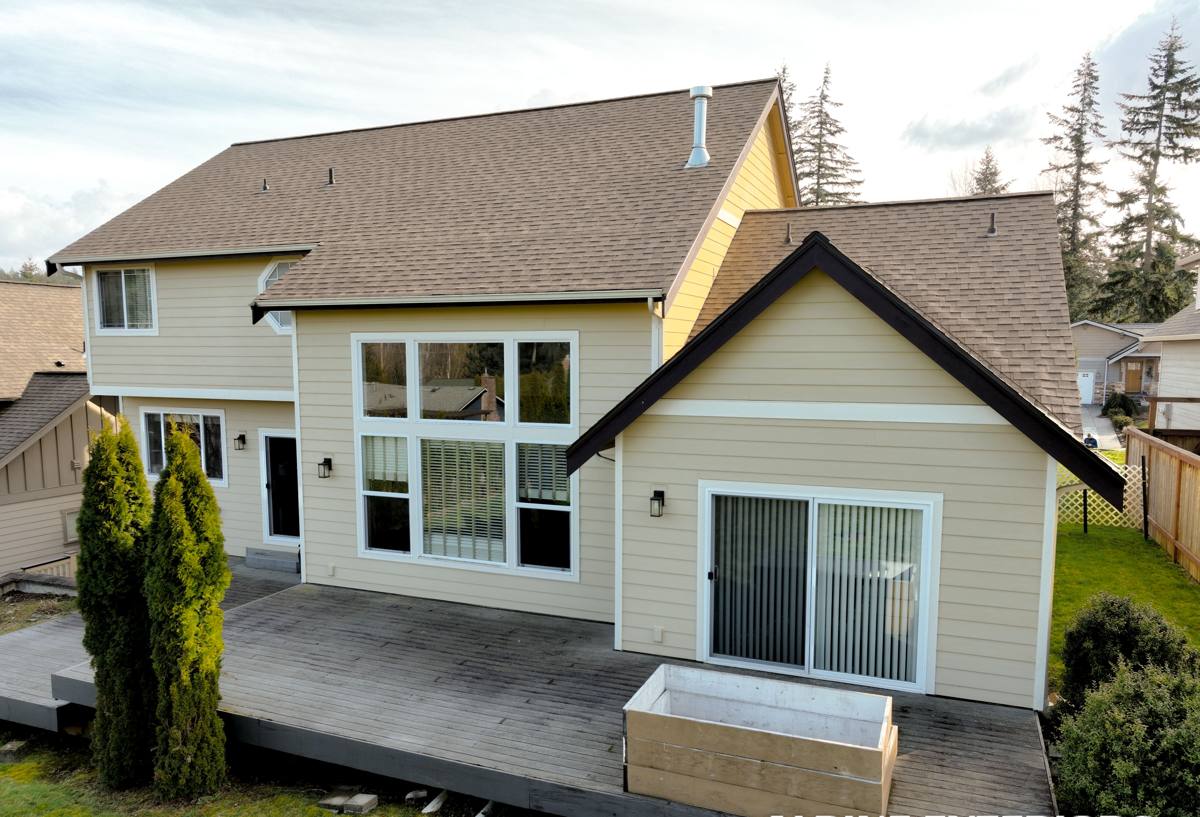
Not every roof problem in Point Roberts calls for a full tear-off. But because of the salt exposure and moss pressure out there, small issues tend to compound faster than they would in a drier, more sheltered part of Whatcom County. Here's what usually tips the decision toward replacement rather than another round of patching:
- Shingles that are cupping, curling, or losing granules across large sections rather than just one spot
- Moss that's thick enough to be lifting shingle edges, not just discoloring the surface
- Rusted or pitted flashing around chimneys, skylights, and valleys
- Soft spots or sagging when you walk the attic and check the decking from underneath
- Multiple past repairs in different areas within the last few years
- The roof is nearing or past the expected service life of its material in a coastal setting, which runs shorter than the manufacturer's inland estimate
- Daylight visible through the deck boards or persistent staining on interior ceilings
If you're only seeing one or two of these, a repair or a moss treatment may buy you real time. If several apply at once, patching becomes a short-term fix on a roof that's already telling you it's done.
What a Correct Roof Replacement Actually Involves
A roof replacement is more than swapping old shingles for new ones. Done right, in a climate like this, it's really a system rebuild.
Tear-Off and Deck Inspection
We remove the old roofing down to the deck rather than layering over it. That's the only way to actually see the plywood or plank sheathing underneath — which is where salt-air and moss-driven moisture problems usually show up first as soft, delaminated, or rotted wood. Any bad decking gets replaced before anything new goes down; skipping this step is how a new roof ends up failing from the inside out within a few years.
Underlayment and Ice-and-Water Protection
Given how much wind-driven rain Point Roberts sees, we don't treat underlayment as an afterthought. A synthetic underlayment across the full deck, with self-adhering ice-and-water membrane at eaves, valleys, and around penetrations, gives the roof a real second line of defense if wind ever forces water up and under the shingle laps.
Flashing, Valleys, and Penetrations
Chimney flashing, valley metal, and pipe boots take the most abuse from salt air because they're the metal components most exposed to moisture cycling. We replace these as part of the job rather than reusing old flashing, and we use corrosion-resistant materials specifically because of the marine-air exposure out there.
Ventilation
Proper intake and exhaust ventilation keeps attic moisture from condensing on the underside of the deck, which is a major contributor to both premature deck rot and moss growth from the inside out. On a shaded, damp lot, ventilation isn't optional — it's part of what makes the rest of the system last.
Material Options for Salt Air and Moss
There's no single "best" roofing material for every Point Roberts home — it depends on your roof's exposure, pitch, budget, and how much upkeep you want to take on. Here's an honest comparison of the main options we install:
| Material | Salt-Air Durability | Moss Resistance | Typical Lifespan (Coastal) | Maintenance |
|---|---|---|---|---|
| Algae-resistant architectural asphalt shingles | Good with corrosion-resistant fasteners and flashing | Better than standard shingles, not immune | 20–25 years | Periodic moss checks and gutter clearing |
| Standard 3-tab asphalt shingles | Fair — shorter-lived hardware and granule loss | Lower — no algae-resistant granules | 12–18 years | More frequent moss and gutter maintenance |
| Standing-seam metal roofing | Excellent with proper coating and fastener spec | High — moss struggles to grip smooth metal | 40–50+ years | Low; occasional inspection of seams and fasteners |
| Cedar shake | Requires diligent upkeep near salt air | Low without regular treatment — shake retains moisture | Varies widely by maintenance | High — treatment, cleaning, and moss control needed regularly |
We'll walk through these trade-offs honestly during your estimate. Metal costs more up front but demands the least attention over decades. Algae-resistant asphalt is the most common choice because it balances cost and performance well for this climate. Cedar can look great, but on a shaded, moisture-heavy lot it asks for a maintenance commitment a lot of homeowners underestimate — that's a fair trade-off to weigh, not a reason to rule it out if you're willing to keep up with it.
Building In Moss Resistance From Day One
Rather than treating moss as something to fight after the fact, we build resistance into the install itself. That includes zinc or copper strips near the ridge on shaded slopes — rainwater washing over them carries trace metal ions down the roof face, which discourages moss and algae growth over time without chemical treatments. We also make sure valleys and low-slope transitions are detailed so water sheds fully instead of pooling, since standing moisture is what lets moss establish itself in the first place. None of this eliminates the need for occasional roof cleaning or gutter clearing, especially under tree cover, but it meaningfully extends the time between maintenance cycles.
Why an Exclave Changes How the Job Gets Planned
Point Roberts is separated from the rest of Whatcom County by Canadian territory, which means every truckload of material and every crew trip in or out crosses an international border. That's not a detail you want your roofing contractor figuring out on the fly. Jobs there need materials staged and scheduled in advance, realistic timelines that account for border wait times, and a crew that isn't learning the logistics for the first time on your project. A crew that already works Point Roberts regularly has that routine down — which means fewer delays, fewer surprise trips back for a forgotten part, and a tear-off that doesn't sit exposed to the weather longer than it has to.
Our Roof Replacement Process
- Inspection and estimate. We walk the roof and attic, check the decking, flashing, and ventilation, and give you a written scope and price — no pressure, no guessing.
- Material selection. We go over the options above based on your roof's exposure and your budget, and help you land on what actually fits your home.
- Permitting. We handle the permit process through the appropriate Whatcom County channels before any work starts.
- Material staging. Because of the border crossing, materials are ordered and staged ahead of the install date so the job isn't waiting on a delayed delivery.
- Tear-off and deck repair. Old roofing comes off, the deck gets inspected, and any damaged sections are replaced before anything new goes on.
- Install. Underlayment, flashing, ventilation, and the finish material go on in that order, with attention to the details that matter most in a salt-air, high-moss environment.
- Final walkthrough and cleanup. We inspect the finished roof with you, clear the site of debris and nails, and go over your warranty paperwork.
What Drives the Cost
Most full roof replacements in this area land somewhere in the low-to-mid five figures for an average single-family home, with total cost shaped by a handful of factors rather than one flat rate:
- Roof size and pitch — steeper roofs take longer and require more safety setup
- How many layers of old roofing need to come off
- Whether decking repair or replacement is needed once the old roof is removed
- Material choice — asphalt, metal, and cedar sit at very different price points
- Access and logistics for the Point Roberts site, including material transport
- Additional work like new ventilation, skylight flashing, or gutter replacement done at the same time
We give you the real number after seeing the roof in person — not a phone estimate that changes once we're up there.
If your Point Roberts roof is showing its age, we're happy to take a look and give you a straight answer on repair versus replacement. Fill out the form below for a free, no-pressure estimate.