 Ferndale Siding
 Point Roberts Sits Right at the Edge of the Salish Sea
Point Roberts is a small piece of Whatcom County that hangs off the bottom of a Canadian peninsula, surrounded by water on three sides. That geography is part of what makes the area beautiful, and it's also what makes a deck out here work harder than a deck built ten miles inland in Ferndale or Bellingham. Salt-laden air off the water, wind-driven rain, and long stretches of gray, damp weather all land on exposed decking surfaces and hardware every single day of the year.
Composite decking earned its reputation in the Pacific Northwest because it doesn't rot, splinter, or need yearly staining the way wood does. But "composite decking" isn't one single product, and Point Roberts isn't an average building site. What holds up fine on a sheltered patio somewhere drier isn't automatically the right choice a few hundred yards from open water. This page covers what a composite deck actually needs to hold up out here, and what we do differently on a Point Roberts project.
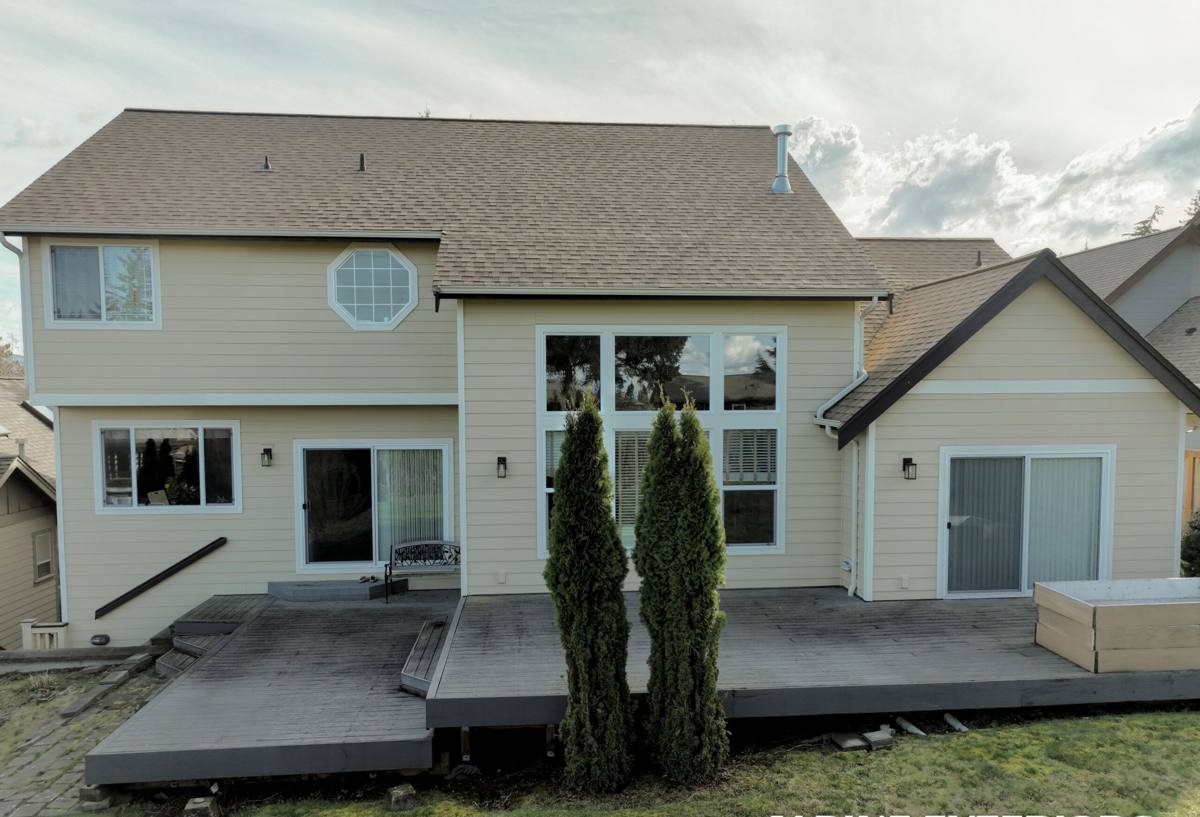
What Salt Air and Moss Season Actually Do to a Deck
Salt and Metal Don't Mix
The decking boards themselves usually aren't the weak point in a marine environment — modern capped composites are engineered to shrug off moisture and UV. The fasteners, brackets, post bases, and any exposed structural hardware are what take the real beating. Standard coated screws and joist hangers corrode faster this close to salt water, and once hardware starts to fail, it fails quietly, underneath the boards, long before anyone notices a problem on the surface.
Moss Doesn't Need Much Encouragement
Whatcom County's wet season runs long, and any deck with poor airflow underneath, tight board spacing, or a shaded, north-facing exposure will grow moss and algae faster than most homeowners expect. On a wood deck that shows up mainly as discoloration and slip risk. On composite decking it shows up the same way — moss doesn't care what the board is made of, it cares about moisture sitting on a surface with nowhere to drain or dry out.
Driving Rain Finds Every Gap
Wind off the water pushes rain sideways more often than it falls straight down. That matters at every point where a deck meets the house — ledger boards, door thresholds, and any transition between the deck surface and the siding. A fastening job that would hold up fine in a calmer inland yard can let water track backward into the wall assembly here if flashing details are treated as an afterthought instead of a requirement.
The Substructure Is Where the Real Decision Gets Made
Composite boards get most of the attention because that's what you see, but the framing underneath decides how long the deck actually lasts. On a Point Roberts job we treat the substructure as the part that has to survive the same salt exposure as the decking, for just as many years, without ever being inspected as often.
Ledger Attachment and Flashing
Where the deck framing bolts to the house is one of the most common failure points in wet coastal climates — not because the connection itself is weak, but because water works its way behind an unflashed or poorly flashed ledger board over years of driving rain. Proper flashing, ledger tape, and a drainage gap that lets water run off instead of pool are treated as requirements here, not upgrades.
Joist Protection
Composite boards don't need staining, but the wood joists and beams underneath most composite decks still need protection — joist tape or a comparable moisture barrier stops water from sitting in fastener holes and exposed end grain. Skipping this step is a common shortcut in the trade, and it's the reason some composite decks develop soft, sagging spots in the frame years before the boards themselves show any wear at all.
Footings and Post Bases
Ground conditions on the point vary — sandy, well-drained soil in some spots, denser and wetter soil in others. Footings need to be sized and set to local frost depth and actual soil conditions, and post bases should hold posts up off the concrete and clear of standing water, not buried in it.
Choosing a Composite Board for This Climate
Most composite decking sold today falls into a few broad categories, and the differences between them matter more here than they would somewhere drier and more sheltered from wind and salt spray.
| Board Type | How It Handles Moisture & Salt | Maintenance Load | General Cost Position |
|---|---|---|---|
| Uncapped wood-plastic composite | Absorbs some surface moisture; more prone to staining and mold in a wet, shaded spot | Periodic cleaning, more attention near ground level | Lower upfront cost |
| Capped composite (cap on all sides) | Fully sealed shell resists moisture intrusion and salt staining much better | Occasional washing; no sealing or staining | Mid-to-upper range |
| Mineral-based / PVC composite | Little to no organic material to feed mold or algae; handles constant dampness well | Lowest ongoing maintenance | Upper range |
For most Point Roberts homes, a fully capped composite board is where cost and performance balance out. Fully synthetic, PVC-style boards perform even better in constant dampness and are worth discussing for shaded, north-facing, or heavily exposed decks, but they carry a higher price and a different feel underfoot that not every homeowner prefers. We'll walk through the real trade-offs for your specific site rather than defaulting to one product line.
Color and Surface Texture
Darker boards show less green staining from algae but run hotter in direct sun and can highlight salt residue as a chalky film if they aren't rinsed occasionally. Lighter, variegated colors hide dust, pollen, and light staining better between cleanings. Texture matters too — a deeply grained, slip-resistant surface is worth prioritizing over a smooth finish anywhere near open water, where boards get wet more often and stay wet longer.
Fastening: The Detail That Decides How the Deck Ages
How boards are fastened affects both appearance and how the deck handles this climate's wide seasonal swings between wet winters and drier summers.
- Hidden fastener clip systems give a clean, screw-free surface and let boards expand and contract without splitting — a real advantage through the Northwest's wet-to-dry seasonal swing.
- Corrosion-resistant fasteners and brackets rated for coastal or marine use cost more than standard hardware, but they're the difference between hardware that lasts and hardware that fails quietly under the boards.
- Consistent board gapping is set for drainage and airflow, not just appearance — tight, moisture-trapping gaps are one of the most common causes of early moss growth.
- Border or picture-frame trim details need the same attention to end-cap sealing as the field boards, since exposed cut ends are where uncapped composite is most vulnerable to moisture.
Our Process on a Point Roberts Project
Point Roberts' location adds a layer of logistics that a lot of contractors aren't set up to handle well. Getting a crew, tools, and a full load of decking material onto the point means crossing the border in both directions and planning the job so materials arrive complete rather than in frustrating partial loads. That's part of why we plan Point Roberts jobs a little differently than an in-town Ferndale project.
- Site visit and assessment — we look at sun exposure, wind direction, existing structure condition, and drainage before recommending a board type.
- Design and material selection — board type, color, fastening system, and railing details are set based on your home's actual exposure, not a generic default.
- Permitting — Whatcom County permit requirements apply on the point the same as anywhere else in the county, and we handle that paperwork as part of the job.
- Logistics and scheduling — material orders and crew scheduling account for the border crossing so the job runs on one continuous timeline instead of stalling mid-project.
- Build — substructure first, with flashing and joist protection addressed before a single deck board goes down, followed by the decking, fastening, and any railing or trim work.
- Walkthrough — we go over the basic care specific to your board choice and site conditions before we consider the job finished.
Living With a Composite Deck in This Climate
Composite decking is genuinely low-maintenance compared to wood, but "low-maintenance" doesn't mean "no maintenance" in a place with this much salt air and shade-driven moss pressure.
- Rinse or wash boards a few times a year to clear salt residue, pollen, and organic buildup before it has a chance to feed algae.
- Keep gutters and downspouts near the deck clear so runoff isn't dumping extra water onto boards or framing.
- Sweep debris out of board gaps regularly — leaves and needles trapped in the gaps hold moisture right where you don't want it.
- Check railing posts and any ground-contact hardware once a year for early signs of corrosion or movement.
- Trim back vegetation that shades the deck if moss keeps returning to the same spots — sunlight and airflow do more to prevent moss than any cleaner does.
Why a Ferndale-Based Crew That Already Works Point Roberts Matters
A lot of contractors treat Point Roberts as too much hassle for one deck job — the border crossing, the added logistics, the scheduling around it. We already build that into how we run projects out there, which means fewer surprises and fewer delays once your project starts. Just as important, we've seen how decks in this specific area actually age over time — which fastener systems hold up, which shaded spots grow moss no matter what board you choose, and which framing shortcuts turn into problems years later. That kind of judgment only comes from working this particular stretch of coastline, not from a generic decking install anywhere in Whatcom County.
If you're weighing a new deck or replacing an aging one in Point Roberts, we're glad to take a look and talk through what actually makes sense for your site — no pressure, no obligation. Use the form below to request a free estimate.