 Ferndale Siding
 What "New-Construction Windows" Actually Means
When we say new-construction windows, we're talking about a specific product and installation method, not just "windows for a new house." A new-construction window comes with a nailing fin (sometimes called a nail flange) built into the frame. That fin gets fastened directly to the wall sheathing before the weather-resistive barrier and siding go on, which lets us build a continuous, layered water management system around the opening from the framing outward. This is different from a retrofit or pocket-replacement window, which is designed to slide into an existing frame in a home that's already sided and finished.
For homes being built or substantially framed in the Nooksack area, new-construction windows are almost always the right call. They give us full access to the rough opening, the header, and the sill pan before anything is closed in, which means the flashing details — the part that actually keeps water out over the next few decades — can be done correctly the first time instead of worked around later.
Why This Distinction Matters to You as the Homeowner
If you're working with a builder on a new home or an addition near Nooksack, the window package gets specified early, often before you've thought much about it. Getting the window type, frame material, and flashing plan right at this stage is far cheaper than fixing a water intrusion problem in a wall that's already closed up and finished. This is one of those decisions where a little attention up front saves a lot of grief down the road.
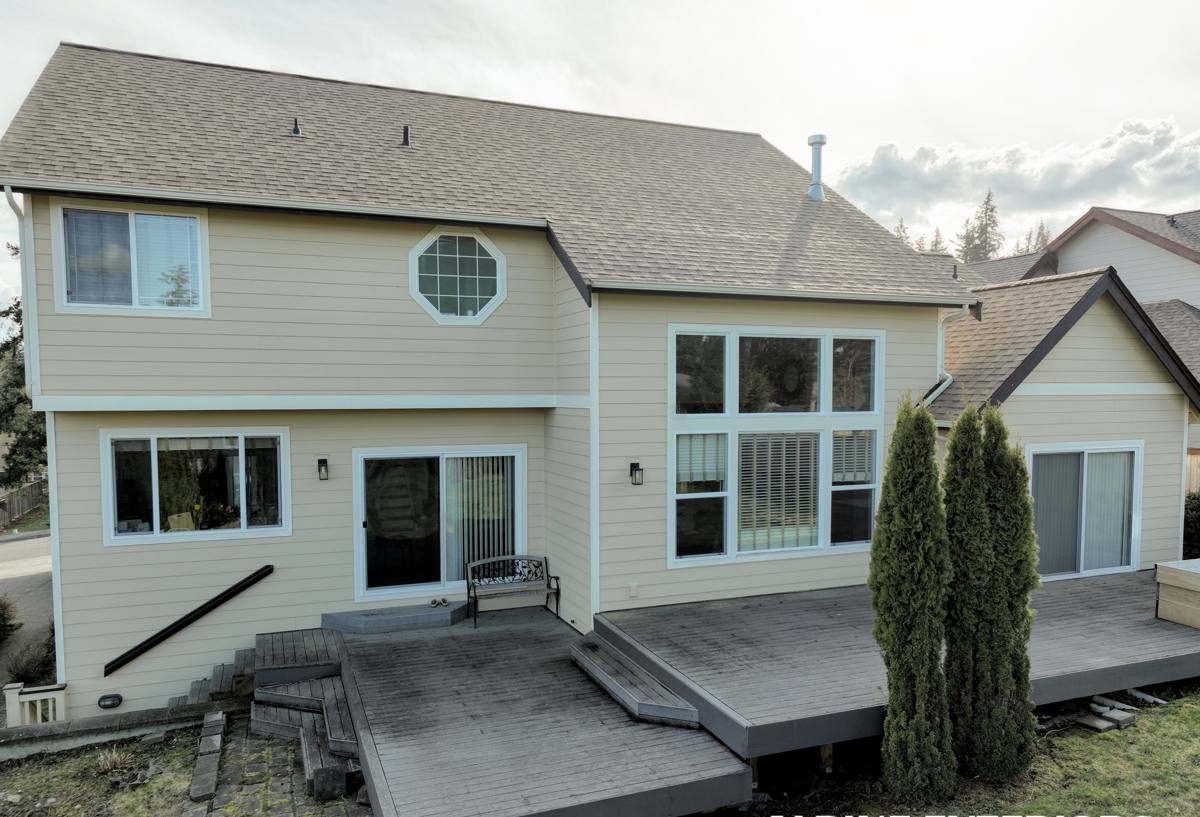
Why the Local Climate Changes the Window Equation
Ferndale and the surrounding Whatcom County communities sit close enough to the water that salt-laden air is a real factor on hardware and finishes, especially on the west and south-facing elevations that take the brunt of weather off the Strait. Layer on top of that the driving, wind-pushed rain that's typical of a Pacific Northwest winter, and you've got conditions that will find any gap in flashing or any weak point in a window's weather-stripping within a few seasons.
Then there's the moss and mildew season, which around here isn't really a season so much as most of the year. Constant damp, filtered light under tree cover, and mild temperatures are ideal for moss and algae growth on anything that stays wet and shaded — including window sills, trim, and the tops of frames if water isn't shedding the way it should. None of this means new-construction windows are complicated to get right. It means the details that are easy to skip on a dry-climate job — sill pans, back-dammed flashing, correct lap sequencing — are not optional here.
What This Looks Like in Practice
- Driving rain pushed by wind can drive water sideways and upward under poorly lapped flashing — sequencing matters more than in calmer climates
- Salt air accelerates corrosion on exposed fasteners and lower-grade hardware, so fastener and hardware spec matters more near the water
- Persistent moisture and shade promote moss and mildew on horizontal surfaces, including window sills and stools, if water isn't shedding cleanly away from the wall
- Temperature swings between a cold morning and a warmer, wet afternoon can create condensation on the interior glass if the window's performance rating doesn't match the local climate
Choosing the Right Frame Material for a New Build Here
There's no single "best" window frame material — each has real tradeoffs, and the right choice depends on your budget, the home's design, and how much upkeep you want to take on. What we can tell you honestly, from installing windows in this climate for years, is how each option tends to perform once it's been through a few wet Whatcom County winters.
| Frame Material | Moisture & Salt-Air Behavior | Maintenance | Typical Fit |
|---|---|---|---|
| Vinyl | Won't rot or corrode; UV can chalk lower-grade vinyl over many years | Low — occasional cleaning | Budget-conscious builds, rentals, straightforward openings |
| Fiberglass | Very stable in wet, temperature-swinging climates; resists warping | Low | Higher-end new builds, larger openings, painted trim schemes |
| Wood-clad | Interior wood look with an exterior-facing clad shell; the shell protects the wood if flashing and finish details are correct | Moderate — clad exterior is low-upkeep, interior wood benefits from periodic finish care | Homes prioritizing a traditional interior wood appearance |
| Aluminum | Strong and slim-profiled, but conducts heat/cold and can promote condensation without a thermal break; more exposed to corrosion near salt air over time | Low to moderate | Modern architectural styles, larger commercial-style glazing |
For most Nooksack-area new-construction projects, we lean toward vinyl or fiberglass because they hold up well against the combination of moisture and salt air without demanding much from the homeowner afterward. If the design calls for something else, that's a conversation about the specific opening, exposure, and finish goals — not a one-size answer.
Performance Ratings That Actually Matter Here
Window spec sheets list a lot of numbers, but two matter most for this climate: U-factor and condensation resistance. U-factor measures how well the window resists heat transfer — lower is better for our mild-but-damp winters, where you're heating a home through long stretches of gray, wet weather rather than extreme cold snaps. Solar Heat Gain Coefficient (SHGC) matters less here than in sunnier climates, but it's still worth getting right on south- and west-facing glazing so the home doesn't overheat on the clearer summer days we do get.
Condensation resistance is the number that gets overlooked most often, and it's directly tied to the interior comfort problems we hear about most — foggy glass, damp sills, and eventually mildew at the bottom corners of a window. A window rated for this region's humidity and temperature swings will resist interior condensation far better than a builder-grade window speced for a drier climate. Washington's energy code sets minimum performance thresholds for new construction, and we make sure whatever we install meets or beats those minimums for the specific orientation and exposure of each opening.
The Flashing and Weatherproofing Details That Matter Most
The window itself is only part of the system. Most water intrusion problems we've diagnosed in older homes in this region didn't start with a bad window — they started with a flashing detail that was rushed or sequenced wrong during the original build. On a new-construction install, we control every layer:
- Sill pan flashing — a sloped, back-dammed pan at the base of the rough opening so any water that gets past the window has a dedicated path back outside instead of soaking into the framing
- Jamb and head flashing — integrated with the weather-resistive barrier in the correct shingle-lap order, so every layer sheds water onto the layer below it, never the reverse
- Window-to-WRB integration — the nailing fin is taped and lapped into the house wrap so the window becomes part of the continuous drainage plane, not a separate patch in it
- Sealant at the right layer only — sealant belongs at the interior air seal and select exterior joints, never as a substitute for proper flashing sequencing (a bead of caulk is not a drainage plane)
- Weep path clearance — making sure sill weep holes and drainage gaps aren't blocked by trim, insulation, or overspray during later trades' work
Done in this order, a new-construction window installation sheds wind-driven rain the way it's designed to, even during the sideways winter storms this area is known for.
Our New-Construction Window Installation Process
On a typical Nooksack-area new build, our process runs in step with the framing and siding schedule rather than as a separate visit tacked on afterward:
- Verify rough openings against the window schedule before units arrive on site — undersized or out-of-square openings get flagged and corrected early
- Install sill pan flashing and back dam at every opening before the window goes in
- Set the window plumb, level, and square, shimming at the manufacturer's specified points to avoid frame distortion
- Fasten the nailing fin per the manufacturer's schedule — spacing and fastener type matter for both structural performance and warranty compliance
- Integrate flashing tape and WRB laps in the correct shingle order around the full perimeter
- Check operation (opening, closing, locking) after final fastening, before siding closes in the opening
- Coordinate with the siding and trim crews so weep paths and drainage gaps stay clear through the rest of the build
A Simple Pre-Install Checklist for Homeowners Working With a Builder
- Confirm window frame material and performance ratings are specified in writing, not just "builder standard"
- Ask who is responsible for sill pan flashing — the framer, the window installer, or the siding crew — so nothing falls through the cracks between trades
- Confirm the WRB (house wrap) brand and the flashing tape brand are compatible with each other per manufacturer guidance
- Walk the openings before siding goes on, if your schedule allows, to see the flashing work firsthand
Cost Factors for New-Construction Window Packages
Every new-construction window quote is a little different, but the line items that actually move the number are consistent. Rather than quote a blanket price, here's what tends to drive cost up or down on jobs in this area:
| Factor | Effect on Cost |
|---|---|
| Frame material (vinyl vs. fiberglass vs. wood-clad) | Vinyl is typically the most budget-friendly; fiberglass and wood-clad run higher |
| Window size and number of openings | Larger openings and higher window counts scale cost directly |
| Performance package (U-factor, glazing options) | Higher-performance glass packages add cost but reduce long-term energy and condensation issues |
| Exposure and elevation | South/west-facing and water-facing elevations may warrant upgraded flashing detail given wind-driven rain exposure |
| Access and building stage | Coordinating install mid-framing is typically more efficient than working around finished siding or interior trim |
| Special shapes or large spans | Custom sizes, arches, or oversized units add both material and labor cost |
We walk every job site-specific and give a written estimate before any work starts — there's no reason to guess when we can look at your plans and openings directly.
Working With Your Builder: Timing and Coordination
New-construction window work only goes smoothly when it's coordinated with the framing and siding schedule rather than squeezed in around it. We typically get involved early enough to confirm rough opening sizes against the window schedule, so there are no surprises when units arrive. From there, our install happens after the WRB is on and before siding closes the wall — the sequence that lets every flashing layer do its job.
If you're the homeowner rather than the builder, it's worth asking early who on the job is responsible for window flashing specifically. On some builds it's the framing crew, on others the window installer, and on others it's assumed to be part of the siding scope — and assumptions are exactly where details get missed. We're comfortable working directly with your builder or general contractor to make sure this handoff is clear before the walls close in.
Why a Crew That Already Works Nooksack Matters
A window installed correctly in a drier, calmer climate can still fail here if the flashing sequence doesn't account for wind-driven rain, or if the frame material wasn't chosen with salt air and near-constant moisture in mind. We work new-construction jobs throughout the Ferndale area and the surrounding Whatcom County communities, including Nooksack, which means the flashing details, fastener choices, and drainage planning on your job reflect what we've actually seen hold up here — not a generic install pulled from a manual written for a different climate.
That local familiarity also means fewer surprises mid-build. We know how this region's weather behaves across the build season, how moss and moisture accumulate on horizontal surfaces if drainage isn't right, and what performance ratings actually make a difference in homes here versus what's just a bigger number on a spec sheet.
If you're planning a new build or addition near Nooksack and want windows installed right the first time, we're happy to walk your plans, talk through frame and performance options, and give you a straightforward, no-pressure estimate — just fill out the form below.