 Ferndale Siding
 Siding That Has to Work in Nooksack's Climate, Not Just Look Good on Day One
Homes in and around Nooksack sit in a stretch of Whatcom County that takes a real beating from the weather. You're close enough to the Salish Sea to pick up salt-laden air, far enough inland to catch heavy driving rain off the foothills, and shaded enough through the fall and winter that moss and algae get a long runway to establish themselves on anything that stays damp. Siding here isn't just a cosmetic choice — it's the first line of defense against moisture intrusion, wood rot, and the slow surface breakdown that comes from months of low sun angle and standing dampness on north-facing walls.
We install James Hardie fiber cement siding exclusively, and this page is specifically about what that looks like for homes in the Nooksack area. Not a generic rundown of fiber cement — the actual climate pressures your walls face, what a correct installation has to account for, and why hiring a crew that already works this part of the county matters more than it might seem.
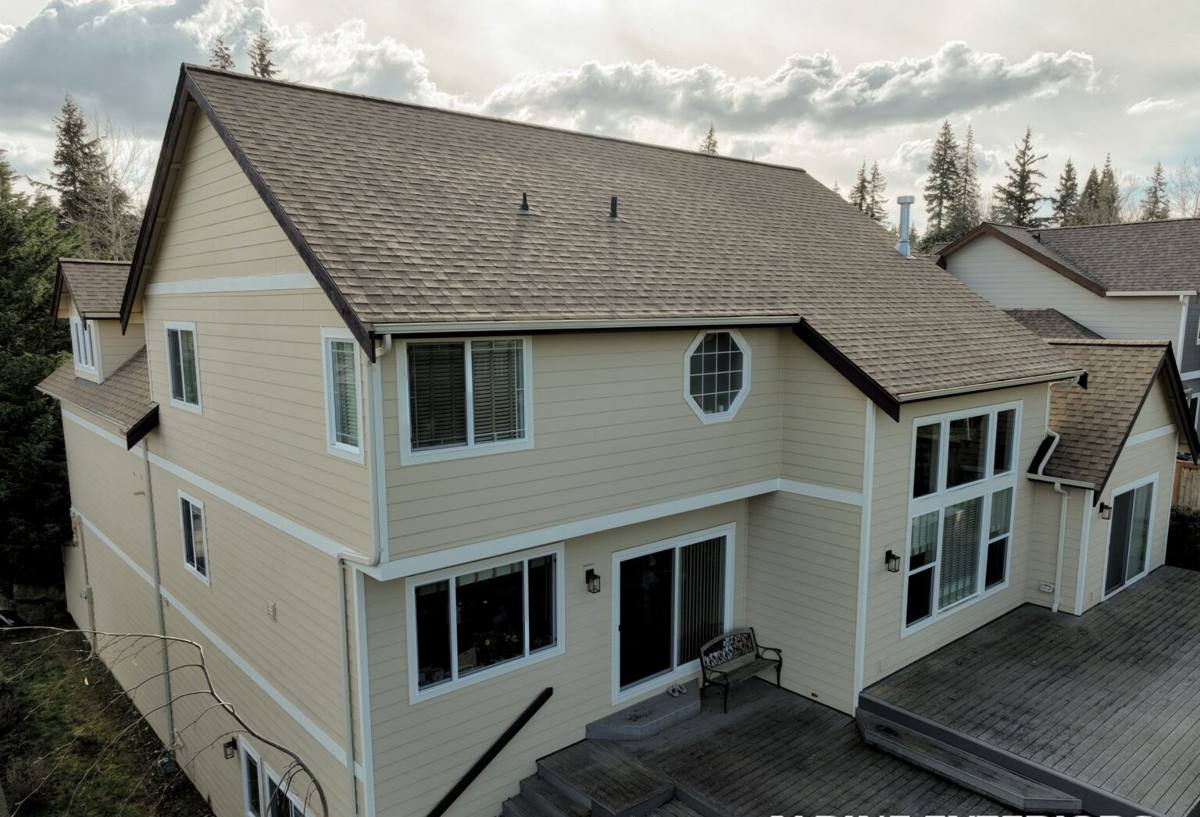
What Nooksack's Climate Actually Does to Siding
Salt Air and Slow Corrosion
Whatcom County's proximity to Bellingham Bay and the broader Salish Sea means airborne salt travels further inland than most homeowners assume, especially during windier winter storms. Salt-laden moisture accelerates corrosion on fasteners, flashing, and trim — which is why the hardware and flashing details matter as much as the siding panel itself. Fiber cement doesn't corrode, but everything holding it to the wall can, if it's the wrong material or installed the wrong way.
Driving Rain and Wind-Driven Moisture
Storms coming off the foothills and through the Nooksack valley tend to arrive with real horizontal push behind them. That means rain doesn't just fall on a wall — it gets driven into every lap joint, corner, and penetration that isn't sealed and shingled correctly. A siding product's water resistance only matters if the installation respects water-shedding order: every course, every trim piece, every flashing has to overlap the one below it so water is directed out, not trapped in.
A Long Moss and Algae Season
Between fall rains and a slow-to-dry spring, north- and east-facing walls in this area can stay damp for weeks at a stretch. That's exactly the environment moss and algae need to take hold. Untreated or poorly finished siding surfaces give organic growth something to grip onto, and once established, it holds moisture against the substrate — which speeds up whatever degradation is already happening underneath.
Why We Standardized on James Hardie Fiber Cement
We don't install LP SmartSide, vinyl, Cemplank, Allura, primed spruce, or cedar. That's not a marketing position — it's a decision based on what actually holds up over decades in this climate versus what looks fine for a few years and then becomes a maintenance project. James Hardie fiber cement is non-combustible, dimensionally stable in wet-dry cycling, and finished at the factory with ColorPlus technology, which bakes color into a baked-on finish rather than relying on field-applied paint that has to be reapplied every several years.
For Nooksack specifically, the relevant advantages are:
- Fiber cement doesn't absorb and swell with moisture the way engineered wood products can, which matters given how long walls here stay wet.
- The factory finish resists fading and chalking better than field-primed products, reducing how often you're up on a ladder repainting.
- Hardie's HZ5 product line is engineered specifically for climates like the Pacific Northwest's — freeze-thaw cycling, sustained moisture exposure, and moss-prone conditions.
- It's non-combustible, which matters increasingly in Washington as wildfire smoke and dry-season risk become a bigger part of insurance and building conversations even west of the Cascades.
What a Correct Fiber Cement Installation Requires Here
Water Management Before the First Panel Goes Up
The siding itself is the last layer, not the first line of defense. Before any Hardie board goes on a Nooksack home, the wall needs a properly lapped weather-resistive barrier, correctly flashed windows and doors, and a rainscreen gap where conditions call for it. Skipping this step is the single most common reason siding fails early — not because the material was wrong, but because water got behind it and had nowhere to go.
Fastening and Clearances
Hardie specifies exact nailing patterns, minimum clearances from grade, roofing, and decking, and specific gaps at butt joints to allow for expansion. In a high-moisture area like this, cutting corners on clearance from grade or roofline is asking for wicking and rot at the bottom courses — exactly where it's hardest to spot until it's already a problem.
Caulking and Joint Treatment
Every joint, corner, and trim intersection either gets caulked to Hardie's specification or is detailed to shed water without caulk at all, depending on the assembly. Given how much wind-driven rain this area sees, inconsistent caulking is one of the fastest ways to turn a good product into a leaky wall.
Finish and Color Considerations for Shaded, Damp Walls
ColorPlus finishes hold up well against moss and algae compared to field-painted surfaces, but wall orientation still matters. On homes with heavily shaded north sides, we factor that into product and color recommendations, since darker, matte finishes on constantly damp walls will show organic growth sooner than lighter, factory-glazed finishes.
Our Process for Nooksack Homes
- On-site assessment — we walk the exterior, check existing wall condition, look for signs of past moisture intrusion, and evaluate grade clearance and drainage around the foundation.
- Water management plan — we determine what's needed underneath the new siding: house wrap condition, flashing repair or replacement, and whether a rainscreen is called for on any elevation.
- Product and color selection — we walk through Hardie's plank, shingle, and panel options along with HZ5 specifics, and factor in sun exposure per wall when recommending finishes.
- Installation to Hardie spec — correct fastening, clearances, joint treatment, and flashing integration, inspected as we go rather than just at the end.
- Final walkthrough — we go over the finished work with you, including basic care and what to watch for seasonally in this climate.
Fiber Cement vs. Other Siding Options in This Climate
| Factor | James Hardie Fiber Cement | Vinyl | Engineered Wood (LP SmartSide) |
|---|---|---|---|
| Moisture behavior in high-rain areas | Dimensionally stable, doesn't swell | Can warp or buckle with heat/cold cycling | Vulnerable to swelling if edges aren't sealed and maintained |
| Salt air / coastal exposure | Not affected; fasteners/flashing are the concern | Generally stable but can become brittle over time | Edge sealing failure accelerates near moisture |
| Moss/algae resistance | Factory finish resists organic growth well | Can host growth, especially in shaded areas | Depends heavily on paint maintenance schedule |
| Fire rating | Non-combustible | Combustible | Combustible (wood-based) |
| Finish longevity | Factory-baked ColorPlus, long repaint intervals | Color molded in, can fade/chalk | Field-primed, needs repainting on a cycle |
Signs Your Current Siding Is Already Losing the Fight
- Soft spots or visible swelling, especially near the bottom courses or around window trim
- Moss or algae that returns quickly after cleaning, particularly on north- or east-facing walls
- Peeling or bubbling paint that keeps recurring in the same spots year after year
- Visible gaps or separation at butt joints and corners
- A musty smell or discoloration on interior walls that back up to exterior siding
- Fasteners that have rusted through or streaked the siding surface
Why Local Experience in This Specific Area Matters
Nooksack's mix of salt air, driving rain, and prolonged shaded dampness isn't identical to what a siding crew sees working in drier parts of the state, or even in denser parts of Bellingham with different wind exposure. A crew that already works this stretch of Whatcom County knows which elevations on a typical local home tend to hold moisture longest, how far grade clearance really needs to be given local drainage patterns, and which flashing details tend to get missed on homes built during particular local construction eras. That familiarity shows up in fewer callbacks and siding that's still doing its job fifteen and twenty years out, not just at the final walkthrough.
Get a Straight Answer for Your Home
If you're dealing with aging siding, visible moss, or just want to know what correct fiber cement installation looks like for a home in the Nooksack area, we're happy to take a look and give you a straightforward assessment — no pressure, no upsell into a product we don't stand behind. Use the form below to request a free estimate.