 Ferndale Siding
 Building New in Lynden? Windows Are Part of the Envelope, Not an Afterthought
If you're framing a new home or outbuilding in or around Lynden, the windows are one of the highest-risk points in the entire building envelope. A siding job on an existing wall can be forgiving in a few ways a rough opening cannot: once the wall is closed up, a poorly flashed window has nowhere for water to go but into the framing. We install new-construction windows as part of full exterior envelope work — siding, trim, flashing, and weather barriers together — because a window installed in isolation, without coordination to the wall assembly around it, is exactly how call-backs happen two or three winters later.
This page is specifically about new-construction window installation for homes going up in the Lynden area — not window replacement in an existing wall, which is a different scope with different tools and different failure points. If you're building new, the sequencing, flashing details, and coordination with your builder matter more than the window itself.
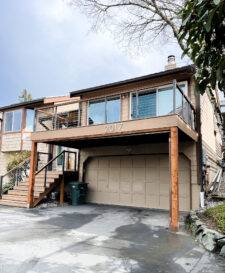
What Whatcom County Weather Asks of a New Window Opening
Whatcom County doesn't get hurricanes, but it gets something arguably harder on a building envelope: long stretches of low-intensity, wind-driven rain that can push water sideways into a wall assembly for days at a time. Add a moss season that runs from fall through spring, cooler and shadier microclimates on north- and west-facing walls, and — closer to the water around Ferndale and the bay — salt-laden air that accelerates corrosion on unprotected metal, and you have a climate that punishes shortcuts a drier region might get away with.
For a new-construction window opening, that translates into a few non-negotiables:
- Sill pan flashing under every window, not just caulk at the bottom edge
- A shingle-lapped flashing sequence that sheds water outward and downward at every layer, no exceptions for "easy" elevations
- Corrosion-resistant fasteners and hardware, especially on walls exposed to marine air
- A drainage plane behind the siding that actually connects to the window flashing instead of stopping at the rough opening
- Sealant placed only where it's supposed to manage air and vapor — not used as a substitute for flashing
None of this is exotic. It's standard best practice almost anywhere in the Pacific Northwest. What changes in Lynden and the surrounding county is the margin for error — with this much annual rainfall and humidity, a flashing detail that's "close enough" in a drier climate will show up as a stain on drywall or rot in framing within a few wet seasons.
New-Construction vs. Replacement: Why the Install Method Is Different
A lot of homeowners assume a window is a window. In new construction, the install method is fundamentally different from a retrofit, and it matters that whoever is setting your windows understands which job they're doing.
New-construction windows typically have a nailing flange around the perimeter of the frame. That flange gets integrated directly into the wall's weather-resistive barrier (WRB) and flashing system before siding goes on — the window becomes part of the water management plane of the wall, not just something sitting inside it. This gives us access to do the job right: we can flash the rough opening properly, lap the WRB over the flanges in the correct order, and build a drainage path that carries water down and out rather than trapping it.
Replacement windows, by contrast, usually go into an existing opening with the exterior wall finish already in place, often without a nailing flange, relying more heavily on sealants and interior/exterior trim to manage water. Both approaches can be done correctly, but they're not interchangeable methods — and a crew that mostly does one shouldn't be assumed to be equally sharp at the other. For new construction specifically, the sequencing discipline is what separates a window that performs for decades from one that becomes a warranty headache.
What a Correct New-Construction Window Install Actually Involves
Rough Opening and Sill Pan Flashing
Before a window ever goes in, the rough opening needs to be checked for square, level, and correct dimensions against the window's actual size — not just the size on the plan. We install a sloped sill pan flashing at the bottom of the opening so that any water that does get past the window has a built-in path to drain back outward instead of pooling on the sill and soaking into the framing. This is one of the most commonly skipped steps in fast-moving new construction, and it's one of the most consequential.
Flashing Sequence and the WRB
Flashing tape and the wall's weather-resistive barrier go on in a specific shingle-lap order — sill first, then jambs, then head flashing, each layer overlapping the one below it like shingles on a roof, never the reverse. Done correctly, water always finds a path down and out. Done out of order, water can get trapped behind the flashing and migrate into the wall, sometimes for years, before anyone notices.
Setting, Shimming, and Fastening
The window gets set into the opening plumb, level, and square, then shimmed at the correct load points so the frame doesn't rack or bind — a poorly shimmed window can bow enough to affect the seal or make the sash difficult to operate. Fasteners go through the nailing flange into solid framing at the spacing the manufacturer specifies; skipping fasteners to save time is a common shortcut that shows up later as air leaks or a window that isn't fully secured against wind load.
Sealant — Where It Belongs and Where It Doesn't
Sealant has a job in a window installation, but it's a supporting role, not the primary water management strategy. We use it at specific joints — around the interior air seal, at trim intersections — while the flashing and WRB do the actual work of shedding bulk water. A window installation that relies mainly on a bead of caulk to keep water out is one leak away from a problem.
Choosing Frame Material for a Lynden New Build
Frame material is one of the bigger decisions in a new-construction window order, and it affects both upfront cost and how the window handles our climate over time. There's no universally "right" answer — it depends on your budget, the look you're after, and how much long-term maintenance you want to take on.
| Frame Material | How It Handles Our Climate | Maintenance | Relative Cost |
|---|---|---|---|
| Vinyl | Good moisture resistance, won't rot or corrode; can flex slightly with big temperature swings | Low — occasional cleaning | Lower |
| Fiberglass | Very stable dimensionally, holds paint well, strong resistance to moisture and expansion/contraction | Low to moderate | Mid to higher |
| Wood (unclad interior) | Excellent insulating properties but vulnerable to moisture if flashing or finish fails | Higher — needs finish upkeep | Higher |
| Wood-clad (exterior aluminum or vinyl clad) | Combines interior wood look with a weather-resistant exterior shell — well suited to a wet climate | Moderate | Highest |
For most new builds in the Lynden area, we see vinyl and fiberglass covering the majority of the budget-to-performance range, with wood-clad reserved for homeowners who want a specific interior finish and are willing to pay for it. Whatever material you choose, the installation quality matters more to long-term performance than the frame material alone — a well-flashed vinyl window will outperform a poorly flashed premium window every time.
How We Work With Your Builder or General Contractor
Pre-Framing Walkthrough
Before framing is finalized, we like to review rough opening sizes against the actual window order — even small discrepancies are far cheaper to fix before drywall than after. If we're also doing the siding and exterior trim on the build, this is also when we coordinate the WRB and flashing plan for the whole envelope, not just the window openings in isolation.
Installation Day
Windows go in after the WRB is on the wall and before siding starts, following the sill-pan-then-shingle-lap sequence described above. We work around weather where we can — flashing tape and some sealants need dry, workable temperatures to adhere properly, and rushing that step in the wrong conditions is how adhesion failures happen later.
Inspection and Sign-off
Once windows are set and flashed, we do a check of every opening before siding goes on and covers up the work — operation, seal, flashing lap direction, fastener pattern. This is the last point where a flashing mistake is cheap and easy to fix. After siding is up, the same fix means removing finished material.
A Checklist Before Your Windows Go In
Whether you're the homeowner, the builder, or the GC coordinating trades, these are worth confirming before window installation starts on your project:
- Rough opening dimensions have been field-verified against the actual window order, not just the plan set
- Sill pan flashing is specified and installed at every opening, not just the ones that look exposed
- The WRB and flashing tape brand are compatible with each other (some combinations aren't, per manufacturer guidance)
- Flashing sequence follows shingle-lap order: sill, then jambs, then head
- Fastener type and spacing match the window manufacturer's installation instructions
- Sealant is specified for air-seal joints, not relied on as the primary water barrier
- Someone has checked operation (open, close, lock) on every window before siding covers the opening
- Manufacturer warranty paperwork is on file, including who performed the installation
Why a Crew That Already Works in Lynden Matters
New-construction window installation touches your local building department, your framer, your siding crew, and the manufacturer's warranty terms all at once. A crew that regularly works Lynden and greater Whatcom County has already worked through the coordination that trips up out-of-area contractors: what inspectors here typically want to see at flashing checks, how to sequence around our wetter shoulder seasons, and which fastener and flashing tape combinations hold up under our marine-influenced air rather than just looking fine on installation day.
There's also a simple accountability argument. If a flashing detail turns up an issue in year three or four — which is a realistic timeline for a slow leak to show up as a stain or soft spot — you want the same local company that did the install to still be reachable, not a crew that came through from out of town for one job. We install windows as part of ongoing exterior work across Ferndale, Lynden, and the surrounding communities, which means we're still local when a warranty question comes up.
Getting Started
If you're planning a new build in Lynden and want your windows installed by a crew that treats the flashing and sequencing as seriously as the window itself, we're happy to take a look at your plans and talk through the details before framing is finalized. Reach out for a free, no-pressure estimate using the form below — there's no obligation, and it's the easiest way to get your project on our schedule.