 Ferndale Siding
 Why Marietta's Location Changes What Your Siding Has to Survive
Marietta sits close enough to Bellingham Bay and the Whatcom County shoreline that homes here take on a different kind of weather load than siding twelve miles inland. Salt-laden air moves in off the water, wind-driven rain hits walls at an angle instead of falling straight down, and the shaded, damp stretches of the year run long. None of that is exotic or unusual for this part of Washington — but it does mean siding that's marginal in a drier, more sheltered part of the county tends to fail faster in Marietta specifically.
When we replace siding here, we're not treating it as a generic Ferndale job. We're accounting for a house that spends more of the year wet, more of the year shaded, and more of the year exposed to airborne salt than most homes even a short drive east.
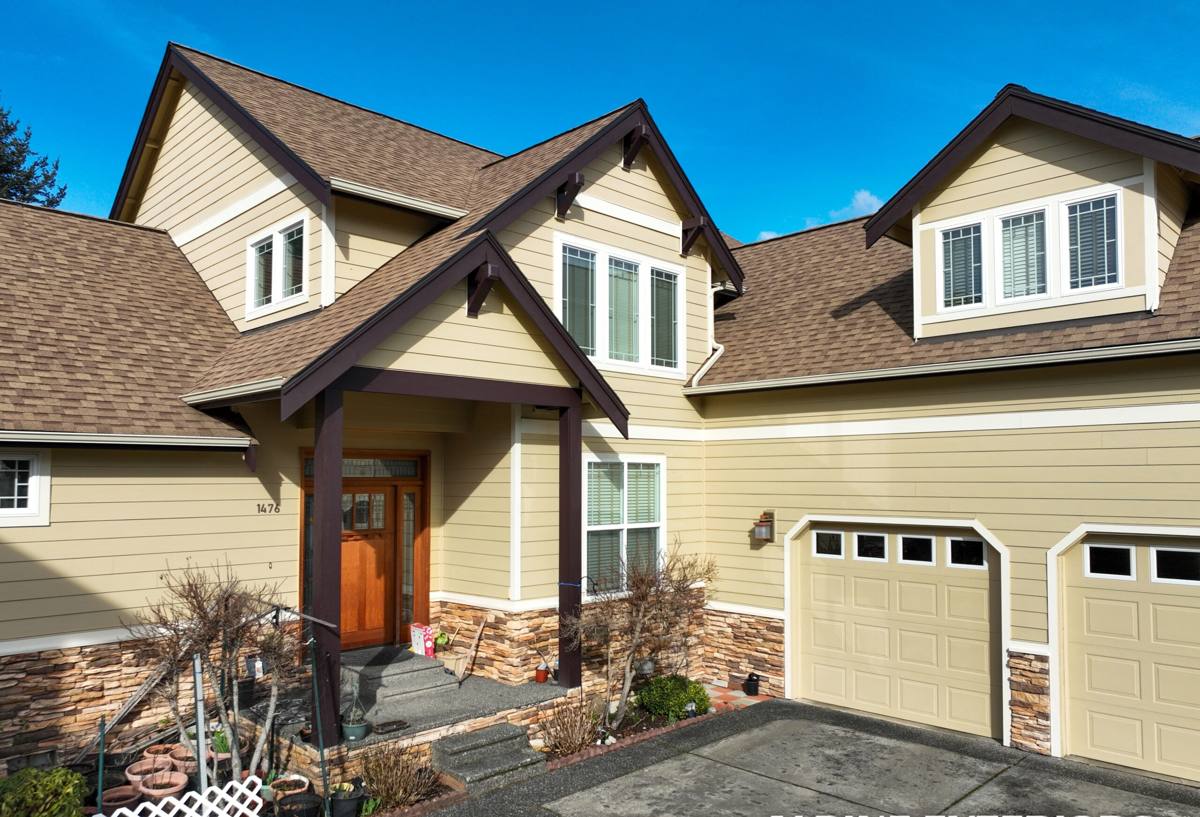
What Salt Air, Driving Rain, and Moss Actually Do to Siding
Salt air
Airborne salt doesn't just sit on the surface — it works into fasteners, trim seams, and any cracked or checked coating, accelerating corrosion at the exact points where water already wants to get behind the siding. Materials that rely on paint film alone to keep moisture out lose that protection faster in a salt-influenced environment, because the film degrades unevenly and often first at fastener heads and butt joints.
Driving rain
Rain that hits a wall at an angle, rather than running straight down the face, pushes water into laps, seams, and any gap in flashing that would otherwise shed a light, vertical rain just fine. Marietta's exposure to weather coming off the water means driving rain is a routine event here, not an occasional storm condition — so lap coverage, flashing detail, and the water-resistive barrier behind the siding all matter more than they would on a fully sheltered lot.
Moss and prolonged dampness
Whatcom County's wet season runs long, and shaded north and west-facing walls in Marietta can stay damp for weeks at a stretch. Moss and algae take hold on any surface that holds moisture at the texture level, and once established they keep the substrate underneath wetter for longer, which is exactly the condition that rots wood-based products and de-laminates poorly bonded coatings.
Why We Only Install James Hardie Fiber Cement
We install one siding system: James Hardie fiber cement, factory-finished with ColorPlus. We don't install vinyl, LP SmartSide, Cemplank, Allura, primed spruce, or cedar, and in an environment like Marietta's the reasons are practical, not brand loyalty.
Fiber cement is non-combustible and dimensionally stable — it doesn't expand and contract with moisture the way wood-based siding does, so it doesn't cup, swell, or open up joints the way primed spruce or cedar can after repeated wet-dry cycles. That stability matters more, not less, in a climate that swings from saturated winters to dry, sunny stretches. James Hardie also engineers specific product lines — HardieZone HZ5 — for the Pacific Northwest's moisture exposure, which is a level of climate-specific engineering that generic fiber cement and wood-composite competitors don't offer.
The ColorPlus factory finish is baked on under controlled conditions rather than field-applied, which gives it more consistent coverage and adhesion than site-painted products — a real advantage against salt air, since the finish is the first line of defense against the corrosion and UV breakdown that salt exposure accelerates. It also carries a strong transferable warranty, which matters to a lot of Marietta homeowners thinking about resale.
None of this means other products are junk — vinyl is inexpensive and low-maintenance in mild climates, LP SmartSide has real fans, and cedar has a look some homeowners specifically want. But we've made a professional call: in a salt-air, high-rainfall, long-moss-season environment, we don't want our name on a product whose long-term performance depends on maintenance discipline the homeowner may or may not keep up with for 20+ years. Hardie's combination of non-combustibility, dimensional stability, factory finish, and climate-specific engineering is what we're willing to warranty our workmanship on.
What a Correct Siding Replacement Involves in Marietta
Replacing siding correctly here is as much about what's underneath the boards as the boards themselves. A job that only swaps old siding for new without addressing the assembly behind it is a job that will fail early in this climate.
- Full tear-off and inspection: removing the old siding lets us actually see the sheathing, framing, and any hidden moisture damage — especially on the shaded, wet-prone elevations common in Marietta.
- Water-resistive barrier: a correctly lapped and taped WRB behind the siding is what actually keeps driving rain out of the wall assembly; the siding itself is the second line of defense, not the only one.
- Flashing at every penetration: windows, doors, hose bibs, light fixtures, and butt joints all need proper flashing detail — this is where most real-world leaks start, and it's the detail that separates a fast install from a correct one.
- Rainscreen or proper drainage gap: in a high-moisture, salt-air environment, giving water a path to drain and the wall a chance to dry out matters more than in drier parts of the state.
- Correct fastening per Hardie spec: fastener type, spacing, and depth are engineered by James Hardie for specific climate zones (HZ5 for this region) — deviating from spec is one of the most common causes of premature siding failure and voided warranties.
- Factory-finished ColorPlus boards with matching caulk and touch-up: minimizing field-cut, unpainted edges reduces the number of vulnerable points exposed to salt air and rain.
Our Process, Start to Finish
1. On-site assessment
We walk the exterior with you, looking specifically at which elevations take the most weather, where moss and algae are already established, and where the existing siding or trim shows signs of moisture intrusion.
2. Honest scope and estimate
You get a clear, written estimate that separates siding, trim, flashing, and any sheathing repair as distinct line items — no vague lump sums that hide what you're actually paying for.
3. Tear-off and structural check
Old siding comes off, and we inspect sheathing and framing before anything new goes up. If there's rot or moisture damage, we address it before covering it back up.
4. Install to Hardie spec
WRB, flashing, fastening, and clearances are installed per James Hardie's published specifications for this climate zone — not shortcuts, because the warranty and the performance both depend on it.
5. Final walkthrough
We go over the finished work with you, including basic care guidance specific to a Marietta property — what to expect from ColorPlus finish here, and what maintenance (if any) actually applies.
Cost Factors for a Marietta Siding Replacement
Every home is different, but these are the factors that most often move the price on a project like this one:
| Factor | Why It Matters in Marietta |
|---|---|
| Extent of tear-off and hidden damage | Long-term moisture exposure on shaded, water-facing walls can mean sheathing repair, which isn't visible until old siding comes off |
| Siding profile and trim complexity | Board width, trim detail, and corner treatments affect labor and material |
| Number of penetrations (windows, vents, fixtures) | Each one needs individual flashing — more penetrations mean more labor time |
| Drainage/rainscreen requirements | Homes with a documented moisture history often benefit from an upgraded drainage gap |
| House size and elevation access | Two-story walls, steep grades, or limited access affect scaffolding and labor time |
| Color and finish selection | Factory ColorPlus finish is a fixed-cost upgrade over field-painted alternatives, but eliminates a recurring repaint cost |
We'll walk through which of these apply to your specific home during the estimate, in plain terms, before any work starts.
Why Hiring a Crew That Already Works in Marietta Matters
Siding installation isn't identical everywhere in Whatcom County. A crew that mostly works drier, more sheltered inland lots can install competent siding that still underperforms on a Marietta property, simply because they're not used to detailing flashing and drainage for this level of salt and wind-driven rain exposure. A crew that already works this specific area knows which elevations typically take the worst weather, what moss growth on an existing wall usually indicates underneath, and how to detail the assembly so it actually holds up to the conditions this neighborhood sees every winter.
That local familiarity isn't a marketing point — it shows up in fewer callbacks, fewer surprises during tear-off, and siding that's still performing well a decade in.
Simple Maintenance That Actually Helps in This Climate
- Rinse siding annually, focusing on shaded, north- and west-facing walls where moss and algae establish first
- Keep gutters clear so overflow doesn't run down the wall face and stay wet longer than it should
- Trim back vegetation that shades siding and traps moisture against the wall
- Re-caulk any gaps at trim and penetrations if you notice them opening up over time
- Have flashing and caulk lines checked periodically, especially after a hard winter
With correctly installed James Hardie siding, this list stays short — it's maintenance, not repair, and it's a lot less demanding than the upkeep wood-based or field-finished products require in this climate.
If you're planning a siding replacement in Marietta, we're happy to walk your property, look at what your specific elevations are dealing with, and give you a straightforward, no-pressure estimate. There's a form below — reach out and we'll get you scheduled.