 Ferndale Siding
 Siding Replacement Built for Life on Lummi Island
Lummi Island sits just off the Whatcom County mainland, reachable only by a short ferry crossing, and that separation shapes more than the commute for the people who live there. It also shapes how hard the island's weather works on a house. Homes on Lummi Island sit closer to open water on more sides than most mainland Ferndale properties, with less tree cover and fewer windbreaks in a lot of spots, which means the salt air, driving rain, and moss that affect all of Whatcom County show up here in a heavier, more constant dose.
Siding replacement on an island property is not the same job as a re-side on a sheltered inland lot, even though the materials and basic steps look similar on paper. Fastener choice, flashing detail, and the underlying moisture-management system all matter more here, because a shortcut that might go unnoticed for years on a calm inland street tends to surface fast on a house that takes wind and rain straight off the water. This page covers what siding replacement specifically involves for a Lummi Island home, what correct work looks like, and how our process runs for an island project.
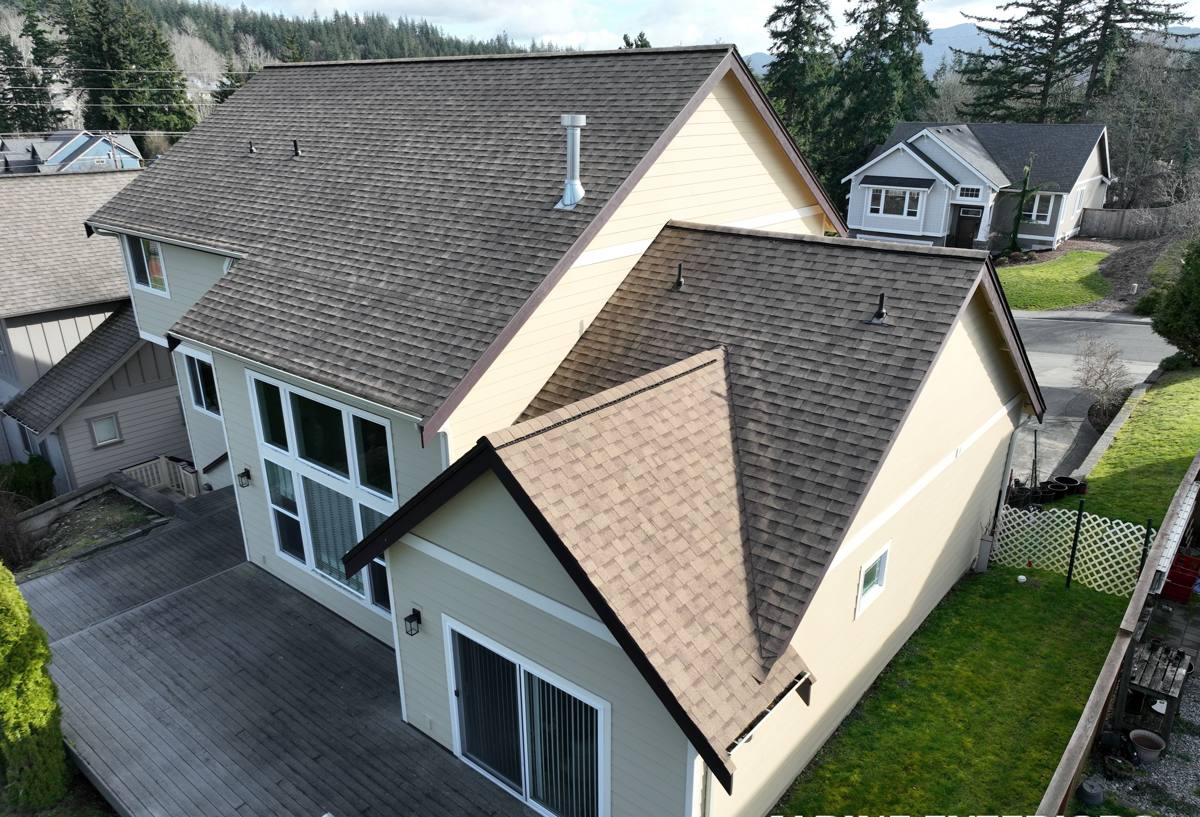
What Lummi Island's Climate Does to Siding
Salt Air With Fewer Windbreaks
Island homes generally sit closer to open water on more exposures than mainland properties, and with less surrounding development to block the wind, salt-laden air reaches the siding, trim, and fasteners more directly and more often. Salt speeds up corrosion in nail heads, flashing, and any exposed metal trim, and it breaks down lower-grade paints and coatings faster than a drier, more sheltered site ever would. On siding that's already marginal, salt exposure is usually what turns a slow failure into a visible one.
Driving Rain Off the Strait
Storms coming across the water don't arrive straight down — wind pushes the rain sideways, and that sideways load finds its way into lap joints, trim seams, and butt joints that a straight-down rain would never reach. Island lots with open water exposure on more than one side see this pattern more often and with more force than a typical inland Ferndale property, which is exactly the kind of moisture that gets behind poorly installed siding rather than running off the surface.
A Moss Season That Runs Most of the Year
Mild temperatures and near-constant island moisture add up to a moss and mildew season that can run most of the year on shaded, north-facing, or tree-covered walls. Moss and mildew don't just look bad — sustained growth holds moisture against the wall surface long after a rain event has passed, and any siding material with even a little surface porosity gives it something to grip. On Lummi Island, that shows up early on lots with heavier tree cover and on walls that don't get much winter sun.
Wind Loading
Open water exposure on more sides of a property also means stronger, more sustained wind during winter storm systems than a lot of mainland Ferndale homes see. That matters directly for siding replacement, since fastening pattern and spacing are what keep panels and trim secured through real wind loading, not just through a calm afternoon.
Why James Hardie Fiber Cement Is What We Install
We install James Hardie fiber cement siding exclusively. That standard didn't come from a supplier deal — it came from what we've seen, repeatedly, on tear-offs and service calls at high-exposure, water-adjacent properties like the ones on Lummi Island.
- Non-combustible core: Fiber cement doesn't feed a fire the way wood-based or wood-derived siding products can, which matters for both household safety and insurance considerations on an island property.
- Factory-applied ColorPlus finish: The color is baked on under controlled factory conditions instead of brushed on in the field, so it holds up against salt exposure, UV, and moisture far longer than a site-applied paint job would.
- Climate-engineered HZ5 formulation: Hardie's HZ5 product line is engineered for regions with sustained moisture exposure and freeze-thaw cycling, which is a close match for an exposed island lot.
- Dimensional stability: Fiber cement doesn't swell, cup, or warp the way engineered wood siding products can after repeated wet-season moisture cycling.
- Strong transferable warranty: Hardie backs its products with one of the stronger warranty structures in the industry, provided installation follows spec — real protection, not just a marketing line.
We don't install LP SmartSide, vinyl siding, Cemplank, Allura, primed spruce, or cedar. Each has a place in the market and homeowners who are satisfied with it. But on a property that takes this much sustained wind, salt, and rain, we made a professional call to install one system we fully stand behind rather than offer something cheaper that quietly shifts maintenance risk onto the homeowner a few years down the road.
What a Correct Siding Replacement Involves Here
Material choice only gets an island home halfway there. The rest comes down to how the job is actually built, and on a lot with this much water exposure, none of the following steps are optional:
- Full tear-off and substrate inspection: Old siding comes off so the sheathing and framing underneath can actually be checked for hidden moisture damage before anything new goes on.
- Rain screen drainage gap: A small cavity behind the siding lets any moisture that does get past the surface drain and evaporate instead of sitting against the wall sheathing.
- Correct fastener type and spacing: Hardie specifies corrosion-resistant fastener types and placement for a reason — loose spacing or the wrong fastener is one of the more common causes of early siding failure we find on tear-offs.
- Properly lapped house wrap and flashing: Every seam, corner, and penetration needs to shed water downward and outward, which matters more on a wall that takes wind-driven rain directly.
- Sealed butt joints and trim transitions: Open or poorly sealed joints are where salt-laden moisture finds its way behind the siding first.
- Fastening pattern matched to wind exposure: An exposed island wall calls for tighter attention to spec than a sheltered inland wall would.
Skip any one of those steps and a new siding job can still look good on install day. The problems tend to show up a season or two later, as staining, soft trim, or a panel that's started to lift at a corner.
Full Re-Side vs. Repair
Not every siding problem on a Lummi Island home calls for a full tear-off. Storm-damaged sections or an isolated area of trim failure can sometimes be repaired and matched into existing Hardie siding. But when moisture has been tracking behind the wall for a while, or the home still has an older, non-Hardie product reaching the end of its service life, patching usually just delays a larger job while hidden rot keeps spreading underneath. We'll tell you honestly which situation you're actually looking at.
Cost Factors for Lummi Island Siding Replacement
| Factor | What It Affects | Why It Matters on the Island |
|---|---|---|
| Ferry access and scheduling | Crew and material logistics | Deliveries and crew transport need to work around ferry crossings, which we build into scheduling |
| Distance from open water | Salt and wind exposure level | Lots with exposure on more sides see faster material wear and higher wind loads |
| Tear-off vs. overlay | Labor scope and substrate access | Tear-off reveals hidden moisture damage that's common under older siding on exposed lots |
| Substrate condition | Repair costs before new siding goes on | Long-term trapped moisture can rot sheathing and framing that has to be addressed first |
| Trim and detail complexity | Labor time | Corners, window trim, and transitions all need extra sealing attention on a high-exposure wall |
These are general cost drivers, not a quote. Every Lummi Island property sits at a different distance from the water and under different tree cover, so we walk the home in person and account for ferry logistics before putting a real number on the work.
Planning Around the Ferry and Island Access
Working on Lummi Island means building a project schedule around the ferry rather than treating it as an afterthought. We coordinate crew transport and material deliveries so the work moves efficiently once we're on-site, and we plan around ferry timing the same way we plan around weather. Homeowners on the island sometimes assume that access adds significant cost or delay to a siding project — in most cases it's a scheduling factor we account for up front rather than something that changes the scope of the work itself.
Timing a Siding Replacement Around Island Weather
Whatcom County's wettest, windiest stretch typically runs from late fall through winter, and Lummi Island's open water exposure can make that stretch feel more pronounced than it does on a sheltered mainland lot. Spring and summer generally offer the driest, most stable conditions for tear-off and installation, since fiber cement, house wrap, and flashing all perform better when they're installed and allowed to set up under dry conditions rather than between storm systems. That said, siding that's already letting moisture in doesn't get better by waiting for the ideal season, so active water intrusion is worth addressing on its own timeline.
Signs a Lummi Island Home Needs Siding Replacement
- Moss or dark staining that returns quickly after cleaning, especially on shaded or north-facing walls
- Soft or spongy siding, particularly low on the wall or around window and door trim
- Rust staining or corroding fasteners and trim, more common this close to open water
- Peeling, chalking, or bubbling paint on walls with heavy sun and salt exposure
- Visible gaps, cracks, or warping at seams, corners, and trim transitions
- Cupping, buckling, or panels that have started to pull away from the wall
- Rising energy bills that may point to a wall assembly no longer sealing the way it should
Why a Crew That Already Works the Island Matters
A contractor based on the mainland can still do competent work on an island property, but a Lummi Island job has variables that don't come up on most Ferndale streets — heavier salt and wind exposure, ferry-dependent scheduling, and a moss season that runs longer than it does further inland. Working this area regularly means we're not guessing at fastening specs or flashing details on your project, and we're not treating the ferry as a surprise that throws off the schedule. We've seen which installation details hold up against the island's specific combination of salt air, driving rain, and wind, and which ones are worth the extra time rather than a shortcut that quietly costs the homeowner later.
That familiarity also shows up in the smaller judgment calls — which walls on an island lot stay wet longest through the winter, and being straightforward about whether a section of siding needs repair or the whole wall needs to come off.
Get a Free, No-Pressure Estimate
If your Lummi Island home needs new siding, or you want an honest read on whether what you're seeing is a repair or a full replacement, we're glad to take a look. Reach out using the form below to schedule a free estimate — no pressure, no upsell script, and we'll work the visit around the ferry schedule.