 Ferndale Siding
 Why Windows Matter Differently in Kendall
Kendall sits inland from Bellingham Bay, tucked up toward the Mount Baker foothills, so it doesn't take the direct salt air that homes closer to the water deal with. What it does get, in full measure, is the rest of Whatcom County's weather: long stretches of driving rain, heavy humidity that never fully lets up between storms, and a moss season that can stretch from fall through spring. Add in the wider temperature swings that come with elevation and distance from the bay's moderating effect, and Kendall homes put real, sustained stress on their windows year after year.
Older or poorly installed windows in this environment don't just waste energy — they let moisture find its way into wall cavities, fog up between panes, and turn drafty in the exact months a home needs to hold heat. Energy-efficient windows, installed correctly for this climate, address both problems at once: comfort and protection.
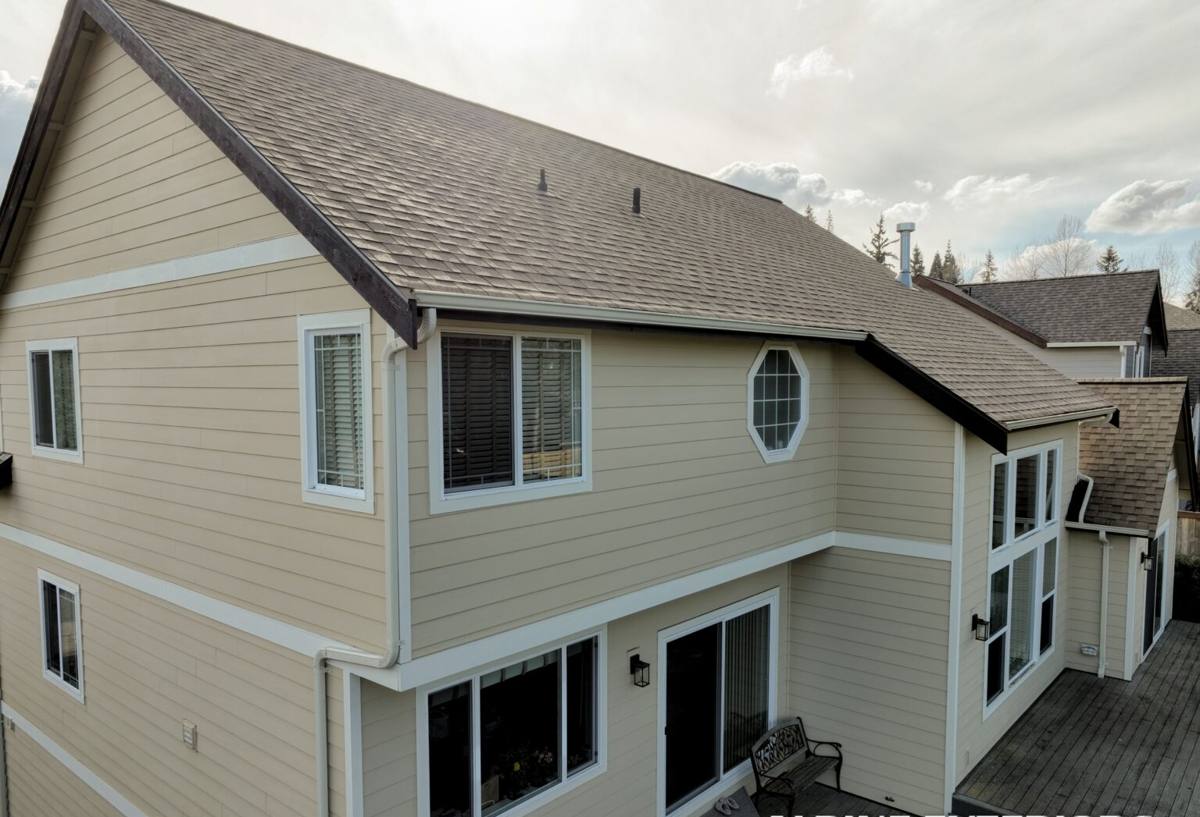
What "Energy-Efficient" Actually Means
The term gets used loosely. For a Kendall home, it should mean a specific set of performance numbers and construction details, not just a sticker on the glass.
The Numbers That Matter
- U-factor — measures how much heat escapes through the window. Lower is better, and it's the number that matters most for a climate with cool, damp winters.
- Solar Heat Gain Coefficient (SHGC) — measures how much solar heat passes through the glass. In this climate we generally aren't fighting excessive summer heat, so this matters less here than it would in a sunnier region, but it still affects comfort on south-facing walls.
- Air leakage rating — how much air moves through the assembly when it's closed. Lower ratings matter a lot when wind-driven rain is a regular event.
- Condensation resistance — a rating that predicts how well a window resists interior fogging in cold, humid conditions, which is directly relevant to a house that stays damp outside for weeks at a time.
A window can carry an efficiency label and still underperform in this specific climate if it wasn't specified with these numbers in mind for a wet, cool, low-sun region rather than a hot, dry one.
Frame Materials: What Actually Holds Up Here
Frame material affects insulation value, moisture tolerance, and how much upkeep a homeowner signs up for. None of these are the wrong choice for every home — the right one depends on the specific wall assembly, exposure, and budget.
| Frame Type | Insulation Performance | Moisture Tolerance | Maintenance |
|---|---|---|---|
| Vinyl | Good, with insulated/multi-chamber options performing well | Handles damp climates well, won't rot | Low — no painting or sealing needed |
| Fiberglass | Very good; dimensionally stable in temperature and humidity swings | Excellent — very low expansion/contraction | Low to moderate |
| Wood-clad | Good, warm interior appearance | Depends heavily on cladding and installation quality; the wood core is the weak point if moisture gets behind the cladding | Higher — exterior cladding and seals need periodic inspection |
| Aluminum | Poor unless thermally broken | Handles rain fine but conducts cold, inviting interior condensation | Low |
For a climate with Kendall's rain totals and humidity, we lean toward vinyl or fiberglass for most homes as our professional standard, because both hold up to sustained moisture without relying on a perfect, unbroken paint or sealant layer over years of PNW weather. Wood-clad windows can still be the right call for a homeowner who wants that look and is committed to the upkeep — it's a trade-off in maintenance burden, not a defect in the product.
Signs Your Windows Are Already Underperforming
Most homeowners don't notice window failure until it's obvious — but there are earlier signs worth checking for, especially heading into another wet season.
- Visible fog or a haze between panes of double- or triple-pane glass (a sign the seal has failed and the gas fill is gone)
- Condensation forming on the inside of the glass regularly, especially on colder mornings
- A noticeable draft when standing near a closed window on a windy, rainy day
- Soft or discolored wood, or bubbling paint, on the interior or exterior trim around the frame
- Difficulty opening, closing, or fully latching a window that used to operate smoothly
- Moss or dark streaking building up on the sill or exterior trim faster than on the surrounding siding
- A noticeable temperature difference near the window compared to the rest of the room
Any one of these on its own might not mean a full replacement is needed. Several of them together, especially on the same wall, usually points to a window and flashing system that's no longer doing its job.
What a Correct Installation Actually Involves
In this climate, the window unit itself is only part of the job. Most window failures we see in Whatcom County homes trace back to installation and flashing details, not the window product itself.
The Details That Matter Most
- Flashing sequence — sill pan flashing, side flashing, and head flashing need to be installed in the correct shingle-lap order so water is directed out and down, never trapped behind the siding.
- Weather-resistive barrier integration — the window's flashing has to tie into the house wrap or building paper correctly, not just get taped over it.
- Air sealing at the rough opening — gaps between the frame and rough opening need proper low-expansion foam or backer rod and sealant, not just fiberglass insulation stuffed in the gap.
- Exterior sealant joints — the right sealant, applied to clean, dry, properly prepped surfaces, with attention to which joints should be sealed and which need to stay open to drain.
- Proper shimming and squaring — a window that's out of square will bind, won't seal tightly, and puts uneven stress on the frame over time.
Get any one of these wrong and a high-efficiency window can still leak, draft, or trap moisture in the wall — which is why we treat installation quality as equally important to the window product itself.
Our Process for a Kendall Window Project
- On-site assessment — we look at existing windows, flashing condition, and any signs of moisture intrusion around the openings, not just the glass.
- Honest recommendation — full replacement, or repair/reseal where that's genuinely sufficient. We don't push replacement where it isn't needed.
- Product selection — matching frame material, glass package, and style to the home's exposure, existing architecture, and budget.
- Written estimate — clear scope, materials, and pricing before any work is scheduled.
- Removal and flashing correction — old units come out carefully, and we correct any flashing or sheathing issues found underneath before the new window goes in.
- Installation and air sealing — proper shimming, insulation, and sealant per the details above.
- Final check and cleanup — operation check on every window, exterior trim finished, site cleaned up.
Cost Factors for Energy-Efficient Windows
Every home is different, so we won't quote a number without seeing the job — but the main variables that move the price are consistent from house to house.
| Factor | Why It Affects Cost |
|---|---|
| Window count and size | More openings and larger units mean more material and labor |
| Frame material | Vinyl is typically the most economical; fiberglass and wood-clad cost more upfront |
| Glass package | Double-pane vs. triple-pane, low-E coatings, and gas fill all add cost along with performance |
| Condition of the rough opening | Rot, water damage, or out-of-square openings found during removal add repair time before the new window can go in |
| Full-frame vs. insert replacement | Full-frame (tear-out to the studs) costs more than an insert but is often the right call when flashing or moisture issues exist |
| Access and site conditions | Second-story windows, tight lot access, or extensive trim work add labor time |
As a broad range, homeowners in this area typically see per-window pricing anywhere from the low hundreds for a straightforward insert replacement into a sound opening, up to well over a thousand dollars per window for full-frame replacement with higher-end glass packages. The only way to get a real number is a look at the actual openings.
Why Local Experience with Kendall Homes Matters
A crew that already works in and around Ferndale and greater Whatcom County has seen how homes here are actually built and how they actually fail — not in a generic sense, but for this specific mix of building stock, exposure, and weather pattern. That means recognizing which wall assemblies are prone to trapping moisture, knowing what a healthy versus failing flashing detail looks like on the styles of homes common in this area, and understanding that a window spec written for a drier or milder climate isn't automatically the right one here.
It also means being realistic about scheduling around the wet season. Window replacement openings can't sit exposed to driving rain for long, so a crew familiar with the local weather pattern plans the work — and the sequence of removal and reinstallation — accordingly, rather than leaving a home vulnerable between steps.
Maintaining Efficient Windows Once They're In
New windows still need basic upkeep to hold their performance through years of Whatcom County weather.
- Rinse pollen, moss spores, and grime off the glass and frames a couple of times a year
- Check and clear weep holes on the exterior sill so water can drain rather than pool
- Inspect exterior sealant joints annually for cracking or separation and have them touched up before they fail
- Operate every window through a full open-close-lock cycle at least once a season so hardware doesn't seize up from disuse
- Keep an eye on nearby vegetation and gutters — overhanging branches and clogged gutters both dump extra moisture directly onto window trim
If your Kendall home's windows are drafty, fogged, or you're just planning ahead for a remodel, we're happy to take a look and give you a straightforward, no-pressure estimate — just fill out the form below.