 Ferndale Siding
 Fiber Cement Siding Built for Lynden's Weather
Lynden sits inland from the coast, but that doesn't mean the weather goes easy on a house. Whatcom County still gets salt-laden air pushing in off the Strait of Georgia and Bellingham Bay, months of driving rain off the Pacific, and the kind of damp, low-sun winters that turn north-facing walls into moss farms. Add in the freeze-thaw swings that show up most winters, and you've got a climate that's genuinely hard on exterior materials — even ones marketed as "low maintenance."
We install fiber cement siding on homes throughout the Lynden area, and we do it with one product line: James Hardie. This page walks through what that actually means for a Lynden home — what the climate demands, what correct installation looks like, and how our process works from first call to final walkthrough.
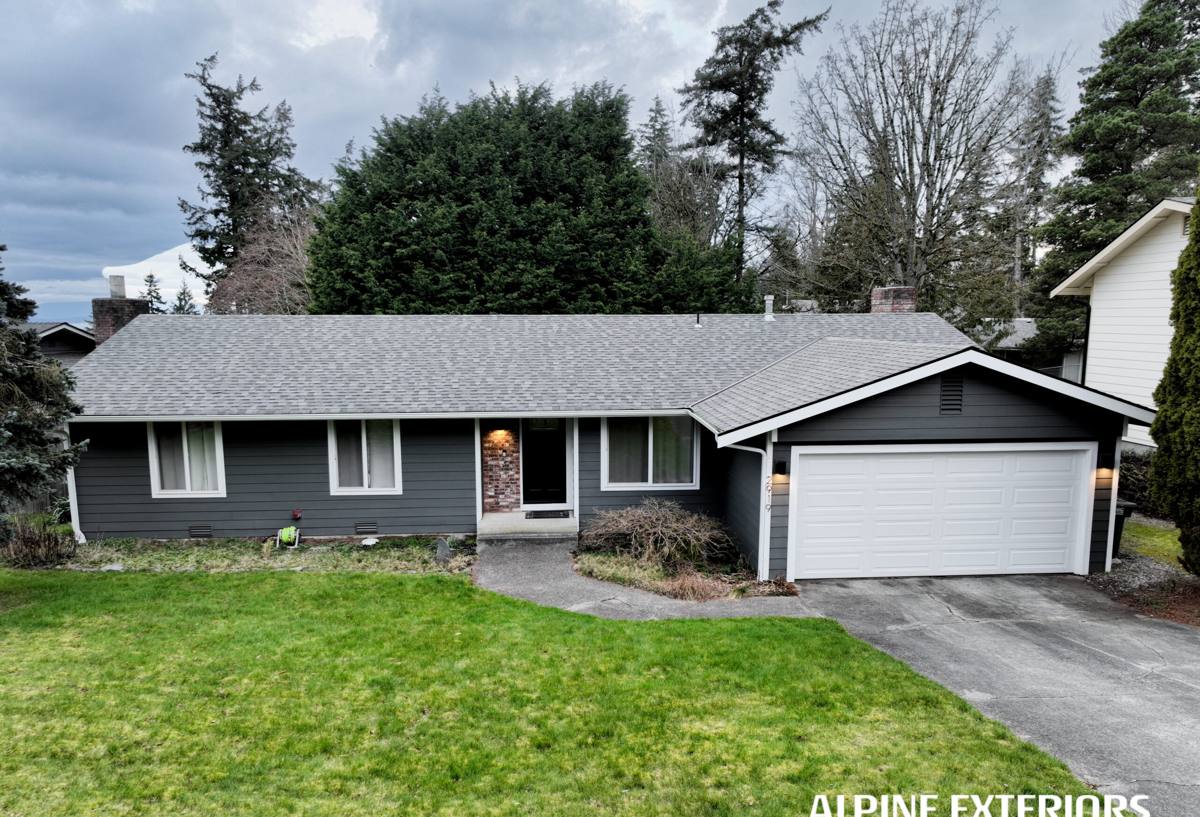
What This Climate Does to Siding Over Time
Most siding failures we get called out to look at aren't dramatic. They're slow. Moisture gets behind a panel that wasn't flashed right, and five years later there's soft trim and a stain nobody can explain. A caulk joint dries out and cracks, and rain starts wicking into the sheathing every time a storm rolls through. None of it happens overnight — that's exactly why it's easy to miss until the repair bill is a lot bigger than it needed to be.
The Three Things Working Against Your Siding
- Moisture load: Extended wet seasons mean siding spends a large share of the year damp, not just rained-on. Materials that absorb or swell with moisture are under constant stress here.
- Moss and biological growth: Shaded walls, fences, and north exposures stay damp long after the rest of the property has dried out, which is exactly the environment moss and mildew need to establish themselves.
- Salt air exposure: Even away from the immediate waterfront, airborne salt accelerates corrosion on fasteners, flashing, and any exposed metal trim — which matters more than most homeowners realize, since a siding system is only as good as the metal that ties it together.
None of this is a reason to panic about your current siding. It's the reason the material choice and the installation quality both matter more here than they would in a drier, milder climate.
Why Fiber Cement Fits Lynden Homes
Fiber cement is a mix of cement, sand, and cellulose fiber, pressed and cured into planks or panels. Unlike wood-based products, it doesn't feed rot fungus, doesn't swell and shrink dramatically with moisture, and it's non-combustible. That combination matters in a region where homes deal with sustained damp weather most of the year.
But "fiber cement" isn't one product — quality varies a lot between manufacturers, and installation quality matters just as much as the material itself. A great product installed wrong will fail in the same places a mediocre product would. That's why we're specific about both the brand we use and how we put it on the wall.
Why We Only Install James Hardie
We don't install LP SmartSide, vinyl, Cemplank, Allura, primed spruce, or cedar. That's a deliberate standard, not a lack of options. Here's the reasoning:
- Climate-engineered product lines: Hardie makes HZ5 and HZ10 formulations specifically engineered for regions with heavier moisture exposure — including the Pacific Northwest. That's not marketing language; it changes the composition of the board itself.
- Factory-applied ColorPlus finish: The color and topcoat are baked on at the factory under controlled conditions, which gives far more consistent, durable coverage than field-applied paint — and it comes with its own finish warranty separate from the substrate warranty.
- Non-combustible core: Fiber cement doesn't ignite or contribute fuel to a fire the way wood-based sidings do. In a state with real wildfire exposure, that's a meaningful difference in risk, not just a spec sheet line.
- A transferable warranty backed by installation standards: Hardie's warranty coverage depends on installation to their published specifications — which pushes us to install correctly every time, and gives homeowners real recourse if something does go wrong with the material itself.
We're not going to tell you competing products are junk — several of them are reasonable materials with real trade-offs in cost, appearance, or maintenance. What we will say is that after years of installing and repairing siding in this climate, Hardie is the one we're willing to put our name behind and warranty our labor against.
What a Correct Fiber Cement Installation Actually Involves
This is the part most homeowners never see, and it's the part that determines whether siding lasts 30-plus years or starts failing in five. A fiber cement job is only as good as the details underneath it.
Before a Single Plank Goes Up
- Removal of old siding and inspection of the sheathing underneath for existing moisture damage or rot
- Repair or replacement of any compromised sheathing — covering over a soft spot is how "new" siding fails in year two
- Installation of a weather-resistive barrier (housewrap) with correctly lapped and taped seams
- Proper flashing at every window, door, and roofline intersection — the single most common failure point we find on inspections
During Installation
- Correct fastener spacing and depth per Hardie's published installation guide — over-driven nails crack boards and void warranty coverage
- Proper gapping at butt joints and around penetrations to allow for expansion without trapping moisture
- Rain-screen or drainage plane detailing where the wall assembly calls for it, so any moisture that does get behind the siding has somewhere to go
- Factory-mitered or field-caulked joints done to spec, not just "close enough"
Finishing Details
- Touch-up of any cut edges with Hardie-approved products to maintain moisture protection
- Proper caulking at trim transitions using a caulk rated for this climate's humidity swings
- Final inspection against Hardie's installation checklist before we call the job done
Skip any one of these steps and you can end up with siding that looks right for a few years and then fails from the inside out — which is a hard thing to diagnose and an expensive thing to fix once it's behind the wall.
Our Process, Start to Finish
- Free on-site estimate: We walk the exterior with you, look at your current siding condition, trim, and any problem areas, and talk through what the job actually requires.
- Detailed written proposal: Scope, product line, color, and price — no vague allowances that turn into change orders later.
- Sheathing inspection during tear-off: We don't cover up problems. If we find rot or moisture damage once the old siding is off, we'll show you and talk through the fix before proceeding.
- Installation to Hardie spec: Flashing, wrap, fastening, and gapping done to the manufacturer's published standard, not shortcuts.
- Final walkthrough: We go over the finished job with you before we consider it complete.
Comparing Siding Options for a Lynden Home
| Material | Moisture Performance in This Climate | Maintenance | Typical Lifespan |
|---|---|---|---|
| James Hardie Fiber Cement | Engineered for wet climates (HZ5/HZ10 lines); non-combustible | Periodic wash; factory finish resists fading | 30+ years with correct install |
| Vinyl | Can warp, buckle, or crack in temperature swings; seams are moisture entry points | Low, but replacement panels can be hard to match after fading | 15-25 years |
| Wood/Cedar | Absorbs moisture readily; needs a sound moisture barrier and diligent upkeep | Regular repainting/staining and inspection for rot | Highly variable, often 15-20 years without diligent care |
| Engineered Wood (LP SmartSide) | Wood-based core is moisture-sensitive if edges or cuts aren't sealed properly | Field touch-up required at cuts and edges | Manufacturer-rated, but installation-sensitive |
This isn't meant to disparage every alternative — plenty of homes wear vinyl or wood siding just fine with the right maintenance habits. It's meant to explain why, given what we see in Whatcom County's climate specifically, fiber cement is where we've chosen to specialize.
What Fiber Cement Siding Typically Costs
Every home is different, and the number that matters is the one in your written estimate — but broadly, cost depends on a handful of factors:
| Cost Factor | Why It Matters |
|---|---|
| Home size and wall complexity | More corners, dormers, and cutouts mean more labor and material waste |
| Current siding removal | Tear-off and disposal of old material adds time versus a bare wall |
| Sheathing condition | Rot repair discovered during tear-off is priced separately, since it's not knowable until the wall is opened up |
| Product line and profile | Lap siding, panel siding, and trim/accent details all price differently |
| Color | Factory ColorPlus finishes and custom colors vary in cost from standard options |
We'll never give you a number over the phone that we can't back up in writing after seeing the house in person.
Signs Your Current Siding May Be Failing
- Persistent moss or dark staining that comes back shortly after cleaning
- Soft or spongy spots when you press on the siding, especially near the bottom courses or window trim
- Visible warping, buckling, or gaps between panels
- Paint that's bubbling or peeling rather than just fading
- Rising energy bills that coincide with drafty walls
- Interior wall staining or musty smells near exterior walls, which can point to moisture intrusion behind the siding
If any of these sound familiar, it's worth having someone look before it turns into a sheathing repair on top of a siding job.
Why Local Experience in Whatcom County Matters
A crew that only occasionally works this area might not think twice about skipping a rain-screen detail or using a caulk that isn't rated for our humidity swings. A crew that works Lynden and the surrounding communities regularly knows which details aren't optional here — where moss builds up fastest, which wall orientations take the worst of the driving rain, and why the flashing details at rooflines and windows can't be treated as an afterthought. That local pattern recognition is part of what you're paying for when you hire a contractor who already knows this climate, not just the general Pacific Northwest.
If you're weighing a siding replacement or dealing with a current siding problem on a Lynden-area home, we'd be glad to take a look and give you a straight, no-pressure assessment. Fill out the form below for a free estimate.