 Ferndale Siding
 New Construction Windows Built for Fairhaven's Weather
Building new near Fairhaven means dealing with weather that's tougher on windows than most of the country ever sees. You're close enough to the water to get salt-laden air working on metal components, close enough to the foothills and marine layer to get long stretches of driving rain, and far enough north in Whatcom County that moss and moisture sit on exterior surfaces for months at a time. Windows installed correctly the first time shrug all of that off for decades. Windows installed with shortcuts start showing problems in year two or three — fogged glass, soft trim, water stains creeping down the wall below the sill.
This page is about one job specifically: installing windows into new construction in the Fairhaven area — not replacing old windows in an existing wall, but setting new units into open rough openings as a home or addition is being built. It's a different job than a retrofit, with different risks and a different correct process, and it's worth understanding before you sign off on a bid.
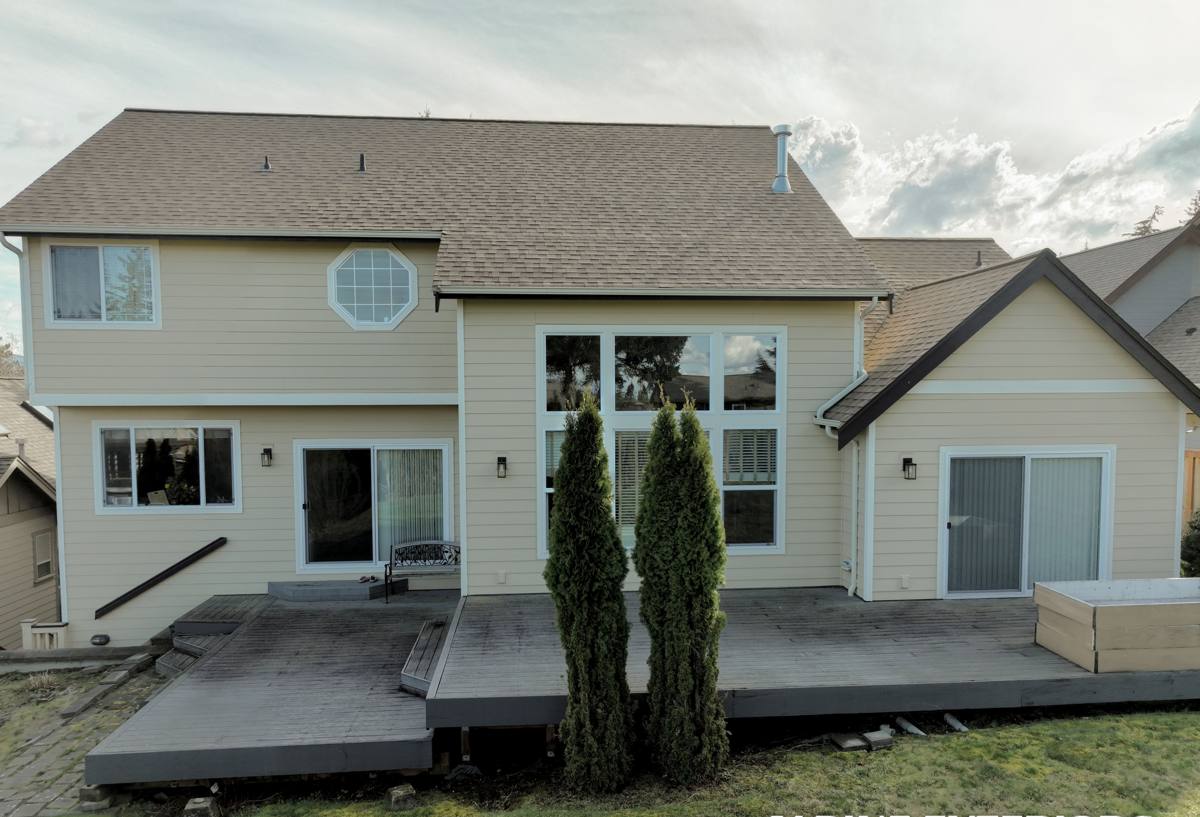
New-Construction vs. Replacement — Why the Distinction Matters
New-construction windows have a nailing fin (or flange) around the perimeter of the frame that gets fastened directly to the sheathing before siding goes on. That fin is what ties the window into the building's water management system — the weather-resistive barrier, the flashing, and eventually the siding all work together with it to shed water outward and downward, never inward.
Replacement windows, by contrast, get set into an existing frame with no fin, relying on the old frame and trim for weatherproofing. If a new-construction window gets installed like a replacement — no fin integration, minimal flashing, caulk doing the work that flashing should be doing — it will leak eventually. It's not a question of if in this climate, it's when. This is the single most common corner-cutting mistake we see corrected on newer homes in Whatcom County.
Why This Matters More Near the Water
Homes closer to Bellingham Bay and the surrounding shoreline take wind-driven rain from more directions and more often than homes further inland. A flashing detail that's "good enough" in a drier climate isn't good enough here. Every rough opening near Fairhaven should be treated as a location that will see sustained, sideways rain at some point in its life — because it will.
What Fairhaven-Area Homes Need From Their Windows
Salt Air and Corrosion
Salt air accelerates corrosion on unprotected fasteners, hinges, and hardware. It's slow and easy to ignore for the first few years, then it isn't. We spec corrosion-resistant fasteners and hardware for anything within a few miles of the water, and we flag it as a real consideration for this job, not an upsell.
Driving Rain
Wind off the water pushes rain sideways, not straight down. That means water tests every seam a window has — not just the top, where most people assume the risk is, but the sides and bottom of the frame where flashing laps matter most. A window that only sheds water well in a straight-down rain isn't built for this area.
Moss Season
Whatcom County's long wet season means moss and algae get a real foothold on any horizontal or slow-draining surface — including window sills, trim, and the top of exterior casing. Moss holds moisture against wood and paint far longer than rain alone would. Detailing that keeps water moving off these surfaces, rather than pooling on them, matters as much as the window unit itself.
What a Correct New-Construction Window Install Actually Involves
The window itself is maybe a third of the job. The rest is water management around it — the part that isn't visible once siding goes back on, and the part that determines whether the install lasts 30 years or fails in five.
Rough Opening Prep
The opening gets checked for square, level, and correct size before the window ever gets set. Sill pan flashing goes in first, sloped to drain outward, so any water that does get past the window has somewhere to go besides the framing.
Weather-Resistive Barrier Integration
The house wrap or weather-resistive barrier has to be cut, folded, and taped in the right sequence relative to the window flange — not just stapled around it. Get this sequence wrong and you've built a shingle that channels water into the wall instead of away from it.
Flashing the Fin
Flashing tape goes over the nailing fin on the sides first, then the top, in a shingled pattern so every layer overlaps the one below it. The bottom is left to drain rather than sealed shut — a sealed bottom traps whatever water does get in.
Setting and Fastening
The window gets shimmed and fastened per the manufacturer's schedule — not just at the corners — checked for square and operation before anything gets covered up, and insulated around the frame with a low-expansion foam or backer rod that won't bow the frame out of square.
Trim and Sealant
Sealant is the last line of defense, not the first. It goes at the joints between trim and siding, using a product rated for the movement and exposure it'll see — never as a substitute for proper flashing underneath.
Window Type & Material Comparison
| Frame Material | How It Handles Salt Air & Rain | Maintenance | Typical Fit for Fairhaven-Area Builds |
|---|---|---|---|
| Vinyl | Won't corrode; good sealed-unit performance | Low — occasional cleaning | Solid, budget-friendly choice for most new builds |
| Fiberglass | Excellent — very stable in temperature swings and moisture, resists warping | Low | Strong choice for exposed, water-facing elevations |
| Aluminum | Needs corrosion-resistant hardware and finish near salt air; thermal bridging is a factor | Moderate — watch fasteners and finish over time | Works with the right spec, but needs attention to detail here |
| Wood / Wood-Clad | Handles moisture poorly without diligent upkeep; clad exterior helps but exposed wood parts are vulnerable | High — regular inspection and refinishing | Best reserved for protected elevations, or skipped in favor of low-maintenance materials |
We'll talk through these trade-offs honestly during your estimate — the "best" material is really about which elevation it's going on and how exposed that side of the house is to wind and rain.
Our Process for New-Construction Window Installs
- Plan review: We look at the window schedule and rough opening sizes before framing is finalized, so nothing gets built out of tolerance.
- Coordination with your builder: Sequencing matters — windows need to go in at the right point relative to the weather-resistive barrier and before siding starts.
- Sill pan and flashing install: Done to a consistent, shingled sequence on every opening, not just the ones facing the weather.
- Window set and fastening: Checked for square, level, and smooth operation before it's covered.
- Insulation and air-sealing: Around the frame, so the window isn't a thermal or air leak once drywall and siding close it in.
- Final walkthrough: Every window operated and inspected before we consider the job done.
Common Mistakes We Get Called to Fix
- Nailing fins caulked instead of flashed — looks sealed, fails within a few wet seasons
- Weather-resistive barrier lapped backward or taped in the wrong order around the opening
- Sill pans missing or flat instead of sloped, so trapped water has nowhere to go
- Fasteners not rated for coastal exposure, corroding faster than the window itself
- Trim sealed on all four sides, trapping moisture that gets past the outer seal
None of these are visible from the street. They show up later as soft trim, interior stains, or a window that suddenly won't close square — usually right around the time a home's original builder-grade caulk starts to fail.
Maintenance Checklist for New Windows
Even a correctly installed window benefits from a homeowner keeping an eye on a few things, especially through Whatcom County's wet months:
- Check exterior sealant joints once a year for cracking or separation, especially after the first winter
- Keep sills and horizontal trim clear of moss, leaves, and debris that trap moisture
- Operate every window at least once each season so hardware doesn't seize
- Look for staining on interior sills or trim below windows — an early sign of a flashing issue
- Have gutters and downspouts checked nearby — overflow onto upper windows is a common hidden cause of leaks
Why Hire a Crew That Already Works the Fairhaven Area
Flashing details that work fine in a dry inland climate aren't automatically right for a lot that catches wind off the water. A crew that installs windows around Fairhaven and the rest of Whatcom County regularly already knows which elevations need the extra attention, which materials hold up, and which shortcuts show up as callbacks two winters later. That's not something you can fully spec on paper — it's built from doing the work in this specific climate, on this specific coastline, season after season.
We coordinate directly with builders and general contractors on new-construction schedules, so windows go in at the right point in the build sequence — not rushed, not delayed past when the weather barrier needs to be closed up.
Get a Free, No-Pressure Estimate
If you're building new near Fairhaven and want windows installed right the first time — flashed, sealed, and set up to handle salt air, driving rain, and a long moss season without drama — we're happy to walk the plans with you. Use the form below for a free estimate, no pressure and no obligation.