 Ferndale Siding
 Why Decks Near Fairhaven Wear Out Faster Than You'd Expect
If you own a home in the Fairhaven area near Ferndale, you already know the weather here is harder on exterior wood than most manufacturers' warranties assume. Whatcom County's coastal position means salt-laden air drifts inland on a regular basis, and that air doesn't just smell like the water — it accelerates corrosion on fasteners, hinges, and any exposed metal hardware holding your deck together. Add in months of driving rain each fall and winter, followed by a long stretch of shade and moisture that keeps moss and algae established well into what should be a dry season, and you have a climate that's genuinely tough on decks.
A deck built with standard hardware and no real drainage plan can look fine on the surface for years while the structure underneath — ledger board, joists, footings — quietly deteriorates. By the time boards are visibly cupping or the railing feels loose, the problem is usually further along than it looks. That's the pattern we see over and over on replacement calls in this area: cosmetic wear is the last symptom to show up, not the first.
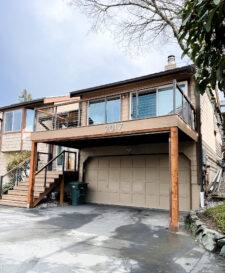
Repair or Replace? Signs It's Time
Not every tired-looking deck needs a full teardown. But there are signs that point clearly toward replacement rather than patching:
- Soft or spongy spots in the decking, especially near the house or around post bases
- A ledger board that's pulling away from the house, or visible gaps at the flashing
- Rust streaking from fasteners or visible corrosion on structural hardware
- Persistent moss or dark staining that returns within weeks of cleaning
- Railings or stairs that flex or feel less solid than they used to
- A deck more than 15-20 years old that was built before current guardrail and footing codes
If what you're seeing is limited to a few boards or a section that gets more weather exposure than the rest, repair can be the right call. If the issues are structural or spread across the substructure, replacement is usually more honest — and often more cost-effective over time — than chasing repairs on a frame that's already compromised.
What a Correct Deck Replacement Actually Involves
The Substructure Comes First
The part of a deck that fails first in this climate is almost never the decking boards — it's what's underneath. Footings need to be sized and set to current code, posts need real ground clearance, and joists need to be spaced and fastened in a way that doesn't trap water. We build the frame first and get it right before a single deck board goes down, because a good-looking deck on a weak frame is just a slower failure.
Ledger and Flashing
Where the deck attaches to the house is the single most important detail on the entire structure, and it's the spot most likely to be done wrong on older or budget builds. Proper flashing — installed so water is directed away from the ledger and the house's wall assembly, not into it — is non-negotiable. This is also where driving rain does the most damage over time if it wasn't detailed correctly the first time.
Fasteners and Hardware
Given the salt air common to this part of Whatcom County, we use corrosion-resistant, code-rated hardware and fasteners rated for the connection type — not just whatever's cheapest at the hardware store. Standard galvanized fasteners can start showing rust within a few seasons this close to the coast; stainless or high-grade coated hardware costs more up front and holds up considerably longer.
Drainage and Airflow
Boards laid too tight, or a frame with no airflow underneath, holds moisture and feeds moss and rot. Correct board spacing and, where the site allows it, some ventilation under the deck make a real difference in how long the whole system lasts through wet Pacific Northwest winters.
Decking Material Options for This Climate
There's no single "best" decking material — it depends on your budget, how much maintenance you want to take on, and how the deck is used. Here's how the common options actually perform in a wet, moss-prone coastal climate like Fairhaven's:
| Material | Moisture Behavior | Maintenance | Typical Lifespan |
|---|---|---|---|
| Pressure-treated wood | Resists rot when sealed regularly; can cup or warp if neglected | Annual cleaning and re-sealing recommended | 10-15 years with upkeep |
| Cedar | Naturally moisture-resistant, still needs sealing to prevent graying and moss | Periodic cleaning and finish renewal | 15-20 years with upkeep |
| Composite decking | Doesn't rot, but can develop surface mold/moss in shaded, damp spots if not cleaned | Occasional washing, no staining or sealing | 25-30 years |
| PVC/capped polymer | Fully moisture-resistant surface, least prone to moss staining | Lowest — occasional rinse | 25-30+ years |
We'll walk you through the honest trade-offs for your specific spot on the property — how much shade it gets, how exposed it is to weather, and what upkeep you're realistically willing to do — rather than pushing one product as the answer for everyone.
Our Deck Replacement Process
- On-site assessment: We check the existing structure, ledger connection, footing condition, and site drainage before quoting anything.
- Honest scope: You get a clear breakdown of what's structural, what's cosmetic, and what code requires versus what's optional.
- Demo and disposal: Full removal of the old deck, including hardware and any compromised framing members.
- Framing and flashing: New footings, posts, joists, ledger, and flashing built to current code — not just matched to what was there before.
- Decking and railing installation: Your chosen material installed with attention to spacing, drainage, and fastening for this climate.
- Final walkthrough: We go over the finished deck with you, including any maintenance recommendations specific to the material you chose.
Cost Factors to Expect
Deck replacement pricing varies a lot based on size, material, and how much of the substructure needs rebuilding versus reusing. Rather than quoting a flat number that won't mean much without seeing your deck, here are the factors that actually move the price:
| Factor | Why It Matters |
|---|---|
| Square footage and shape | Larger and multi-level decks require more material and labor |
| Decking material chosen | Composite and PVC cost more upfront than wood but less over the deck's life |
| Substructure condition | Rotted footings or a compromised ledger add rebuild scope beyond the surface |
| Railing style and code requirements | Guardrail height, baluster spacing, and stair codes affect materials and labor |
| Site access | Decks with difficult equipment or material access take longer to build |
Permits and Code in Whatcom County
Most deck replacements of any real size require a permit, and older decks were often built to codes that have since changed — particularly around guardrail height, baluster spacing, and footing depth. When we replace a deck, we build to current requirements rather than just matching what was there, which protects you both for safety and for resale down the road. We handle the permit process as part of the job so you're not left navigating it alone.
Why Hire a Crew That Already Works in This Area
A deck built for a dry inland climate isn't built for Fairhaven. Crews who don't regularly work this close to the water can underestimate what salt air and prolonged moisture do to fasteners, framing, and finishes over time — and that shows up as premature failure five or ten years down the road, not on installation day. Working consistently in this part of Whatcom County means we spec hardware, flashing details, and material choices with this specific climate in mind, not a generic regional average.
Before you hire anyone for a deck replacement, a few questions are worth asking:
- Do you pull permits and build to current guardrail and footing code, or just match the old deck?
- What fastener and hardware grade do you use, and why?
- How do you detail the ledger flashing where the deck meets the house?
- Can you explain the maintenance trade-offs between decking materials honestly, not just sell the most expensive option?
- Do you carry insurance and offer a written warranty on the work?
A contractor who answers these clearly, without hedging, is one who's actually thought through what a deck needs to survive out here.
If your deck is showing wear, feels less solid than it used to, or you're just planning ahead, we're happy to take a look and give you a straight assessment — no pressure, no obligation. Use the form below to request a free estimate for your Fairhaven-area deck replacement.