 Ferndale Siding
 Metal Roofing for Everson Homes
Everson sits inland in Whatcom County, away from the immediate coastline, but it's still squarely inside the same marine-influenced weather pattern that shapes roofing decisions across this whole corner of Washington. Moist air moves up the valleys from the Sound, rainfall comes wind-driven more often than it falls straight down, and mild, damp conditions give moss and algae a growing season that runs most of the year. Add in some salt-laden air that reaches inland on stronger weather systems, and you have a climate that's genuinely hard on roofing materials that weren't chosen or installed with it in mind.
We work roofing, siding, windows, and decks across Ferndale and the surrounding Whatcom County communities, including Everson, and metal roofing is one of the systems we get asked about most from homeowners who are tired of re-treating moss, patching wind-lifted shingles, or replacing a roof on a shorter cycle than they'd like. It's not the right call for every home or every budget, but for the right situation it holds up to this climate better than almost anything else on the market.
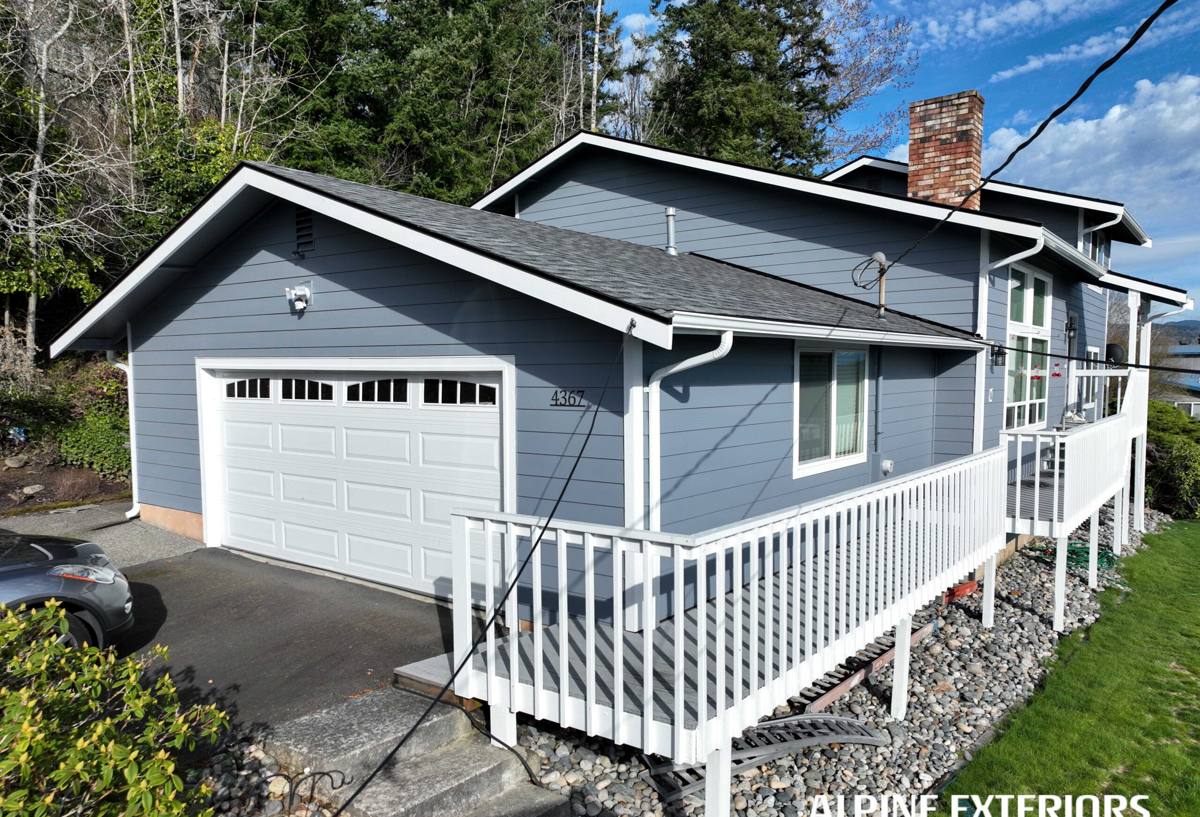
What This Climate Does to an Everson Roof
Moss and Algae Growth
Shaded roof planes, tree cover, and long stretches of damp weather add up to a moss season that barely lets up here. Moss doesn't just sit on top of a roof looking bad — it holds moisture against the roofing surface, works its way under shingle tabs and lap joints, and over time can lift material enough to open a path for water. Roofs that stay shaded most of the day are the first to show it, and once moss gets established it tends to come back faster after each cleaning.
Wind-Driven Rain
Rain in this part of Whatcom County rarely falls straight down for long. Wind pushes it sideways into valleys, around chimneys and vent penetrations, and under any flashing that isn't properly lapped and sealed. That's a tougher test than a simple annual rainfall number suggests, and it's usually where an aging or poorly installed roof leaks first — not out in the open field of the roof, but at the details.
Salt Air and Corrosion
Everson is far enough inland that salt exposure isn't as constant as it is on a waterfront lot, but it's not zero either — enough salt-laden moisture moves through this region on stronger storms to accelerate corrosion on lower-grade fasteners, flashing, and hardware over the years. It's a slower process here than on a bluff overlooking the water, but it still shows up eventually on materials that weren't specified with any coastal exposure in mind.
Temperature Swings and Material Fatigue
Whatcom County doesn't see extreme heat or deep, sustained cold most winters, but the repeated cycle of damp, mild days punctuated by occasional cold snaps still stresses roofing materials over time. Products that stay saturated more than they get a chance to fully dry age faster here than the same product would in a drier inland climate, which is part of why material choice matters as much as workmanship.
Why Homeowners Look at Metal Roofing Here
Metal roofing earns its reputation in this climate for a few concrete reasons, not because it's trendy. Its smooth, continuous surface sheds water and snow faster than a shingled surface, gives moss and algae far less to grip onto, and doesn't have overlapping tabs that wind can catch and lift the way it can on asphalt shingles. Panels are also non-combustible, which matters for both household safety and, in some cases, insurance pricing. None of that makes metal roofing the automatic right answer for every home — cost, roof pitch, budget, and how long you plan to stay in the house all factor in — but for homeowners planning to stay put for decades, the lifespan and lower long-term maintenance are usually the deciding factors.
Standing Seam vs. Metal Shingle
Metal roofing isn't one product. Standing seam panels run in long, continuous vertical runs with raised interlocking seams and hidden fasteners, which gives the best water-shedding performance and the cleanest look, at a higher material and labor cost. Metal shingles and shakes are smaller interlocking panels formed to resemble traditional shingle or shake profiles, install faster on complex rooflines, and cost less than standing seam while still delivering most of the durability and moss resistance. Which one makes sense depends on the roof's pitch, the home's style, and the budget.
| Roofing System | Moss/Algae Resistance | Wind-Driven Rain Performance | Typical Lifespan | Upfront Cost Tier |
|---|---|---|---|---|
| Standing seam metal | Excellent — smooth, no exposed fasteners | Excellent — continuous panel runs | Decades, often the longest of common options | Highest |
| Metal shingle/shake panel | Very good — interlocking, low-profile | Very good, if flashing detail is done right | Long, close behind standing seam | High |
| Architectural asphalt shingle | Fair — needs periodic treatment/cleaning | Good, when installed with marine-rated hardware | Shorter, roughly a third to half of metal's span | Lowest |
None of these options is universally "best." A homeowner planning to sell within a few years may reasonably choose asphalt; a homeowner planning to stay for the long haul, or one who's tired of dealing with moss and repeat repairs, often finds metal pays for itself in reduced maintenance and fewer callbacks over time.
What Correct Metal Roof Installation Actually Involves
Metal roofing has a longer service life than asphalt shingle roofing, but that advantage disappears fast if the installation is off. This is not a forgiving material to install poorly — mistakes tend to show up as leaks, noise, or panel damage rather than staying hidden.
Underlayment and Ice/Water Protection
A quality synthetic or self-adhering underlayment matters more under metal than people expect, since it's the backup layer if wind-driven rain ever gets past a seam or fastener. Valleys, eaves, and penetrations need the highest-grade protection, since those are the spots that take the most sustained water exposure in this climate.
Fastening and Panel Expansion
Metal panels expand and contract with temperature swings, and fastening systems that don't account for that movement will eventually work loose, oil-can, or crack sealant joints. Standing seam systems use hidden clip fasteners specifically designed to let panels move without binding; exposed-fastener systems need the right screw spacing, gasketed fasteners, and periodic maintenance to stay watertight over decades.
Flashing at Valleys, Chimneys, and Penetrations
This is where most roof leaks actually start, on metal or any other material. Correct flashing means custom-formed pieces that integrate with the panel profile, proper laps in the direction water flows, and sealant used as a backup, not a substitute for good metal work. Given how much wind-driven rain this region sees, cutting corners here is one of the fastest ways to end up with a callback.
Ventilation
A metal roof still needs a properly vented attic assembly underneath it. Without adequate intake and exhaust ventilation, moisture from inside the home can condense against the underside of the roof deck regardless of how good the metal panels are, leading to deck rot that has nothing to do with the roofing material itself.
Repair, Recoat, or Full Replacement
Not every roofing issue on an Everson home calls for a full tear-off, whether the existing roof is metal, asphalt, or something else.
- Isolated leaks or fastener issues on an existing metal roof can often be repaired — resealing a penetration, replacing a section of damaged flashing, or re-securing loose panels — without touching the rest of the roof.
- An aging asphalt roof nearing the end of its service life is usually a better candidate for full replacement than patch repairs, especially if you're considering switching to metal at that point anyway.
- Storm-damaged sections — lifted shingles, dented or creased metal panels, or damaged flashing after a wind event — can typically be repaired and matched into the surrounding roof if the rest of the system is sound.
- Widespread underlayment failure or deck rot found during a repair call usually means the roof needs full replacement, since patching over a compromised deck just delays the real problem.
We'll tell you honestly which category your roof falls into rather than defaulting to whichever answer costs more.
How Roofing Connects to the Rest of the Exterior
Roof problems on an Everson home rarely start and end at the roofline. A failed roof valley or a poorly flashed chimney can send water down behind siding long before it shows up as a stain on a ceiling inside. Gutters that are undersized, clogged, or pitched wrong send overflow straight down the wall, which accelerates exactly the kind of moss and moisture damage this climate already encourages. Because we handle roofing, siding, windows, and decks rather than just one piece of the exterior, we look at how water actually moves across the whole house — roof, gutters, flashing, siding, and grade — instead of treating each component as a separate, unrelated job.
Signs Your Roof Needs Attention
- Moss or dark algae streaking that returns quickly after cleaning
- Granule buildup in gutters, or bald spots on asphalt shingles
- Rusting fasteners, corroding flashing, or panels showing early wear
- Curled, cracked, lifted, or missing shingles after a windstorm
- Visible daylight or water staining around chimney and vent penetrations
- Oil-canning, loose panels, or unusual noise from an existing metal roof
- Water stains on interior ceilings or in the attic near the roofline
Why a Local Crew Matters Here
A crew that regularly works Everson and the rest of Ferndale's surrounding Whatcom County service area knows how moss, wind-driven rain, and the region's damp-and-mild cycle actually behave on real roofs over a full year, not just how a spec sheet describes it. That experience shows up in practical decisions on install day: how much valley and eave protection is worth the extra material cost, which flashing details are worth slowing down for, and where a home's specific roof pitch and shading pattern call for a different approach than the house down the road. Whatcom County's marine-influenced climate treats every roof the same way over time — it finds the weak points — and a crew with local, hands-on experience knows where those weak points usually are before they turn into a leak.
What to Expect When You Call Us
- An honest inspection of your current roof, including attic ventilation and any signs of past water intrusion
- A clear explanation of whether you're looking at a repair, a partial re-roof, or a full replacement
- A straightforward comparison of metal versus asphalt for your specific roof, budget, and timeline — not a one-size-fits-all pitch
- A written estimate with no pressure to sign on the spot
If your Everson home needs a new roof, has a leak worth tracking down, or you just want an honest opinion on whether metal roofing makes sense for your situation, we're glad to take a look. Reach out using the form below to schedule a free, no-pressure estimate.