 Ferndale Siding
 Why Sandy Point Decks Wear Out Faster Than You'd Expect
Sandy Point sits close enough to the water that salt air is part of daily life, and that air is hard on wood, hardware, and finishes in ways that inland Ferndale and Whatcom County properties don't deal with as much. Salt-laden moisture accelerates corrosion on fasteners and metal connectors, and it works its way into end grain and joints faster than plain rainwater does. Add in Whatcom County's long stretch of wet months and the moss season that follows, and a deck out here is under near-constant low-grade attack even when nothing looks obviously wrong.
Most deck problems we see in this area aren't dramatic failures — they're slow ones. A ledger board that's been quietly absorbing moisture behind the flashing for a couple of seasons. Fasteners that have rusted enough to lose grip strength but haven't sheared yet. A shaded corner where moss has held moisture against the decking long enough to start soft spots. None of that shows up as an emergency until someone's foot goes through a board or a railing feels loose under a hand.
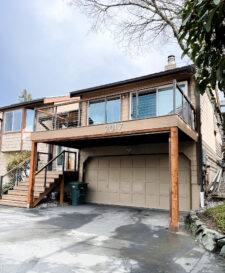
What a Real Deck Repair Actually Involves
"Deck repair" covers a wide range, from swapping a handful of boards to rebuilding the structural frame underneath. The honest answer to "what does my deck need" always starts with an inspection, not a guess — but there are a few problem areas that show up again and again on decks in this part of Whatcom County.
Ledger Board and Flashing
The ledger board — where the deck attaches to the house — is the single most common failure point on any deck, and it's the one place where driving rain and marine moisture do the most damage if the flashing was never installed correctly or has worn through. A compromised ledger connection is a structural safety issue, not a cosmetic one, and it's usually invisible until you pull back decking or siding near the attachment point.
Joists, Beams, and Posts
Rot and rust don't announce themselves. We check joists and beams for soft spots, delamination, and fastener corrosion, and we check posts and footings for movement, cracking, or ground contact issues that let moisture wick upward. A deck can look level and solid on the surface while the framing underneath has already lost meaningful strength.
Decking Boards
Cupping, splintering, soft or spongy spots, and persistent moss or algae growth are the visible symptoms of moisture getting into the boards faster than it can dry out. Shaded, low-airflow sections of a deck — common on lots with mature trees or tight setbacks — are almost always the first to show wear.
Railings, Guardrails, and Stairs
Loose railings and wobbly stair stringers are a safety issue first and a cosmetic one second. Fastener corrosion from salt air is a frequent culprit here, since railing hardware often gets less attention during routine maintenance than the decking surface does.
Repair or Replace? How We Help You Decide
Not every deck problem needs a full rebuild, and not every "repair" is actually worth doing instead of a partial replacement. We walk every job through the same honest math: what's actually failed, what's still sound, and what it costs to fix each piece versus starting fresh on that section.
| Condition Found | Usually Means | Typical Approach |
|---|---|---|
| A few isolated soft or cupped boards | Localized moisture exposure, frame likely sound | Board replacement, spot repair |
| Rusted or failing fasteners throughout | Salt-air corrosion of original hardware | Full re-fastening with corrosion-rated hardware |
| Soft or spongy ledger area | Flashing failure, moisture behind the house connection | Ledger and flashing repair — treated as priority/safety work |
| Widespread rot in joists or beams | Long-term moisture intrusion into the frame | Partial or full structural rebuild |
| Loose railings or stair movement | Hardware failure or post connection issues | Railing/stair rebuild to current code |
How Our Deck Repair Process Works
We keep the process straightforward because homeowners deserve to know what's actually happening under their deck, not just what it looks like from the top.
- Full inspection: We check the ledger connection, framing, fasteners, decking, and railings, not just the areas you flagged as concerning.
- Moisture and structural check: We probe suspect boards and framing members for soft spots and check for movement in posts and footings.
- Honest scope and plan: You get a clear breakdown of what needs to be fixed now, what's borderline, and what can wait — with the reasoning behind each call.
- The repair itself: Structural work is addressed before cosmetic work, always. We don't put new decking over a compromised frame.
- Hardware and fastener upgrade: Where corrosion is part of the problem, we address it with appropriate hardware rather than just replacing what failed with the same grade.
- Cleanup and walkthrough: We show you what was found, what was done, and what to watch going forward.
Materials and Hardware: Why It Matters More Near the Water
The materials that hold up fine on a deck twenty miles inland don't always hold up the same way in Sandy Point's salt air. This isn't about buying the most expensive option — it's about matching the hardware and fasteners to the actual exposure the deck sees.
For fasteners and structural connectors, we favor stainless steel or high-grade hot-dip galvanized hardware in salt-exposed applications, since standard coated fasteners corrode noticeably faster here. For decking material, both treated lumber and composite decking have real trade-offs worth understanding rather than picking based on appearance alone:
| Material | Maintenance Burden | Moisture Behavior | Honest Trade-off |
|---|---|---|---|
| Pressure-treated lumber | Higher — needs periodic cleaning, sealing/staining | Can absorb and release moisture with the seasons | Lower upfront cost, shorter interval between refinishing in a wet climate |
| Composite decking | Lower — no staining/sealing needed | Doesn't absorb moisture the way wood does, but moss/algae can still grow on the surface if shaded | Higher upfront cost, longer service life with less upkeep |
Whichever direction a homeowner chooses, the fasteners, flashing, and framing underneath matter more to long-term performance than the decking surface itself — a beautiful new composite board over a corroding frame is still a problem waiting to resurface.
Keeping a Sandy Point Deck Ahead of the Weather
Whatcom County's long wet season and the moss that follows it aren't going anywhere, but a few habits go a long way toward slowing the damage between repairs:
- Sweep debris and standing organic matter off the deck surface regularly, especially in shaded corners where moss takes hold first.
- Rinse salt residue off decking and railings periodically, particularly after windy weather off the water.
- Check railing and stair hardware by hand once or twice a year — loose connections are easier to feel than to see.
- Keep gutters and downspouts clear so runoff isn't dumping extra water directly onto or under the deck.
- Look underneath the deck occasionally, not just at the walking surface — framing problems start out of sight.
- Address small soft spots or loose boards as soon as they're noticed rather than waiting for a full section to fail.
Why It Matters That We Already Work in Sandy Point
A crew that only occasionally works this close to the water can miss how much faster salt air ages hardware and finishes compared to a typical inland job. Working regularly in and around Ferndale and the Sandy Point area means we're used to sizing fasteners, flashing, and material choices for this specific exposure rather than applying a one-size-fits-all approach built for drier, less corrosive conditions. It also means we're familiar with the kind of deck construction common in this part of Whatcom County and the realistic lifespan issues that come with it.
That local familiarity shows up in small but meaningful ways: knowing which areas of a property tend to hold moisture longest, recognizing early corrosion patterns before they become structural problems, and giving straightforward answers about what a repair actually needs instead of over-selling or under-scoping the work.
What to Expect When You Call
Every deck repair conversation starts the same way — we want to see the deck before we talk numbers, because two decks that look similar on the surface can have completely different problems underneath. A soft board near the stairs might be a five-minute fix, or it might be a symptom of a bigger moisture issue in the framing below it. We'd rather tell you which one it is up front than guess over the phone.
If your deck in Sandy Point or the surrounding Ferndale area is showing soft spots, loose railings, corroded hardware, or persistent moss and algae that won't go away, we're happy to take a look. Reach out for a free, no-pressure estimate using the form below, and we'll give you a straight answer about what's going on and what it'll take to fix it right.