 Ferndale Siding
 Cordata's Roofs Work Harder Than Most People Realize
Cordata sits close enough to Bellingham Bay and the Strait of Georgia that salt-laden air is a constant, low-grade stressor on roofing materials, even on days when nothing dramatic is happening overhead. Add Whatcom County's driving winter rain, the wind that funnels through this part of the county during frontal systems, and a moss season that can run eight months or more, and you have a roof that ages differently than one fifty miles inland. Storm damage here rarely shows up as a single catastrophic event. More often it's a wind-lifted shingle from last November that let water in slowly, or a gutter clogged with fir needles that backed up during a heavy rain and soaked the fascia behind it.
We repair storm-damaged roofs on Cordata homes with that pattern in mind. A repair that only addresses the visible tear or missing shingle, without accounting for what the salt air and moss have already done to the surrounding material, tends to fail again within a season or two. A correct repair looks at the whole roof plane, not just the spot that got hit.
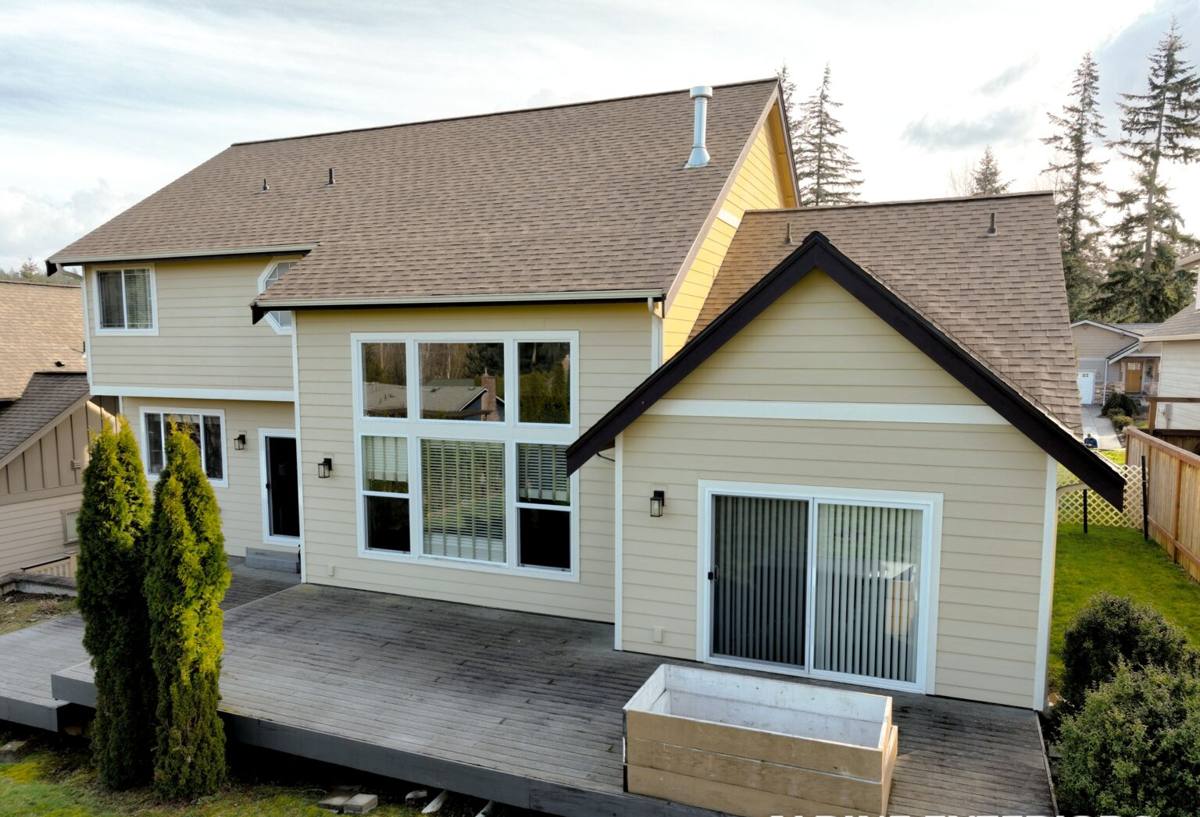
What Actually Counts as Storm Damage
Homeowners often assume storm damage means a hole you can see from the driveway. In practice, most of what we're called out for in Cordata falls into a handful of categories:
- Wind-lifted or creased shingles, especially along ridge lines and roof edges where uplift is strongest
- Flashing knocked loose or bent around chimneys, skylights, and roof-to-wall transitions
- Gutter and downspout damage that lets water dump against the fascia or siding instead of away from the house
- Impact damage from falling branches, common where mature conifers overhang the roofline
- Granule loss on asphalt shingles from wind-driven rain, which shows up as premature wear rather than an obvious break
- Moss and debris buildup that traps moisture against a storm-damaged area and speeds up rot underneath it
That last one is easy to miss. A homeowner sees a patch of moss and thinks it's a cosmetic issue. But moss holds water against the roofing material long after the rain has stopped, and if there's already a compromised seam or lifted shingle underneath it, the moss accelerates the damage considerably. Part of an honest storm damage inspection is checking whether existing moss growth is hiding a problem that started with wind or impact.
What a Correct Storm Damage Repair Involves
Inspection Before Anything Gets Touched
We start on the roof itself, not just from the ground with binoculars. That means checking the underlayment condition where shingles have lifted, looking at fastener patterns, and examining flashing at every penetration and transition point. We also check the attic side when accessible, since water staining on the underside of the decking often tells you more about how far damage has spread than what's visible from outside.
Matching Materials, Not Just Patching Them
A repair patch that doesn't match the existing shingle's granule color, profile, or age creates a visible seam and, more importantly, a spot where the two materials don't shed water the same way. Wherever possible we source matching shingles or, when an exact match isn't available anymore, we're upfront with the homeowner about the closest reasonable option and where we'll place it so it's least noticeable.
Flashing and Underlayment Get the Same Attention as Shingles
Most storm-related leaks trace back to flashing, not the shingle field. Step flashing along walls, counter-flashing at chimneys, and valley metal all take a beating from wind-driven rain. If flashing is bent, corroded, or was undersized to begin with, we replace it as part of the repair rather than just resealing it with caulk, which is a short-term fix that tends to fail within a year or two in this climate.
Dealing With Moss as Part of the Repair, Not an Afterthought
Where moss has established itself around a damaged area, we remove it as part of the job and address the conditions that let it take hold, usually shade, debris buildup, or slow-draining valleys. Treating moss without fixing the underlying moisture source just means it comes back in a season.
How Our Process Works, Start to Finish
1. Initial Call and Photo Review
We ask what happened and when, and whether the homeowner has any photos from before and after the storm. This helps us prioritize urgent issues, like active leaking, ahead of scheduling a full inspection.
2. On-Roof Inspection and Documentation
We physically inspect the affected area and document it with our own photos, which matter both for our repair plan and for any insurance claim the homeowner is filing. We'll point out anything we find that goes beyond what the homeowner initially noticed.
3. A Written Scope Before Work Starts
We explain what we found, what we recommend fixing now versus monitoring, and give a written estimate. We don't upsell a full re-roof when a targeted repair will genuinely hold up, and we say so plainly when a repair is the wrong long-term call instead.
4. The Repair Itself
Work is done in a way that ties into the existing roof system correctly: proper shingle nailing patterns, correct flashing laps, and underlayment that integrates with what's already there rather than sitting on top of it as a stopgap.
5. Cleanup and Walkthrough
We clear debris, check gutters near the repair for blockage, and walk the homeowner through what was done and what to keep an eye on going forward.
Repair or Replace: How We Help You Decide
Not every storm-damaged roof needs a full replacement, and not every roof is a good candidate for another round of patching. The right call usually comes down to a few concrete factors rather than a gut feeling.
| Factor | Favors Repair | Favors Replacement |
|---|---|---|
| Roof age | Under 12-15 years, asphalt shingle | Nearing or past expected lifespan |
| Extent of damage | Isolated to one section or plane | Spread across multiple roof planes |
| Underlying decking | Solid, no rot found | Soft spots or rot at multiple points |
| Shingle availability | Matching product still available | Discontinued, poor match likely |
| Repair history | First or second repair on this roof | Repeated repairs in same area |
When a roof lands somewhere in the middle, we'll say so and lay out the honest trade-offs rather than pushing toward the more expensive option.
Why the Long Moss Season Changes the Math on Repairs
In parts of the country with a shorter wet season, a rushed or partial repair might survive a few years before the consequences show up. In Whatcom County, where roofs stay damp for long stretches and moss has months to establish itself in any shaded or slow-draining area, a corner-cut repair shows its weaknesses fast. We factor that into how we approach even small repairs: proper flashing laps, correct fastener placement, and full moss and debris removal in the work area, because a repair that's "good enough" for a drier climate often isn't good enough here.
Salt Air and Metal Components
Cordata's proximity to the water means metal flashing, fasteners, and gutter hardware corrode faster than they would further inland. When we replace flashing or fasteners as part of a storm repair, we use materials rated for coastal exposure rather than standard-grade hardware, since mismatched corrosion resistance between old and new metal is a common source of repeat leaks in this area.
Why It Matters That We Already Work in Cordata
A crew that's worked roofs in this specific neighborhood knows the common roof pitches, the typical shingle products used on homes built in the area's main construction eras, and which parts of the neighborhood tend to see more wind exposure or tree debris than others. That familiarity shortens the inspection process and reduces the chance of missing a damage pattern that's common locally but might be overlooked by a crew unfamiliar with Cordata specifically or with Ferndale and Whatcom County conditions generally.
It also means we're not guessing at material availability or local permitting requirements when a repair needs to escalate into something larger. We'd rather tell a homeowner early that a job is bigger than expected than discover it mid-repair.
What to Do (and Avoid) After Storm Damage
- Do photograph visible damage from the ground as soon as it's safe to do so
- Do check attic spaces or ceilings for staining if you can safely access them
- Do call for an inspection promptly rather than waiting for the next dry spell
- Do keep any insurance correspondence and claim numbers organized in one place
- Do not get on the roof yourself, especially on wet or moss-covered surfaces
- Do not rely on tarps as anything more than a short-term measure
- Do not authorize repairs from a crew that hasn't physically inspected the roof
- Do not assume a small visible issue means the damage is only cosmetic
Getting an Honest Look at Your Roof
If your Cordata home has visible storm damage, or you're just not sure whether that patch of moss or missing shingle is worth worrying about, we're happy to take a look and give you a straight answer. There's no cost and no pressure to book an estimate, and if the fix turns out to be smaller than expected, we'll tell you that too. The form below is the easiest way to get started.