 Ferndale Siding
 Cordata's Climate Is Harder on Siding Than It Looks
Cordata sits close enough to Bellingham Bay and the Salish Sea that homes here deal with a steady dose of salt-laden marine air, on top of everything else Whatcom County's weather throws at an exterior. That combination — salt air, driving rain that comes in sideways during winter storms, and a moss season that can run most of the year under our cloud cover — is a lot to ask of a wall covering. Some siding materials handle one of those stresses reasonably well. Very few handle all three for decades without maintenance turning into a second job.
This page is about one thing specifically: James Hardie fiber cement siding, installed correctly, on homes in and around Cordata. Not a generic rundown of what fiber cement is — a straight answer on what this climate demands from your siding, what a correct installation actually looks like here, and how we approach the work.
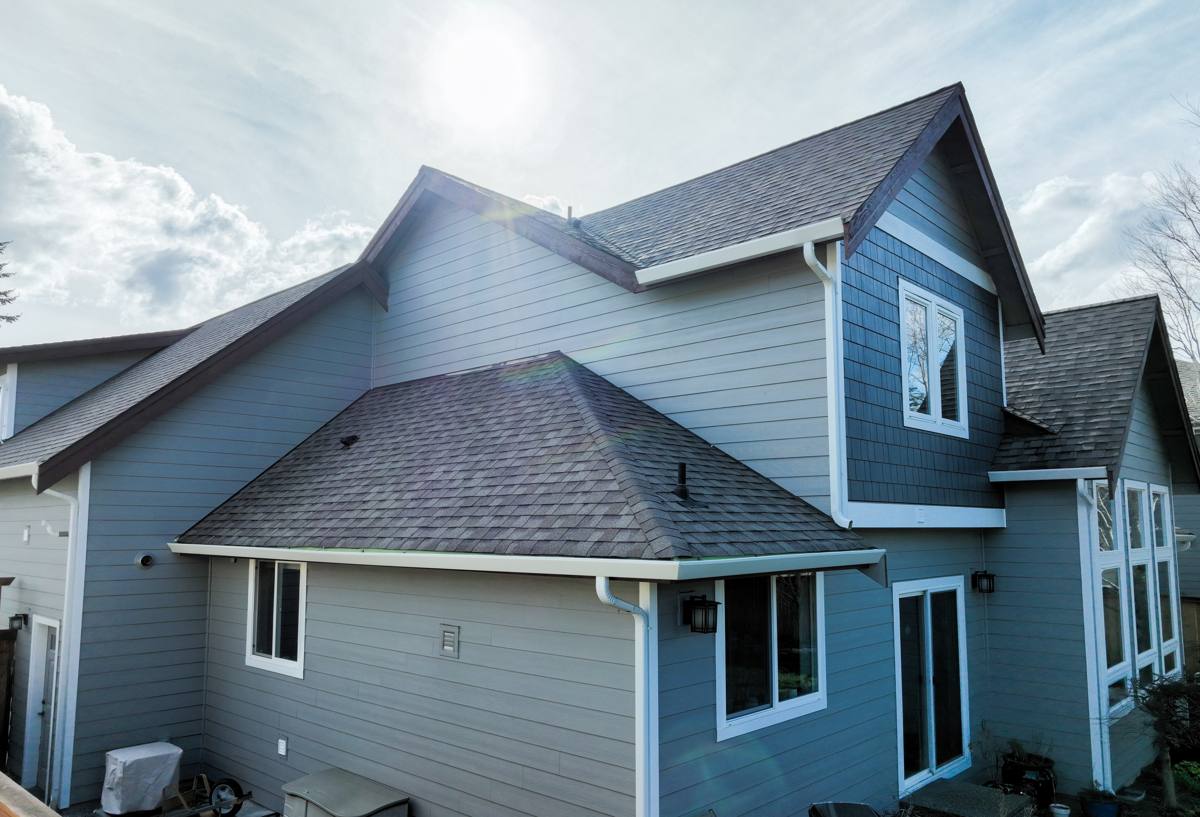
What Cordata's Climate Actually Does to a Wall
Salt Air and Coating Breakdown
Airborne salt doesn't just affect homes right on the water. It travels, and over years it accelerates the breakdown of paint films, corrodes exposed metal fasteners, and speeds up UV fading on lower-grade coatings. Siding that relies on a thin field-applied paint job — instead of a factory-cured finish — tends to show chalking, fading, and peeling sooner in a marine-influenced climate than the same product would inland.
Driving Rain and Wind-Driven Moisture
Pacific storm systems don't just drop rain straight down here — wind pushes it into wall assemblies at an angle, which is exactly the condition that exposes weak flashing, poor caulking, and gaps at trim and penetrations. A siding material can be excellent and still fail early if it's installed without the water-management details this region requires.
A Long Moss and Algae Season
Mild, wet winters and shaded, tree-covered lots — common throughout Whatcom County — give moss and algae a long window to establish on north-facing and shaded wall sections. Once organic growth gets a foothold in a porous or poorly finished material, it holds moisture against the wall and accelerates whatever damage the rain started.
What Correct Siding Needs to Deliver Here
Given all three of those pressures, siding for a Cordata home needs to do more than look good on installation day. It needs:
- A factory-applied finish that resists fading and chalking under UV and salt exposure, not just a field-painted surface
- Dimensional stability so panels don't swell, cup, or separate at seams when they take on repeated wetting and drying cycles
- A surface and composition that doesn't feed moss and mold the way bare wood or some composite products can
- Fastener and flashing details engineered for wind-driven rain, not just vertical rainfall
- A warranty structure that actually accounts for material performance over 20-30 years, not just the first few
Why We Install Only James Hardie Fiber Cement
We don't install LP SmartSide, vinyl, Cemplank, Allura, primed spruce, or cedar. That's a deliberate standard, not a supply preference, and it comes down to how those products perform against the specific conditions above versus how James Hardie's fiber cement system performs.
James Hardie's HardiePlank and related products are engineered specifically for climate zones like ours — Hardie makes a version of its siding tuned for the Pacific Northwest's wet, moderate climate, which matters more here than in a dry inland market. The ColorPlus finish is baked on and cured at the factory under controlled conditions, which is a meaningfully different process than field-applying paint or primer on site, and it holds up better against the UV and salt exposure Cordata homes see. Fiber cement itself is non-combustible, which matters given wildfire smoke seasons are now a regular part of the Pacific Northwest summer, and it doesn't provide the same food source for moss and mildew that untreated or lightly primed wood products do.
Hardie also backs its siding with a long, transferable limited warranty on the material and a separate warranty on the ColorPlus finish — something that matters a lot if you sell the home before the siding's functional life is up. We standardized on one product line because it lets us guarantee the installation details, the material behavior, and the warranty coverage as one system, instead of adapting our process to whatever product a homeowner happened to source.
What a Correct Fiber Cement Installation Actually Involves
The material is only half the equation. Fiber cement siding installed without attention to the details below will still develop moisture problems in this climate, warranty or not.
Clearances and Water Management
Panels need proper clearance from grade, roof lines, decks, and patios — typically a minimum gap that keeps splash-back and standing water off the bottom edge of the siding. Skipping this is one of the most common shortcuts we see on prior installs we're asked to repair or replace.
Flashing at Every Penetration
Windows, doors, vents, hose bibs, and light fixtures all need proper flashing and integration with the weather-resistive barrier behind the siding. In a driving-rain climate, a missed flashing detail is where water gets behind the wall assembly — and it can take years to show up as visible damage.
Fastening and Joint Treatment
Hardie specifies fastener type, spacing, and placement for a reason — under-fastened or improperly placed nails reduce wind resistance and can telegraph through the ColorPlus finish over time. Butt joints and seams need to be treated per manufacturer specification, not just caulked and painted over.
Ventilation Behind the Cladding
A drainage plane or rainscreen gap behind the siding lets any incidental moisture that does get past the cladding dry out instead of sitting against the sheathing. This is one of the details that separates a fiber cement job that lasts three decades from one that develops rot behind the walls in ten years.
Our Process on a Cordata Siding Project
- On-site assessment — we look at existing siding, sheathing condition, trim, and any signs of past moisture intrusion before quoting anything
- Product and color selection — walking through Hardie's HZ product lines and ColorPlus color options against your home's exposure and shading
- Tear-off and prep — removing old siding, checking sheathing for hidden rot (common on homes with a history of wind-driven rain exposure), and correcting any water-management issues underneath before new siding goes up
- Weather barrier and flashing installation — the unglamorous part of the job that determines whether the siding performs for 30 years or 10
- Fiber cement installation — panels, fasteners, and joints installed to Hardie's published specifications, not a generalized "siding install" approach
- Final walkthrough — checking caulking, trim, and finish details with you before we consider the job done
Siding Options Compared for This Climate
We only install fiber cement, but it's worth understanding where the alternatives actually stand on the factors that matter most for a Cordata home.
| Factor | James Hardie Fiber Cement | Vinyl Siding | Untreated Wood/Cedar |
|---|---|---|---|
| Moss/mildew resistance | High — dense, non-organic composition | Moderate — can trap moisture behind panels | Low — organic material feeds growth |
| Salt air/UV finish durability | High — factory-cured ColorPlus finish | Moderate — can chalk and fade over time | Depends entirely on maintenance schedule |
| Performance in driving rain | High, if installed to spec | Moderate — seams and laps can allow intrusion | Low without diligent sealing and upkeep |
| Maintenance burden | Low — periodic rinse, no repainting for years | Low but limited color/repair options | High — regular sealing, staining, or painting |
| Fire resistance | Non-combustible | Combustible, can melt/deform | Combustible |
| Typical functional lifespan | Multiple decades with correct install | Shorter, especially in coastal exposure | Highly variable, maintenance-dependent |
Maintaining Fiber Cement Siding in a Marine, Mossy Climate
Fiber cement is low-maintenance, not no-maintenance. A little seasonal attention goes a long way toward getting the full functional life out of the material:
- Rinse the exterior annually with a garden hose to remove salt residue and organic buildup, especially on shaded or north-facing walls
- Avoid pressure washing directly at seams and caulked joints — it can drive water behind the panels
- Trim back vegetation and tree limbs that keep a wall section damp and shaded longer than the rest of the house
- Inspect caulking at trim, windows, and joints every year or two and re-caulk before gaps open up
- Watch gutters and downspouts — overflow and splash-back against siding is a common source of localized moss and staining
- Address any moss growth early with a gentle wash rather than letting it establish and hold moisture
Why a Crew That Already Works in Cordata Matters
Siding installation isn't identical everywhere. A crew that regularly works Ferndale and the surrounding Whatcom County neighborhoods already has a feel for which wall exposures on a given lot take the worst of the wind-driven rain, how much shade a typical lot's tree cover creates, and how local permitting and inspection expectations run. That local pattern-recognition shows up in small decisions — where to add extra flashing attention, which elevations need closer joint treatment, how a home's orientation relative to prevailing weather should influence the install — that a crew unfamiliar with the area is more likely to treat as generic.
It also means we're not learning on your house. We've seen how homes in this specific climate age, both siding installed correctly and siding installed as a shortcut, and we bring that directly into how we plan and execute the job.
If you're weighing a siding replacement on a Cordata home, we're glad to walk the property, look at what's there now, and give you a straight assessment of what James Hardie fiber cement would involve for your specific home — no pressure, no upsell script. Reach out for a free estimate using the form below.