 Ferndale Siding
 Why Bellingham Roofs Wear Differently Than Roofs Inland
A roof over a home near Bellingham Bay does a different job than a roof forty miles inland. The marine layer off the Salish Sea keeps salt-laden moisture in the air year-round, which speeds up corrosion on exposed fasteners, flashing, and metal components long before it would show up on a roof in the eastern part of the state. Add in the driving, wind-pushed rain that rolls through Whatcom County during fall and winter storms, and water gets forced sideways under flashing and around penetrations in ways a straight-down rain never would. Then there's moss. Between the mild, wet winters, the shade from mature conifers common on Ferndale and Bellingham lots, and a growing season that barely pauses, moss doesn't just grow on local roofs — it thrives on them for a good chunk of the year.
None of that means a roof here has to fail early. It means the installation has to account for those three stressors from the start: corrosion-resistant materials, water management that assumes wind-driven rain, and a roof surface and maintenance plan that keeps moss from getting a foothold in the first place.
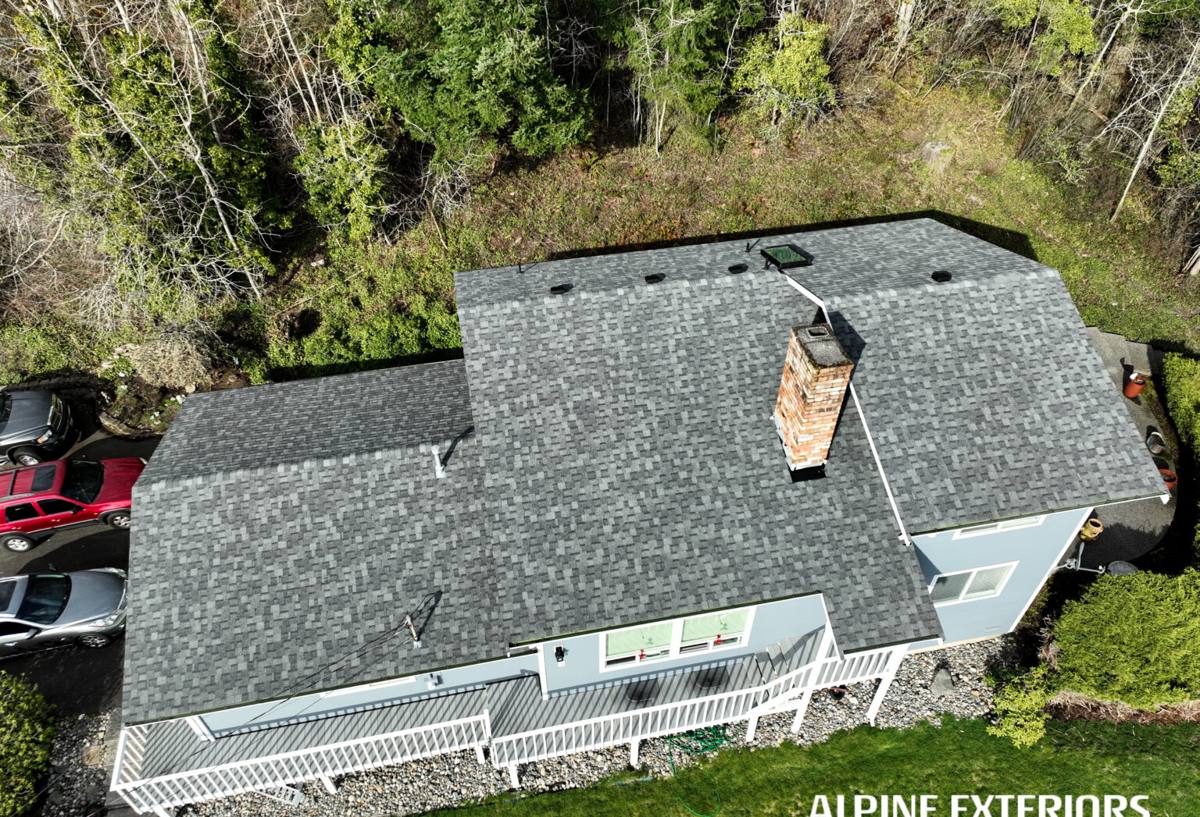
Signs a Bellingham Home Actually Needs a New Roof
Not every roof problem calls for full replacement, and not every worn-looking roof is actually failing. Before recommending a tear-off, we look for signs the roofing system itself — not just the surface — has reached the end of its service life.
- Granules collecting in gutters or at downspout outlets, leaving bald patches on the shingles
- Shingles that are cupping, curling at the edges, or cracking when you look closely
- Thick moss mats holding water against the shingle surface, especially on north-facing slopes
- Soft or spongy spots when walking the roof, which usually means the decking underneath is compromised
- Daylight visible through the roof boards from inside the attic
- Staining on interior ceilings or exterior fascia boards near valleys, chimneys, or skylights
- A roof that's 20-25+ years old (asphalt) and has never been fully replaced, only patched
If a roof only shows one or two of these and the decking is sound, a repair may be the honest recommendation. We'll tell you that. A new roof installation makes sense when the underlying system — not just a few shingles — is compromised.
What a Correct New Roof Installation Actually Involves
Tear-Off and Deck Inspection
A proper installation starts with removing the old roofing down to the decking, not layering over it. That's the only way to see what's actually happening underneath — rot from long-term moisture intrusion, delaminating plywood, or fasteners that have corroded from years of salt air exposure. Any damaged decking gets replaced before anything new goes down; skipping this step is one of the most common ways a new roof fails early.
Underlayment and Ice-and-Water Shield
Over the repaired deck goes a synthetic underlayment rated for the wind and moisture this area sees, with self-adhering ice-and-water shield reinforcing the vulnerable spots — eaves, valleys, and around every penetration. In a climate with this much sustained rain, underlayment isn't a formality; it's the roof's actual last line of defense if wind ever drives water past the shingles.
Flashing
Flashing around chimneys, skylights, vent pipes, and roof-to-wall transitions gets replaced, not reused. Old flashing that's been through years of salt air and freeze-thaw cycling is often thinner and more corroded than it looks, and it's one of the most common leak points on older Whatcom County roofs.
Ventilation
A balanced intake-and-exhaust ventilation system — typically soffit vents paired with a ridge vent — keeps the attic dry and temperature-stable. Without it, moisture from everyday household use gets trapped under the decking, which invites rot and mold from the inside even on a roof that's shedding rainwater perfectly on the outside.
Fasteners and Hardware
Standard fasteners can start showing surface corrosion within a few years this close to Bellingham Bay, especially on roofs with regular salt-laden wind exposure. We use corrosion-resistant nails and hardware suited to coastal conditions, and the same standard applies to any exposed metal — vent caps, drip edge, and flashing — so the roof isn't held together by parts that degrade faster than the shingles themselves.
Roofing Material Options for Whatcom County Weather
There's no single "right" material for every home — it depends on budget, roof pitch, how much shade the property gets, and how much long-term maintenance an owner wants to take on. Here's how the common options compare for this climate specifically:
| Material | Typical Lifespan Here | Moss & Algae Resistance | Relative Upfront Cost | Ongoing Maintenance |
|---|---|---|---|---|
| Standard 3-tab asphalt shingle | 15-20 years | Low without treatment | $ | Regular moss removal and gutter clearing |
| Architectural / laminate shingle | 25-30 years | Moderate | $$ | Periodic moss checks, gutter clearing |
| Algae-resistant (AR) shingle | 25-30 years | Better resistance to algae streaking | $$ | Lower algae upkeep, still needs moss checks |
| Standing seam metal | 40-50+ years | High — moss struggles to grip smooth metal | $$$ | Minimal; occasional debris clearing |
Metal has gained ground in this region specifically because of moss and rain performance, not just looks. It costs more up front, but for owners planning to stay in the home long-term, the reduced maintenance and extended lifespan often make the math work out. Asphalt remains a sound, proven choice too, especially with algae-resistant granules and a maintenance plan that keeps moss in check. Roof pitch factors in too — very low-slope sections need extra attention to water shedding regardless of material, since standing water is what actually feeds moss and algae growth.
Our Installation Process, Start to Finish
Every new roof installation follows the same core sequence, whether the home has a simple gable roof or one with several valleys and dormers:
- On-site assessment. We walk the roof and the attic, check the decking condition, and look at ventilation and flashing before recommending anything.
- Material selection. We go over options based on your budget, roof pitch, and how much shade the property gets, with honest trade-offs for each.
- Permitting. Full tear-off-and-replace roofing typically requires a permit; we handle that paperwork with the local building department.
- Tear-off and deck repair. Old roofing comes off completely, damaged decking is replaced, and the deck is inspected before anything new goes down.
- Underlayment, flashing, and ventilation. Water management goes in first — underlayment, ice-and-water shield at vulnerable areas, new flashing, and a balanced venting system.
- Roofing installation. Shingles or panels go down to manufacturer specifications, with attention to nailing patterns and exposure that hold up to wind-driven rain.
- Cleanup and haul-away. The property is cleared of old material and debris, including a magnetic sweep for stray fasteners.
- Final walk-through. We review the finished roof with you and go over warranty paperwork before calling the job done.
Moss, Algae, and Coastal Maintenance After Installation
A new roof in this area still needs a maintenance plan — the climate doesn't change once the shingles are new. Zinc or copper strips installed near the ridge use rainwater runoff to inhibit moss growth over time, which is a practical, low-effort addition for shaded roofs. Gutters need clearing more often here than in drier climates, since needle and leaf litter from surrounding conifers combines with moss debris to clog downspouts quickly. Trimming back overhanging branches where possible also cuts down on both shade and debris, which are the two biggest drivers of moss growth on Bellingham-area roofs. In this region, that active moss season stretches across much of the fall through spring — longer than most homeowners moving from drier climates expect.
None of this is about babying a new roof — it's about protecting the investment. A roof installed correctly for this climate, paired with basic seasonal upkeep, holds up to salt air, driving rain, and moss pressure far better than a roof that's otherwise identical but left unmaintained.
What Affects the Cost of a New Roof
Every roof is priced on its own specifics, but the factors that move the number are consistent:
- Total roof size and number of facets (a simple gable roof costs less to roof than one with multiple valleys, dormers, and hips)
- Roof pitch — steep roofs take longer and require more safety setup
- How many layers of old roofing need to come off
- Extent of decking repair needed, which often isn't known until tear-off begins
- Material choice, from standard asphalt up through standing seam metal
- Number of penetrations — chimneys, skylights, and vent stacks each add flashing work
- Site access, including how easily material and equipment can reach the roof
We give a written estimate after seeing the roof in person, not a phone-quote guess — and we'll flag anything that could change the price, like decking that turns out to be soft, before doing the work.
Why Hiring a Crew That Already Works in Bellingham Matters
A roofing crew that regularly works Whatcom County knows the difference between a roof detail that's fine inland and one that fails within a few years this close to the water. That shows up in choices like which fasteners resist salt-air corrosion, how much ice-and-water shield to run at eaves and valleys given the rainfall this area gets, and how aggressively to plan for moss based on the shade a specific lot gets. It also means familiarity with local permitting and building department expectations, so the paperwork side doesn't slow the project down.
It matters after installation too. A crew based in the area is reachable if a windstorm knocks a branch onto the roof or a valley needs a look after an unusually heavy rain season — not a call center for a company that installed the roof once and left the region.
Licensing, Insurance, and Warranty Coverage
Before any work starts, it's worth confirming a contractor carries a valid Washington state contractor registration, current liability insurance, and workers' compensation coverage — all things a legitimate local crew provides without hesitation. Manufacturer warranties on shingles and underlayment often depend on the installation meeting specific requirements, which is another reason installation quality matters as much as the material itself. We're glad to walk through our coverage and what warranty protection applies to your specific roof before work begins.
Get a Straightforward Roof Assessment
If your roof is showing its age, or you just want an honest read on how many years it has left, we're happy to take a look. The estimate is free, there's no pressure attached to it, and we'll tell you plainly whether you need a full replacement or just a repair. Use the form below to get started.