 Ferndale Siding
 Why Roofs Take a Beating in Sandy Point
Sandy Point sits right on the water in Whatcom County, and that waterfront location is a mixed blessing for anyone who owns a roof out here. The same exposure that makes the views worth it also means homes take on salt-laden air, near-constant marine humidity, and wind-driven rain coming straight off the Strait with almost nothing to slow it down. Add in the long, damp shoulder seasons that Western Washington is known for, and you get a roofing environment that's noticeably harder on materials than what a house fifteen miles inland in Ferndale proper deals with.
We've worked on enough roofs in this corner of the county to know the failure patterns are consistent: fastener corrosion happens faster near the water, moss and algae get a longer growing season because things simply don't dry out, and asphalt shingles in particular tend to show granule loss and edge lifting sooner than the manufacturer's own timelines suggest. None of that is a knock on any single product — it's just physics. Salt air accelerates oxidation, and standing moisture accelerates organic growth. A roofing system for Sandy Point has to be chosen and installed with both of those facts in mind from day one.
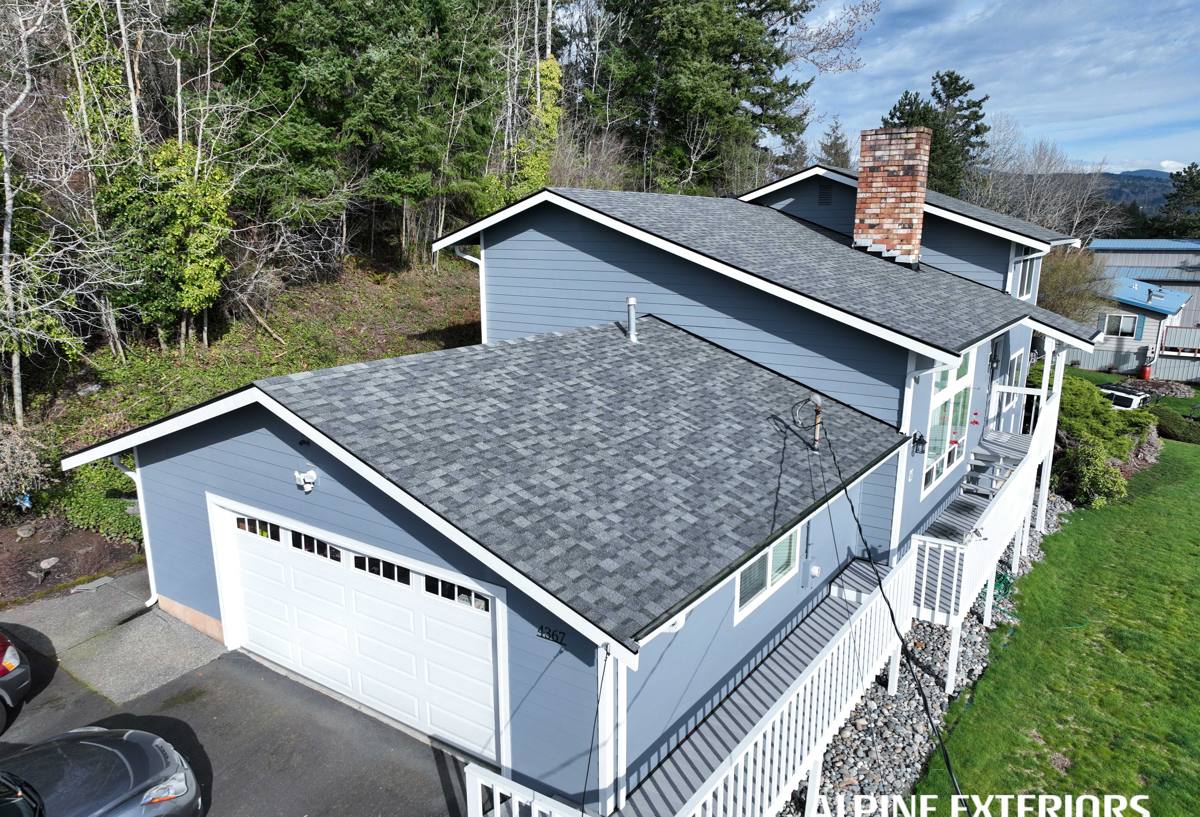
Why Metal Roofing Fits This Environment
Metal roofing isn't the right call for every home or every budget, but for a waterfront property in this climate it solves several problems at once. A correctly specified metal roof sheds wind-driven rain instead of relying on capillary action or gravity alone, which matters when storms come in sideways off the water. It also gives moss and algae far less to hold onto than a shingle surface does — there's no granule texture for spores to root in, and the smooth, sloped panel surface dries out much faster after a marine fog rolls through.
The other piece is longevity under UV and salt exposure. A properly coated steel or aluminum panel system is built to handle decades of coastal weather without the surface degradation that shortens the practical life of organic roofing materials near the water. That doesn't mean metal is maintenance-free — we'll get into what upkeep actually looks like below — but it means the roof's core material isn't the thing failing first.
What "Correctly Specified" Actually Means
The phrase gets used loosely in this industry, so here's what it means on a job like this one. It means matching the panel material and coating to a marine environment specifically, not just picking whatever's cheapest per square. It means using fasteners and flashing metals that won't set up a corrosion reaction with the panel itself. And it means an installation crew that understands how wind uplift and wind-driven rain behave on an exposed waterfront lot, not just how they behave on a sheltered inland roof.
Choosing a Panel and Coating System
There are several credible ways to build a metal roof for a coastal home, and the right one depends on budget, the home's architecture, and how long you plan to own the property. Here's how the common options stack up for a Sandy Point-type exposure:
| System | Salt-Air Performance | Typical Lifespan Here | Trade-Offs |
|---|---|---|---|
| Galvanized steel, standing seam | Good with proper coating | 30-40 years | Needs a quality paint/coating system to hold up; coating failure exposes steel to faster corrosion near the water |
| Galvalume steel, standing seam | Very good | 35-45 years | Slightly more cost than plain galvanized; performs well in coastal test data |
| Aluminum, standing seam | Excellent — won't rust | 40-50+ years | Higher material cost; softer metal, so panel gauge and installation care matter more |
| Steel, exposed-fastener panel | Fair to good | 20-30 years | Lower upfront cost, but exposed fasteners are the first thing to fail in salt air and need periodic inspection |
| Zinc or copper | Excellent | 50+ years | Premium material and labor cost; best suited to homeowners planning to stay long-term |
For most Sandy Point homes, we steer people toward Galvalume or aluminum standing seam. The standing seam profile matters as much as the metal itself out here — concealed fasteners mean there are no exposed screw heads for salt spray to attack over time, which is the single biggest maintenance headache with exposed-fastener panel systems on waterfront homes.
What Goes Wrong When Installation Cuts Corners
A metal roof is only as good as the details underneath it, and this is where we see the most problems on homes that had work done by crews unfamiliar with coastal conditions.
- Mismatched metals: Using the wrong fastener or flashing metal against the panel material sets up galvanic corrosion — two metals touching in the presence of moisture will corrode faster than either would alone. This shows up as pitting and staining around fasteners and flashing edges, often within a few years.
- Underlayment shortcuts: A synthetic, high-temp underlayment matters more here than in a dry inland climate, because it's the backup layer if wind ever drives moisture past a seam. Cheap felt underlayment degrades faster in the persistent humidity this area sees.
- Under-flashed penetrations: Every pipe boot, vent, and chimney flashing is a place where wind-driven rain can find a way in. On an exposed lot, these details need to be built for horizontal rain, not just water running straight down a slope.
- Wrong fastening pattern for wind exposure: Waterfront lots see higher sustained wind loads than sheltered inland sites. Panel and clip spacing should reflect that, not just follow a generic manufacturer minimum.
None of these mistakes are visible from the ground when the job is finished. They show up two, five, or ten years later as leaks, staining, or panels that start to work loose in a windstorm — which is exactly why the installation details matter more than the brand name on the panel.
Moss, Algae, and Ongoing Maintenance
Metal roofing dramatically reduces moss and algae problems compared to shingles, but "reduces" isn't "eliminates." Debris still collects in valleys and along eaves, especially under trees, and where it collects, moisture sits longer and moss can eventually gain a foothold even on a metal surface — usually in accumulated organic debris rather than on the panel itself. The long moss season this region is known for means gutters and roof valleys need to be checked and cleared more than once a year on a wooded or shaded lot.
Salt air also means metal roofs near the water benefit from an occasional rinse to clear accumulated salt residue, particularly on homes with a direct, unobstructed water exposure. This is a simple maintenance step, not a repair, but it's one that inland homeowners never have to think about and coastal ones shouldn't skip.
A Practical Seasonal Checklist
- Clear gutters and roof valleys of needles and debris at least twice a year, more often under overhanging trees
- Do a visual check of flashing around chimneys, vents, and skylights after major windstorms
- Rinse accumulated salt residue off the roof surface periodically on direct-waterfront homes
- Watch for any panel fastener that looks loose, lifted, or discolored and have it checked before winter storm season
- Trim back branches that keep sections of the roof shaded and slow to dry
Repair, Recover, or Full Replacement?
Not every roofing problem in Sandy Point requires a full tear-off. The right call depends on the roof's age, the extent of the damage, and what's underneath the surface material. A few honest guidelines:
| Situation | Usually Means |
|---|---|
| Isolated leak, roof otherwise sound and under 10-15 years old | Targeted repair — flashing, sealant, or panel section replacement |
| Widespread fastener corrosion on an exposed-fastener system | Re-fastening or, if severe, a recover or replacement with a concealed-fastener system |
| Existing shingle roof showing coastal wear (granule loss, edge lift, moss) | Often a good candidate for full replacement to metal, especially on directly exposed lots |
| Underlying decking with rot or moisture damage | Full tear-off required — no metal system should go over compromised decking |
We'll always tell you honestly which category a roof falls into. There's no advantage to us in selling a full replacement when a repair will genuinely hold up, and there's no advantage to you in patching a roof that's structurally past the point of a reliable fix.
How We Approach a Sandy Point Job
Every job starts with a roof assessment that specifically accounts for the property's exposure — how close it sits to the water, what direction the prevailing wind and rain come from, and how much tree cover affects drying time. That assessment shapes the panel material, fastening pattern, and flashing details we recommend, rather than defaulting to a one-size-fits-all spec.
- On-site inspection of the existing roof, decking condition, and site exposure
- Written recommendation covering panel material, profile, and coating suited to the home's specific wind and salt exposure
- Tear-off (when required) with a check of decking condition before any new material goes down
- Installation of high-temp synthetic underlayment rated for the moisture load this area sees
- Panel installation with fastening and flashing details built for wind-driven rain, not just vertical drainage
- Final walkthrough covering what maintenance the specific roof will need going forward
Why Local Experience on This Coastline Matters
A roofing crew that mostly works inland jobs isn't necessarily going to get a Sandy Point roof wrong, but they're guessing at details that a crew working this stretch of Whatcom County coastline regularly already knows from experience — how far wind-driven rain travels under a poorly flashed edge, which fastener finishes actually hold up against salt spray over years rather than months, and how much longer moss has to grow in on a shaded, damp lot this close to the water. That local pattern recognition is the difference between a roof that's engineered for the marine environment it's actually in and one that's engineered for generic Pacific Northwest weather.
It also matters for warranty and service down the line. A crew based in the area and familiar with the community is far more available for a maintenance check, a storm-damage inspection, or a warranty question than one that only shows up for the original install and is hard to reach afterward.
Questions Worth Asking Before You Hire
- What panel material and gauge are you specifying for a direct waterfront exposure, and why?
- What fastener and flashing metals are you using, and are they compatible with the panel to avoid galvanic corrosion?
- What underlayment goes down before the panels, and is it rated for sustained coastal moisture?
- How is the fastening pattern adjusted for higher wind exposure on an open waterfront lot?
- What does routine maintenance look like for the specific system you're installing?
A contractor who can answer those specifically, rather than in generalities, is one who's actually thought through what this coastline does to a roof.
If you're weighing a repair, a full replacement, or just want an honest read on where your current roof stands, we're happy to take a look and walk you through it. Fill out the form below for a free, no-pressure estimate.