 Ferndale Siding
 Decks Built for Lynden's Weather, Not Just Its Looks
A deck in Lynden lives outside year-round in a climate that doesn't take breaks. Whatcom County sits close enough to the water that salt air reaches inland lawns and porches, the rainy season runs long and steady rather than in short bursts, and shaded or north-facing decks can carry a green film of moss well into the dry months. A deck built the way a catalog picture suggests — without attention to drainage, fastener selection, and airflow underneath — will show problems within a few winters: soft boards near the ledger, rusted screw heads bleeding stains into the wood, and a walking surface that turns slick every time the temperature drops and the humidity climbs. We build decks in Lynden and the surrounding Ferndale area with those conditions as the starting assumption, not an afterthought.
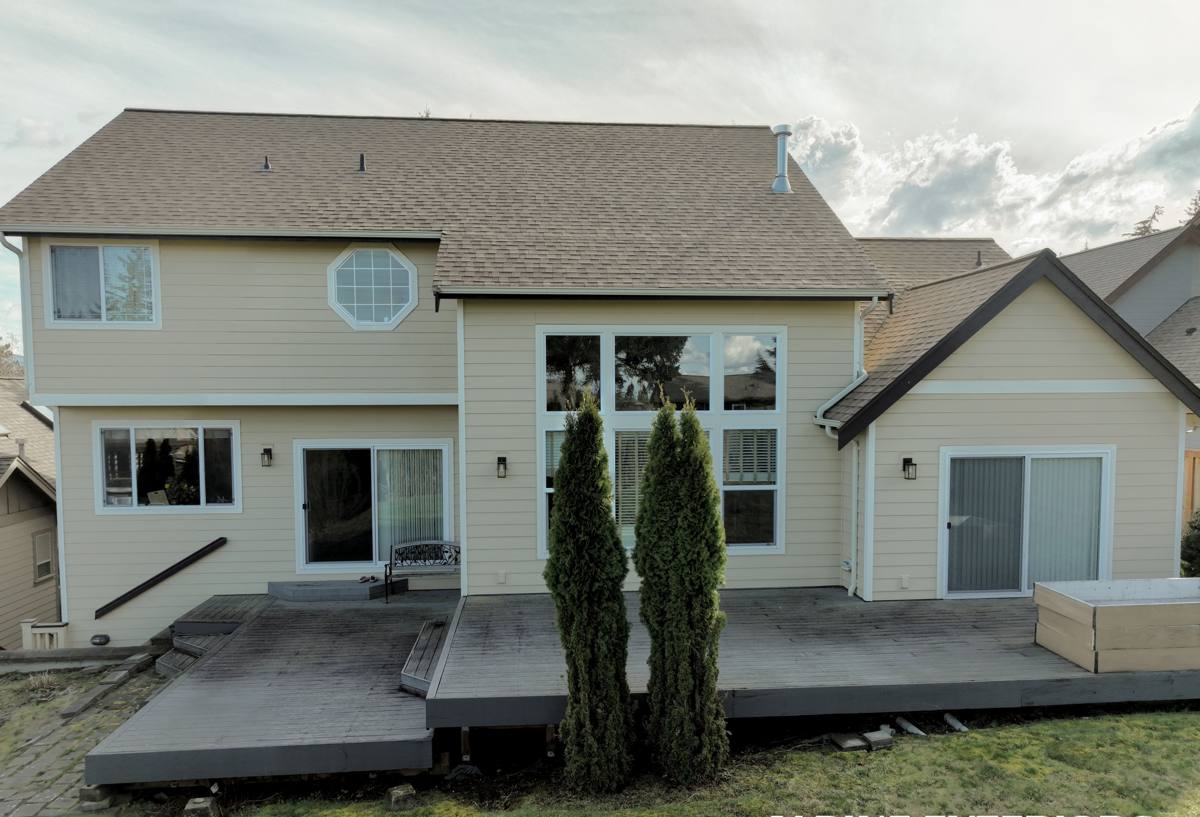
What Driving Rain and Salt Air Actually Do to a Deck
Moisture at the Ledger Board
The single most common failure point on an attached deck isn't the decking itself — it's the ledger board, the piece that bolts the deck to the house. If it isn't flashed correctly, water works its way behind it during every driving rain and sits against the house's framing where nobody can see it. By the time a soft spot shows up on an interior wall or the deck starts to pull away from the house, the damage has usually been building for years. Proper flashing — metal Z-flashing integrated with the house's water-resistive barrier, not just caulk over the joint — is non-negotiable on every deck we attach to a home in this climate.
Salt Air Corrosion on Fasteners and Hardware
Homes near Bellingham Bay and the surrounding Whatcom County coastline deal with airborne salt that accelerates corrosion on anything less than fully rated hardware. Standard zinc-coated screws and joist hangers can start showing rust streaks in a season or two, and once corrosion starts on a structural fastener, it's not a cosmetic issue — it's a slow loss of holding strength. We spec stainless steel or heavy hot-dip galvanized fasteners and connectors rated for coastal exposure on every deck we build in this region, even for inland Lynden properties, because salt-laden air travels further than most homeowners expect.
Moss, Algae, and the Long Wet Season
Whatcom County's wet season isn't just about total rainfall — it's about how many consecutive months surfaces stay damp without a real drying window. That's exactly the condition moss and algae need. On a deck, this shows up two ways: green film on the walking surface, which turns dangerously slick in the mornings and under shade, and moisture retention in the wood itself where moss holds water against the boards longer than open air would. Deck orientation, gap spacing between boards, and material choice all affect how much of a moss problem a given deck will have. A deck tucked under mature trees on the shaded side of a Lynden lot needs different detailing than one that gets full afternoon sun, and we account for that during design rather than leaving it as a maintenance surprise.
Choosing the Right Decking Material
There's no single "best" decking material — there's a right material for a given budget, sun exposure, and maintenance appetite. Here's how the common options compare for a Whatcom County deck:
| Material | Moisture & Moss Resistance | Maintenance | Typical Lifespan Here |
|---|---|---|---|
| Pressure-treated lumber | Good if sealed regularly; end grain and cut edges are vulnerable | Annual cleaning and re-sealing recommended | 15–20 years with upkeep |
| Western red cedar | Naturally rot- and insect-resistant; still needs periodic sealing in this rainfall | Regular cleaning, occasional oil or sealant | 15–25 years with upkeep |
| Capped composite | Excellent — the cap layer sheds moisture and resists moss staining | Occasional washing, no sealing or staining | 25–30+ years, manufacturer-backed |
| Uncapped/early-generation composite | Weaker — porous edges can absorb moisture over time | More cleaning than capped composite | Shorter than capped composite |
We'll walk through this trade-off honestly for your specific site. A sun-exposed deck with good airflow underneath can do fine in cedar or treated lumber for decades. A shaded, low-clearance deck that stays damp most of the year is usually money well spent on capped composite, because the labor cost of scrubbing and resealing a wood deck twice a year adds up fast, and moss that's allowed to sit on wet lumber shortens its life regardless of species.
What a Correctly Built Deck Involves
Beyond the visible decking, the parts nobody sees are what determine whether a deck lasts fifteen years or thirty in this climate:
- Footings set below frost depth and sized for the actual load of the deck, not guessed at
- Ledger flashing integrated with the house's existing water barrier, not surface-applied caulk
- Joist tape or capping on framing lumber to keep fasteners from sitting in standing moisture
- Corrosion-rated hardware throughout — hangers, screws, structural screws, and post bases
- Airflow underneath so the framing can dry out between rain events instead of staying damp
- Proper board spacing so water and debris don't collect and feed moss growth between boards
- Guardrails and stair framing built to the loads and spacing the local building code requires
Skipping any one of these doesn't usually cause an obvious problem in year one. It shows up in year five or six, as soft framing, loosening hardware, or a walking surface that's noticeably more slippery than it should be.
Our Process for a Lynden Deck Project
1. On-Site Walkthrough
We look at sun exposure, drainage patterns on your lot, how close the deck will sit to grade, and what the house's existing siding and flashing look like at the attachment point. This tells us as much about the right build as the size and shape you have in mind.
2. Design and Material Discussion
We talk through decking material, railing style, and layout against your budget and how much upkeep you actually want to do. If a lower-maintenance material makes more sense for your site's exposure, we'll say so directly.
3. Permitting
Most attached decks in Whatcom County require a building permit, and we handle that process — drawings, structural details, and scheduling inspections — as part of the job rather than leaving it to you to sort out.
4. Build
Footings, framing, flashing, and decking, in that order, with inspections at the stages the county requires. We don't cover up framing work before it's been checked.
5. Walkthrough and Care Guidance
Before we consider the job done, we walk the finished deck with you and go over what maintenance — if any — your chosen material needs going forward.
Permits and Local Building Considerations
Building requirements for decks vary by jurisdiction, and Lynden-area projects may fall under Whatcom County or a nearby city's building department depending on the exact property. In general, most attached decks above a certain height require a permit, with inspections along the way covering footings, framing, ledger attachment, and guardrail construction. We pull the permits and schedule the inspections as part of every deck build — it's part of the job, not an add-on, and it protects you if you ever sell the house and a buyer's inspector checks the deck's history.
Maintaining Your Deck Through Whatcom County's Seasons
Whatever material you choose, a little seasonal attention goes a long way in this climate. A simple yearly routine:
- Clear leaves and debris from between boards and off the surface before the wet season sets in
- Wash the surface at least once a year to knock back moss and algae before it stains or gets slick
- Check railings and stair connections for looseness — a sign fasteners may be corroding
- Reseal wood decking on the manufacturer's or installer's recommended schedule, not "whenever it looks dry"
- Keep gutters and downspouts near the deck clear so runoff isn't dumping extra water onto or under it
- Look underneath once a year for standing water, sagging joists, or hardware showing rust
Why Hire a Crew That Already Works in Lynden
A deck built to a generic national spec sheet doesn't account for what Whatcom County actually throws at it — the salt air drifting in from the coast, a rainy season that gives lumber little chance to dry, and shaded lots where moss becomes a standing maintenance issue rather than an occasional nuisance. We build decks in Lynden and throughout the Ferndale area regularly, which means we're not guessing at fastener grade, flashing detail, or material choice for this climate — we're applying what we've already learned from the decks we've built and maintained here. That local familiarity shows up in fewer callbacks and a deck that still looks and performs well a decade in, not just on installation day.
If you're planning a new deck or replacing one that's showing its age, we're happy to take a look and put together a straightforward, no-pressure estimate — just fill out the form below to get started.