 Ferndale Siding
 Siding Installation in Blaine: Getting the Job Right the First Time
Blaine sits at the far northwest corner of Whatcom County, right on Semiahmoo Bay and Drayton Harbor, close enough to the water that salt air is a daily condition rather than an occasional one. Add in wind-driven rain coming off the water and a moss season that can run most of the year on shaded walls, and you get a climate that's genuinely harder on an exterior wall than most inland towns in the county. We're based in Ferndale, a short drive south, and Blaine is regular territory for our crew, not a stretch assignment we take on once in a while.
This page is specifically about siding installation for Blaine homes — full re-siding jobs and new construction, not spot repair. The material matters, but on a coastal property like this, how the material goes on the wall is what actually decides whether it lasts three decades or starts showing problems in five years. We install James Hardie fiber cement exclusively, and everything below is written around installing that system correctly on a Blaine house.
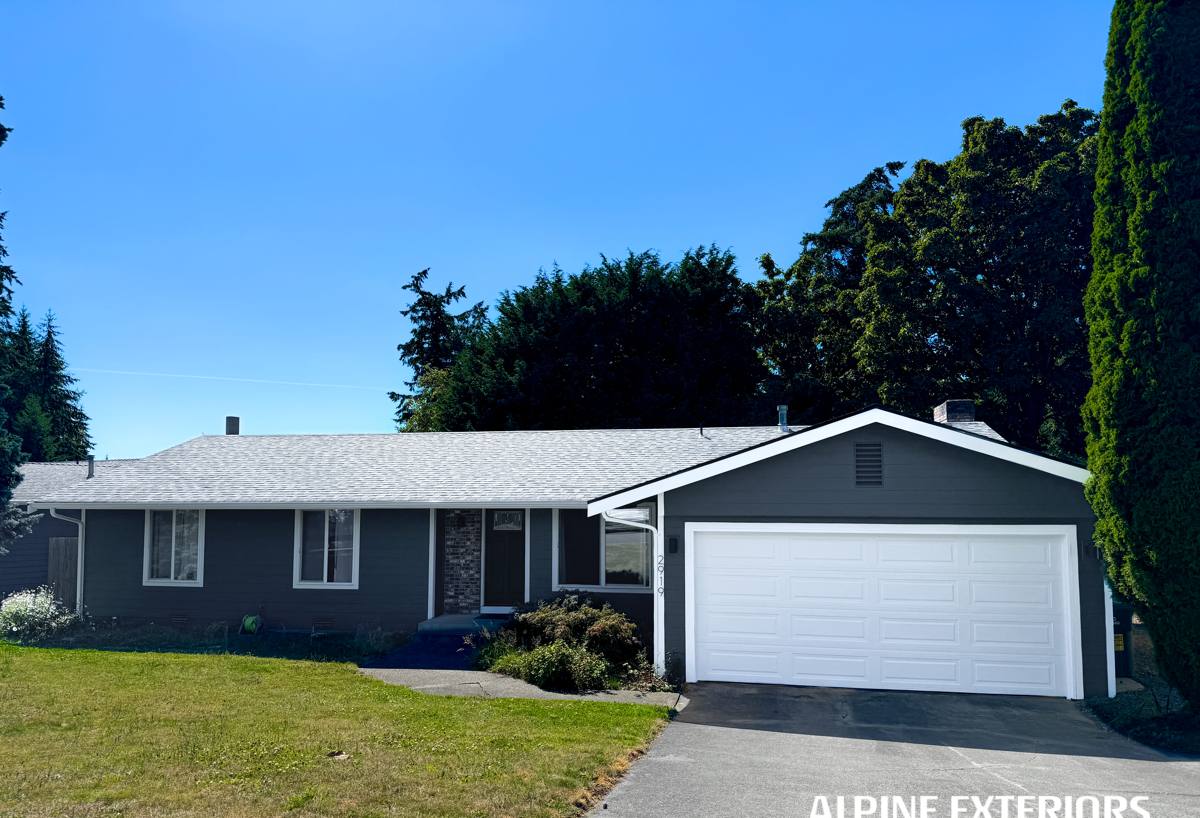
What Blaine's Climate Demands From an Installation
Salt Air and Corrosion
Homes anywhere near Semiahmoo Bay or Drayton Harbor take on salt-laden air as a constant, not a coastal accent. That air works on fasteners, flashing, and trim hardware over time, and it does it faster than it would twenty or thirty miles inland. An installation that uses standard-grade hardware because it's cheaper or easier to source is a decision that shows up as rust streaking, loosened trim, and premature finish failure well ahead of schedule in a town like this.
Wind-Driven Rain Off the Water
Storms coming off the water at Blaine don't drop rain straight down. Wind pushes it sideways into panel joints, window flashing, and the transitions where trim meets field siding, which is a harder load on a wall assembly than the same rainfall total falling calmly would be. The barrier system underneath the siding, and how carefully every seam and penetration is lapped and sealed, ends up mattering as much as the visible siding itself.
A Moss Season That Punishes Poor Airflow
Mild temperatures and near-constant moisture give moss and mildew a growing season that runs most of the year on north-facing or tree-shaded walls. Installation detail affects this more than most homeowners expect. Proper clearance at the bottom of the wall, a working drainage plane, and siding that isn't crammed tight against trim or flashing all give a wall the chance to dry out between wet stretches instead of staying damp for weeks at a time.
The Only System We Install: James Hardie Fiber Cement
We used to install a broader range of siding products. We narrowed to one system after seeing, on repeated tear-offs and service calls in coastal, high-moisture towns like Blaine, which materials held up and which ones quietly failed behind a fine-looking exterior.
- Non-combustible core: fiber cement doesn't feed a fire the way wood-based siding products can, which matters for both household safety and insurance considerations.
- Factory-applied ColorPlus finish: baked on under controlled conditions rather than brushed on in the field, holding its color and integrity far longer against salt air and constant moisture.
- HZ5 formulation: Hardie's climate-engineered line built for sustained moisture exposure and freeze-thaw cycling, which describes coastal Whatcom County accurately.
- Dimensional stability: fiber cement doesn't swell, cup, or warp the way engineered wood siding can after repeated wet-season exposure.
- A strong transferable warranty: backed by Hardie, provided the installation is done to the manufacturer's published spec.
We won't install LP SmartSide, vinyl siding, Cemplank, Allura, primed spruce, or cedar. Each has a place in the market and homeowners who are satisfied with them. We made a professional call that in a town with this much sustained salt and moisture exposure, we'd rather stand fully behind one system than offer something cheaper that quietly moves maintenance risk onto the homeowner a few years down the road.
The Installation Details That Actually Determine Longevity
Fastening and Hardware
Hardie publishes exact fastener type, spacing, and placement requirements, and coastal exposure like Blaine's calls for corrosion-resistant hardware, not the standard-grade fasteners that might be fine further inland. Getting this wrong is one of the more common causes of early trim and panel failure we find when we tear off older siding near the water.
Weather-Resistive Barrier and Flashing
Everything visible on a finished wall sits on top of a barrier layer that does most of the real work of keeping wind-driven rain out of the wall assembly. Proper overlap, taped seams, and correctly lapped flashing at every window, door, and penetration matter more in Blaine than in a drier, calmer climate, because sideways-driven rain finds gaps that straight-down rain never would.
Clearances at Grade, Roofline, and Decks
Hardie specifies minimum clearance between the bottom of the siding and grade, decks, roofing, and other horizontal surfaces. Skipping that clearance is an easy way to end up with siding sitting in splash-back or standing moisture, which is one of the most common failure points we find at the bottom courses of older installations.
Field-Cut Edges and Joints
Any panel cut on site, around a window opening, at a corner, at the end of a run, needs the cut edge sealed or primed per spec before it goes up. An unsealed cut edge is one of the more common places fiber cement actually takes on water, and it's a workmanship issue, not a flaw in the material itself.
How We Approach an Installation on a Blaine Home
The sequence matters as much as any single detail, so we follow the same disciplined order on every job:
- Exposure walk-through: we look at how each wall of the house faces the water, wind, and shade before pricing anything, since a water-facing wall and a sheltered one don't need identical detailing.
- Tear-off and sheathing check: old siding comes off and the sheathing underneath gets inspected before anything new goes up. Covering damaged sheathing with new siding just hides the problem for a few years.
- Weather barrier installation: the water-resistive barrier goes on with full overlap and taped seams, since this layer is completely hidden once the siding covers it.
- Siding installed to Hardie's published spec: fastening, spacing, and clearances follow the manufacturer's requirements as the baseline, not as an upgrade option.
- Final walkthrough: we go over the completed work with the homeowner and cover basic maintenance for a house this close to the water.
Cost and Timeline Factors for a Blaine Installation
| Factor | What It Affects | Blaine-Specific Consideration |
|---|---|---|
| Home size and number of stories | Labor hours, staging, and access equipment | Taller walls near open water need secure staging on windier days |
| Trim and roofline complexity | Flashing and cutting time | More joints and transitions mean more places wind-driven rain can test the install |
| Sheathing condition found at tear-off | Added repair scope before new siding goes up | Coastal moisture exposure makes hidden sheathing damage more common on older homes |
| Panel style and ColorPlus finish selection | Material cost | Factory finish holds up longer against salt air than field-applied paint |
| New construction vs. full re-side | Whether tear-off and discovery work are needed | New construction has no unknowns behind the wall; re-siding often does |
These are general drivers, not a quote. Two Blaine homes on the same block can need different scopes once we're actually pulling old siding or looking at the framing, which is why we walk every property before putting a real number on the work.
Timing an Installation Around Blaine's Weather
Whatcom County's wettest, windiest stretch generally runs from late fall through winter, and Blaine's open, water-facing position can make that stretch harder on both the crew and the materials than it is a few miles inland. Spring and summer typically offer the most stable conditions for installation, since fiber cement, sealants, and the weather barrier all perform better when they're installed and allowed to set up under dry conditions rather than between storm systems. Homes with active moisture intrusion don't need to wait for ideal weather, but for a planned full re-side, a spring or summer start generally gives the job the best chance to go smoothly.
A Checklist for a Correctly Installed Blaine Home
Whether you're reviewing our proposal or getting a second opinion, these are reasonable things to confirm before an installation is considered finished:
- Corrosion-resistant fasteners and hardware, not standard-grade material, given the proximity to salt water
- Documented clearance between the bottom of the siding and grade, decks, and roofing
- Flashing visible and properly lapped at every window, door, and penetration before it's covered by siding
- All field-cut panel edges sealed or primed, not left raw
- A continuous, properly lapped and taped water-resistive barrier underneath the siding
- Installation that follows Hardie's published fastening and spacing spec for the product line used
- A final walkthrough where the crew explains what was done, not just an invoice
Why a Ferndale Crew That Already Works Blaine Matters
A crew based nearby that installs siding across this stretch of Whatcom County regularly sees how salt air, wind-driven rain, and moss actually behave on real Blaine houses through a full year of weather, not just how a product performs on a spec sheet. That repeated exposure shapes real decisions on install day: which walls stay damp longest, where extra flashing attention is worth the added time, and which fastener and clearance details genuinely can't be shortcut regardless of schedule pressure. Blaine's coastal position isn't identical to Ferndale's, even though the two towns are close and share the same general Whatcom County climate, and a crew that pays attention to that difference builds accordingly instead of treating every wall the same.
If you're planning a full siding installation on a Blaine home, whether that's new construction or replacing siding that's reached the end of its life, we're glad to walk the property and give you a straightforward, honest estimate. Reach out using the form below to schedule a free, no-pressure estimate.