 Ferndale Siding
 Birch Bay Decks Live in a Tougher Environment Than Most of Whatcom County
Birch Bay sits right on the water, and that changes what a deck has to survive. A deck built a few miles inland in Ferndale deals with the normal Pacific Northwest wet season. A deck in Birch Bay deals with that same driving rain plus a steady dose of salt-laden air coming off the bay, more direct wind exposure, and a moss and algae season that runs longer than it does on higher, drier lots. None of that means a deck can't be built right here — it means the material choices, fastener grades, and drainage details matter more than they would on a typical inland Whatcom County property.
We've built and repaired decks up and down this stretch of coastline long enough to know which shortcuts cause problems in year three instead of year fifteen. This page is specifically about custom deck work for Birch Bay homes — what the site conditions demand, how we build to handle them, and what a homeowner should expect from a contractor who actually understands this environment.
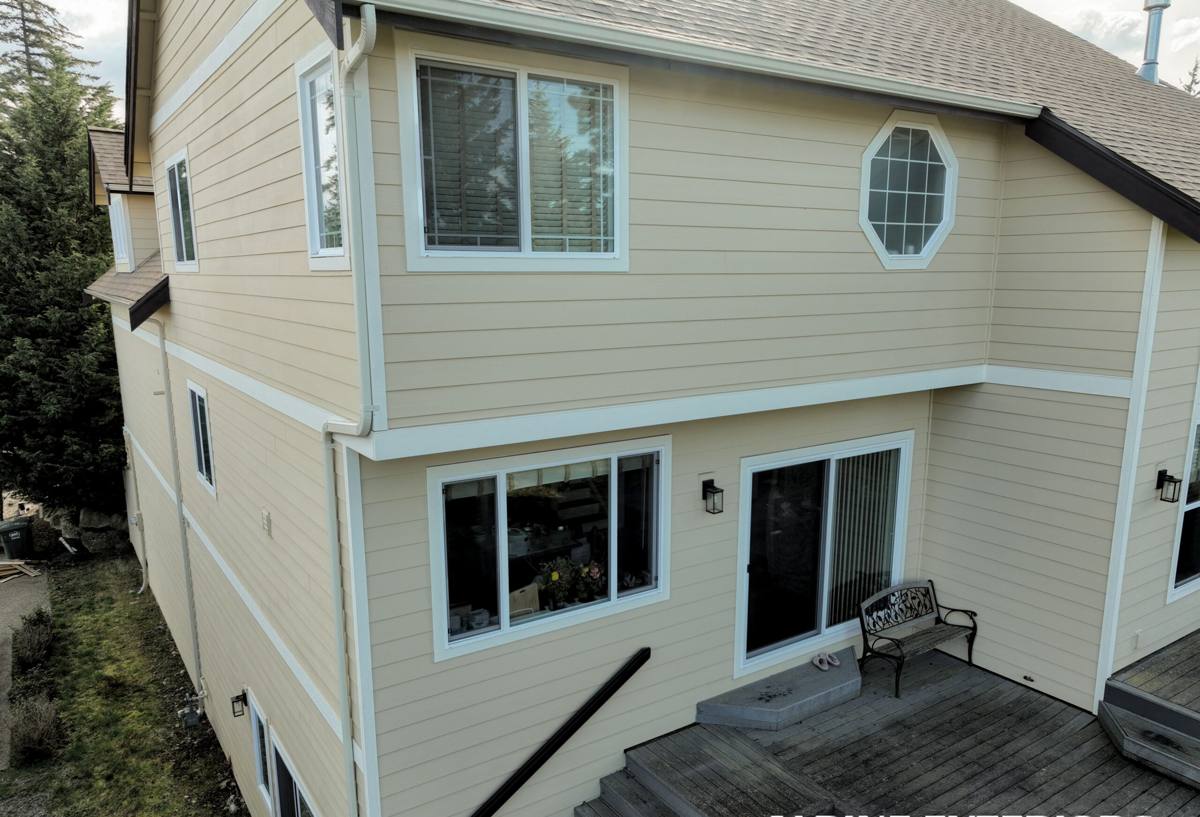
What Salt Air and Coastal Wind Actually Do to a Deck
Salt air isn't just a nuisance smell near the water — it's an accelerant for corrosion. Airborne salt settles on every exposed surface, and combined with the near-constant moisture from rain and fog, it speeds up rust on hardware, pitting on lower-grade metal, and premature failure of fasteners that would otherwise last for decades. Wind off the bay also drives rain sideways into railings, fascia, and ledger connections in a way that inland lots rarely experience, which means water finds gaps that a standard build might get away with elsewhere.
The practical result is that a deck built to a generic spec — the kind that would hold up fine in a sheltered inland yard — often shows corrosion streaks, loosening connections, or soft spots within a few years near the bay. Building correctly here means treating salt exposure as a design factor from the first conversation, not an afterthought.
Where the Damage Shows Up First
- Fastener heads and joist hangers, especially where they're exposed to direct weather rather than shielded under decking boards
- Railing post bases and any hardware near ground or deck-surface level where moisture pools
- Ledger board connections to the house, where a poor flashing detail lets water track behind the siding
- Stair stringers and lower framing members closest to grade
- Any cut end of lumber that wasn't re-sealed after on-site trimming
Choosing a Decking Material for a Birch Bay Site
There's no single "correct" decking material for every home — it depends on budget, how much upkeep the owner wants to do, and how exposed the specific lot is. What we do is walk through the real trade-offs honestly, including for materials we don't typically recommend in this environment and why.
| Material | Salt Air / Moisture Behavior | Maintenance | Realistic Lifespan Here | Upfront Cost |
|---|---|---|---|---|
| Composite decking | Doesn't absorb moisture or salt; resists rot and splintering | Occasional wash to keep moss from taking hold; no staining or sealing | Long — backed by manufacturer warranties | Mid-to-high |
| Cedar | Naturally rot-resistant but still needs a maintained finish near salt air | Regular cleaning and re-staining/sealing on a set schedule | Moderate, shorter if maintenance lapses | Mid |
| Pressure-treated fir/pine | Treatment resists rot but is more sensitive to salt-accelerated fastener corrosion and surface checking | Requires consistent sealing to perform well long-term | Shorter unless well-maintained | Lowest upfront |
| Tropical hardwood (e.g., ipe) | Very dense and naturally weather-resistant | Periodic oiling to maintain color; low rot risk | Long | Highest |
For most Birch Bay homeowners who want the least ongoing work, composite is the easiest recommendation — it simply doesn't care about salt the way wood does. But we build plenty of wood decks too, for owners who prefer the look and are willing to keep up a maintenance schedule. The honest trade-off with pressure-treated lumber isn't that it's a bad product — it's that in a high-salt, high-moisture environment it demands more diligence to hit the same lifespan a composite deck gets with far less effort.
Framing, Fasteners, and Hardware: Where Corrosion Resistance Actually Matters
The decking surface is what homeowners see, but the framing and hardware underneath are what determine whether a deck is still solid in fifteen years. In a coastal environment like Birch Bay, this is the part of the job where cutting a corner is invisible until it isn't.
| Hardware Grade | Best Suited For | Coastal Performance |
|---|---|---|
| Standard galvanized | Inland, low-moisture builds | Adequate inland; prone to earlier corrosion near salt air |
| Hot-dip galvanized | General coastal use | Meaningfully better corrosion resistance than standard galvanized |
| Stainless steel | Ledger connections, structural hardware, railing posts near the water | Best long-term performance in high-salt exposure |
For a Birch Bay build, we default to corrosion-resistant fastener and hardware grades on the connections that matter most — ledger bolts, structural joist hangers, and railing hardware — rather than treating that as an optional upgrade. It costs more up front than the bare minimum, but replacing hardware after the decking is already installed is a much bigger job than specifying it correctly from the start.
The Ledger, the Framing, and Getting Moisture Management Right
Most deck failures that aren't cosmetic start at the ledger board — the piece that attaches the deck to the house. If flashing isn't installed correctly there, water tracks behind the siding and into the wall structure, and you don't see it until there's rot or a soft spot. On a Birch Bay lot with more wind-driven rain, that detail has even less margin for error.
Beyond the ledger, correct framing means:
- Footings sized and set to current code depth for frost and load, not guessed at
- Joist spacing matched to the decking material's span rating — composite and wood often have different requirements
- Proper flashing tape and a drainage gap at the ledger connection so any water that does get behind the board has somewhere to go
- Beam and post sizing that accounts for the wind exposure of an open, waterfront-adjacent lot rather than a sheltered inland yard
Moss, Algae, and Drainage: Designing the Deck to Shed Water
Whatcom County's wet season is long, and Birch Bay's proximity to the water keeps humidity and moss pressure high even longer into the year than most inland lots see. A deck surface that stays damp is a deck surface that grows moss and algae — and that's not just cosmetic, it's a slip hazard on stairs and low-traffic corners.
We manage this through board orientation and spacing, correct decking gap width for drainage and airflow underneath, and grading the substructure so water moves off the site instead of pooling under the deck. On composite decking, proper gapping also prevents the kind of moisture trapping that discolors boards over time. On wood decking, airflow underneath is what keeps the underside from staying wet long enough to rot or host moss growth that eventually works its way to the top surface.
Our Process for a Birch Bay Deck Project
- Site assessment — we look at sun exposure, wind direction relative to the water, existing drainage patterns, and how close the build site is to salt spray
- Design and material selection — we walk through the trade-offs above based on your budget and how much maintenance you want to take on
- Permitting — we handle the permit process through the applicable local jurisdiction so the structure is inspected and compliant
- Framing and structural work — footings, ledger, framing, and hardware installed to the corrosion-resistant standard appropriate for the site
- Decking, railings, and finish work — surface material installed with correct fastening and spacing for drainage and long-term performance
- Final walkthrough — we go over the finished deck with you, including what maintenance (if any) the chosen material needs going forward
Maintenance Checklist for a Birch Bay Deck
Whatever material you choose, a little seasonal attention goes a long way in this climate. Here's what we recommend to owners after we finish a build:
- Sweep off standing debris regularly — trapped leaves and needles hold moisture against the surface
- Rinse salt residue off the surface and railings periodically, especially after storms with onshore wind
- Check railing post bases and stair connections once a year for early rust or loosening
- For wood decking, keep to a consistent staining/sealing schedule rather than waiting until it visibly needs it
- Keep gutters and downspouts near the deck clear so runoff isn't dumping extra water onto or under the structure
- Address any moss growth on stairs promptly — it's the highest-risk spot for slips
Why It Matters That We Already Work in Birch Bay
Building a deck that holds up here isn't about a fundamentally different construction method — it's about not treating this as a generic inland job. A crew that hasn't worked this stretch of Whatcom County coastline might spec standard hardware, skip the extra flashing detail, or recommend a material without mentioning what salt air will do to it over time. We've seen what happens on decks that were built without accounting for the bay, and we build to avoid repeating those problems on your project.
That local experience also means we're familiar with the permitting expectations for this area and can plan the project timeline around it accurately, rather than guessing at what an inspector will want to see.
If you're planning a new deck or replacing one that hasn't held up to the Birch Bay environment, we're happy to walk the site with you and put together a free, no-pressure estimate — just fill out the form below to get started.