 Ferndale Siding
 Siding Built for Bellingham's Weather, Not Just Its Curb Appeal
Bellingham sits close enough to the water, and far enough into the Pacific Northwest's wet season, that siding here does a different job than siding in a drier climate. It isn't just a finish layer over your walls — it's the first line of defense against salt-laden air off Bellingham Bay, months of driving rain, and the kind of persistent damp that turns north-facing walls green with moss before most homeowners notice. When we install siding on a Bellingham-area home, we're not thinking about how it looks on install day. We're thinking about how it performs in year six, year twelve, and year twenty-five, through repeated freeze-thaw cycles, wind-driven rain events, and the low-angle winter sun that never quite dries out shaded walls.
This page is specifically about siding installation for homes in and around Bellingham. It's not a general "why siding matters" page — it's a look at what this particular climate demands from a siding job, what correct installation actually involves, and why the crew doing the work matters as much as the material itself.
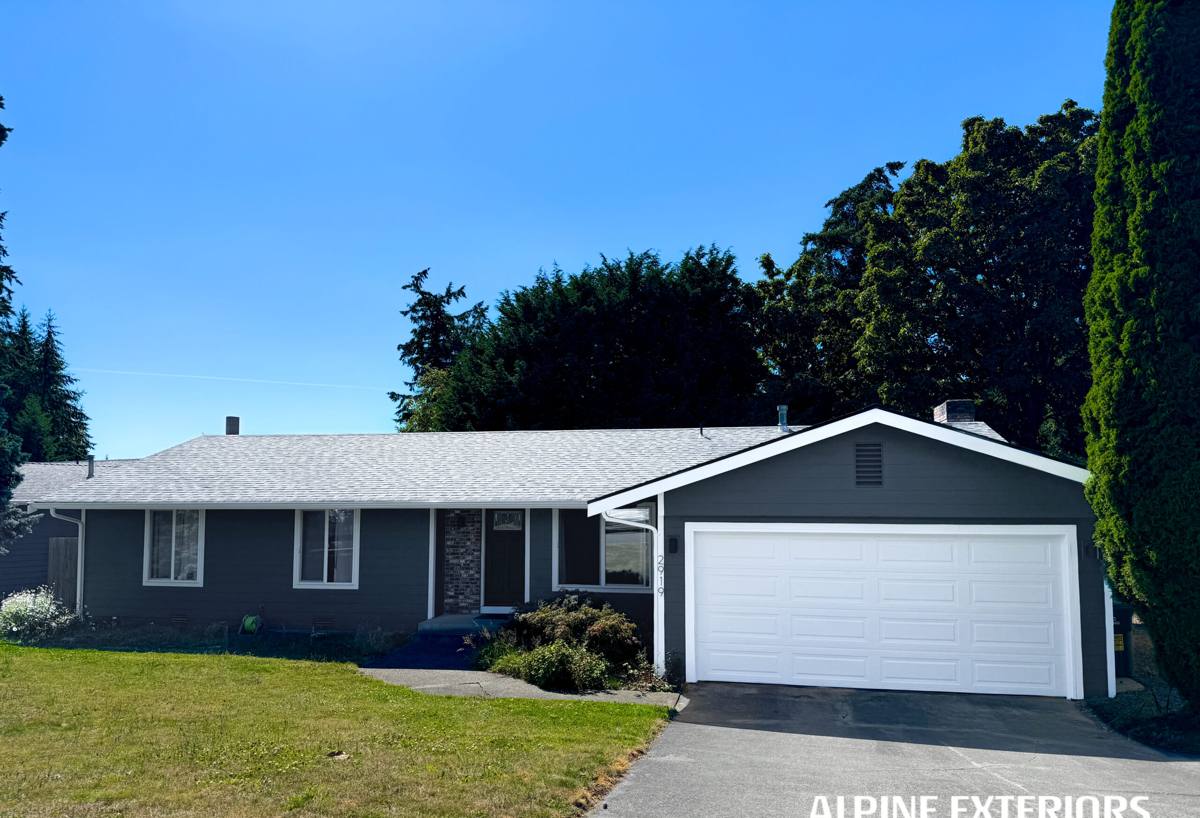
What Whatcom County Weather Does to Siding Over Time
Three climate factors show up again and again on siding jobs in this part of Whatcom County:
Salt Air
Proximity to Bellingham Bay means airborne salt is a real factor, especially on homes closer to the water or exposed to prevailing winds off the bay. Salt accelerates corrosion on fasteners, flashing, and any metal trim that isn't rated for coastal exposure. It also degrades cheap paint finishes faster than inland weather would, which is part of why factory-applied, baked-on finishes hold up so much better here than field-applied paint.
Driving Rain
This isn't gentle, straight-down rain. Storms coming off the Strait of Georgia and Puget Sound often push rain sideways into wall assemblies, which means siding has to shed water at laps, seams, and penetrations — not just resist it on the face. A siding system with weak lap performance or poor flashing details will let water track backward into the wall over time, even if the surface looks fine.
Long Moss Season
Cool temperatures, shade from mature trees, and near-constant moisture from fall through spring create ideal conditions for moss and algae growth on north- and east-facing walls. Siding that absorbs moisture or has a porous surface gives moss something to root into. Siding that's dense, factory-sealed, and properly ventilated behind it dries out between rain events instead of staying damp.
None of this means Bellingham homes need exotic materials. It means the siding installed here needs to be dimensionally stable, moisture-resistant at the material level, and installed with details that account for wind-driven water — not just a product that looks good in a showroom.
Why We Install Only James Hardie Fiber Cement in This Area
We don't install vinyl, LP SmartSide, primed wood, or cedar on Bellingham homes, and the local climate is a big part of why. Fiber cement is non-combustible, dimensionally stable in swings between wet winters and dry summers, and doesn't rely on a surface paint film alone to keep water out — the material itself is engineered to resist moisture intrusion. James Hardie's ColorPlus finish is baked on at the factory under controlled conditions, which gives it better fade and chip resistance in salt air than field-applied paint, and it comes backed by a stronger, transferable finish warranty than most site-painted products offer.
Hardie also builds climate-specific product lines (the HZ5 line is engineered for the wetter, harsher parts of the country, which includes the Pacific Northwest), so the material itself is matched to conditions like ours rather than being a one-size-fits-all product. That's the whole reason we standardized on one manufacturer instead of offering a menu of options — we'd rather install one system correctly and stand behind it than install several and hope each one performs.
How Hardie Compares to Alternatives in This Climate
| Factor | James Hardie Fiber Cement | Vinyl | Wood / LP SmartSide |
|---|---|---|---|
| Moisture resistance | Engineered for wet climates (HZ5 line) | Water can get behind panels at seams | Vulnerable if finish is breached |
| Finish durability in salt air | Factory-baked ColorPlus finish | Can fade, brittle over time | Depends on paint maintenance schedule |
| Moss/algae resistance | Dense, low-absorption surface | Resists moss but can trap moisture behind it | More porous, moss can take hold |
| Fire rating | Non-combustible | Combustible | Combustible |
| Warranty structure | Long-term, transferable | Varies by manufacturer | Varies, often shorter on finish |
What a Correct Siding Installation Actually Involves
The material is only part of the equation. Most siding failures we see on older Bellingham homes weren't caused by bad siding — they were caused by installation shortcuts that let water in behind a perfectly good product. A correct install includes:
- A properly detailed weather-resistive barrier (house wrap) installed shingle-style so water sheds outward at every overlap
- Rain screen or furring strategy where appropriate, to give the wall assembly a drainage gap and airflow to dry out after storms
- Correct flashing at every window, door, and roofline intersection — the majority of hidden leaks trace back to flashing, not the siding itself
- Fastener placement and spacing that follows Hardie's published installation instructions, using corrosion-resistant fasteners suited to coastal exposure
- Proper clearance between siding and grade, decks, and roof lines to keep the bottom edge from sitting in standing moisture
- Caulking and sealant only where Hardie's specifications call for it — over-caulking can trap moisture instead of releasing it
Skipping any one of these doesn't usually show up as a problem on install day. It shows up two, five, or ten years later as staining, soft trim, or moss creeping in around a window — long after the crew that cut corners is gone.
Our Process for a Bellingham Siding Installation
1. On-Site Assessment
We walk the exterior, check the condition of the existing wall assembly, look for signs of past water intrusion, and note site-specific factors — tree cover, wind exposure, proximity to the bay, drainage around the foundation — that affect how the job should be detailed.
2. Product and Color Selection
We help you choose the right Hardie board profile (lap, panel, or shingle style) and ColorPlus color for your home, factoring in HOA requirements if applicable and how different finishes read in the Pacific Northwest's often-overcast light.
3. Removal and Wall Prep
Old siding comes off, and we inspect sheathing underneath for rot or damage before anything new goes on. Any compromised sheathing gets addressed before the weather barrier goes up — installing new siding over a bad substrate just hides the problem.
4. Weather Barrier and Flashing
This is the step that determines whether the house stays dry for the next several decades. We install house wrap and flashing details built for wind-driven rain, not the minimum code requirement for a drier climate.
5. Hardie Installation
Boards are installed to manufacturer specification — correct fastener pattern, correct gapping, correct lap exposure — by a crew that installs this product regularly rather than occasionally.
6. Final Walkthrough
We walk the finished job with you, checking trim lines, caulking, and touch-up work before we consider the job complete.
Signs Bellingham Homeowners Should Watch For
If you're not sure whether your current siding is doing its job, a few signs are worth a closer look:
- Persistent moss or dark staining on north- or east-facing walls that returns shortly after cleaning
- Soft or spongy trim boards, especially around windows and doors
- Visible gaps, warping, or buckling at siding seams
- Peeling or chalking paint on wood siding, especially on the side of the house facing prevailing weather
- Rust streaks below fasteners or metal trim, a sign that hardware isn't holding up to salt exposure
Any of these can point to a wall assembly that's taking on more moisture than it should, even if the siding still looks acceptable from the street.
Why Hiring Local Experience Matters Here
Siding installation isn't identical from region to region, even within the same state. A crew used to installing in a drier inland climate will often under-detail flashing and wall assemblies for a coastal, high-rainfall area like Bellingham — not out of carelessness, but because it's simply not what they're used to building for. A crew that regularly works Whatcom County homes already knows how to detail for driving rain off the bay, how to account for moss-prone shaded walls, and which fastener and flashing choices actually hold up to salt air over time. That local pattern recognition is difficult to replicate from a spec sheet alone.
Get a Free, No-Pressure Estimate
If you're planning a siding project in the Bellingham area, we're happy to take a look at your home, talk through what your specific exposure and wall conditions call for, and give you a straightforward estimate. There's no pressure and no obligation — just an honest look at what your home needs. The form below will get you started.